
UPSC CURRENT AFFAIRS – 06th July 2025
India Becomes Fourth ‘Most Equal’ Country Globally
Why in News?
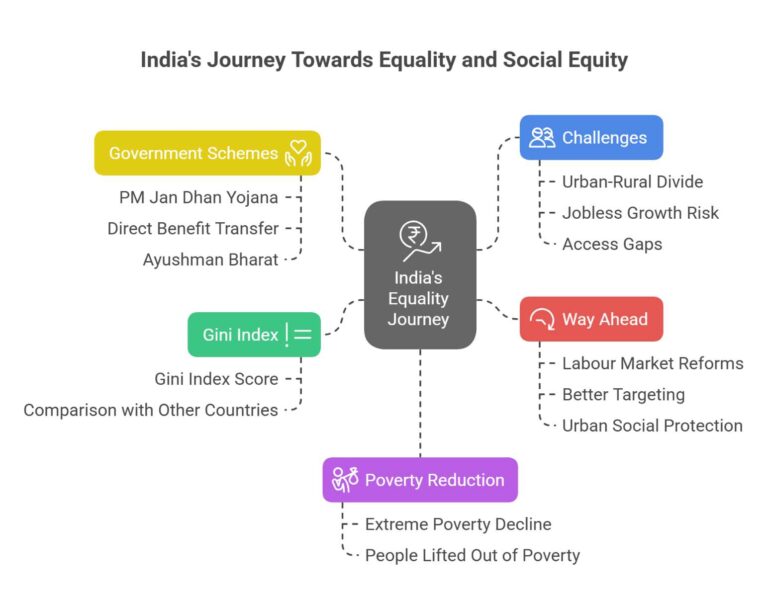
- According to a new World Bank report, India now ranks as the fourth most equal country in the world, with a Gini Index score of 25.5.
- Only the Slovak Republic, Slovenia, and Belarus fare better.
- India’s extreme poverty also sharply declined: from 16.2% in 2011–12 to just 2.3% in 2022–23, lifting around 171 million people out of extreme poverty.
Key Highlights
Gini Index Context:
- Measures income/wealth/consumption inequality; ranges from 0 (perfect equality) to 100 (absolute inequality).
- India’s Gini Index improved from 28.8 (2011–12) to 25.5 (2022–23) — moving towards the “low inequality” category.
Comparison with Other Countries:
- India’s inequality is now much lower than China (35.7), the USA (41.8), and the UK.
- India is among 30 countries in the “moderately low” inequality category (Gini 25–30) alongside welfare states like Iceland, Norway, Belgium, and UAE.
Poverty Reduction:
- Extreme poverty (people living on <$2.15/day) dropped to 2.3%.
- Around 171 million people moved out of poverty in the past decade.
Government’s Attribution:
- Welfare schemes like PM Jan Dhan Yojana, Direct Benefit Transfer (DBT), Ayushman Bharat, Stand-Up India, and PM Vishwakarma Yojana credited for enhancing social protection and financial inclusion.
Balanced Growth:
- India is being showcased as a model combining economic growth with social equity, balancing reforms and protection.
Explaining the Concepts
Gini Coefficient:
- A statistical measure of income or wealth distribution.
- Low Gini = High equality, High Gini = High inequality.
- Useful to compare income gaps within countries.
Constitutional Provisions & Goals:
- Preamble: India as a sovereign, socialist, secular, democratic republic; aims at social, economic, and political justice.
- DPSPs (Directive Principles of State Policy):
- Article 38(2): The State shall strive to minimise inequalities in income and endeavour to eliminate inequalities in status, facilities, and opportunities.
- Article 39: Right to adequate means of livelihood, equal pay for equal work, protection against economic exploitation.
- Article 43: Living wage, conditions of work ensuring decent standard of life.
Key Welfare Schemes
PM Jan Dhan Yojana (PMJDY):
- Financial inclusion through zero-balance bank accounts.
- Over 50 crore accounts opened with direct benefit linkages.
Direct Benefit Transfer (DBT):
- Transfers subsidies/welfare benefits directly to bank accounts, reducing leakages.
Ayushman Bharat:
- Health insurance for 50 crore citizens — financial protection for vulnerable families.
Stand-Up India & PM Vishwakarma Yojana:
- Entrepreneurship support for SC/ST and women; skill development for traditional artisans.
Food Security Act & MGNREGA:
- Legal entitlements for food grains and guaranteed rural employment.
Challenges to Sustaining Equality
- Urban-Rural Divide: Regional disparities persist in income, education, health outcomes.
- Jobless Growth Risk: Inequality can widen if growth doesn’t generate enough quality jobs.
- Access Gaps: Digital divide and literacy barriers limit benefits for some groups.
- Measurement Limitations: Some argue household surveys underestimate real poverty and inequality, especially post-pandemic.
- Fiscal Stress: Balancing welfare spending with fiscal discipline remains tricky.
Way Ahead — Specific Actions
- Labour Market Reforms: Improve employability, upskilling, and generate decent jobs to prevent hidden income inequality.
- Better Targeting: Strengthen SECC data, Aadhaar-linked DBT to plug leaks.
- Urban Social Protection: Extend social security and health coverage to urban poor, gig and informal workers.
- Empower Marginalised Groups: Focus on education, skilling, and entrepreneurship for women, SC/ST, and minorities.
- Data Transparency: Modernise poverty and consumption surveys; harmonise with global best practices.
- Regional Equity: Invest more in backward districts to bridge intra-state inequality.

3rd UN conference on landlocked countries
UPSC CURRENT AFFAIRS – 08th August 2025 Home / 3rd UN conference on landlocked countries Why in News? At the

Issue of soapstone mining in Uttarakhand’s Bageshwar
UPSC CURRENT AFFAIRS – 08th August 2025 Home / Issue of soapstone mining in Uttarakhand’s Bageshwar Why in News? Unregulated
Groundwater Pollution in India – A Silent Public Health Emergency
UPSC CURRENT AFFAIRS – 08th August 2025 Home / Groundwater Pollution in India – A Silent Public Health Emergency Why
Universal banking- need and impact
UPSC CURRENT AFFAIRS – 08th August 2025 Home / Universal banking- need and impact Why in News? The Reserve Bank
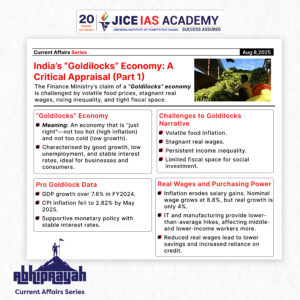
India’s “Goldilocks” Economy: A Critical Appraisal
UPSC CURRENT AFFAIRS – 08th August 2025 Home / India’s “Goldilocks” Economy: A Critical Appraisal Why in News? The Finance

U.S.-India Trade Dispute: Trump’s 50% Tariffs and India’s Oil Imports from Russia
UPSC CURRENT AFFAIRS – 07th August 2025 Home / U.S.-India Trade Dispute: Trump’s 50% Tariffs and India’s Oil Imports from

Eco-Friendly Solution to Teak Pest Crisis: KFRI’s HpNPV Technology
UPSC CURRENT AFFAIRS – 07th August 2025 Home / Eco-Friendly Solution to Teak Pest Crisis: KFRI’s HpNPV Technology Why in

New Species of Non-Venomous Rain Snake Discovered in Mizoram
UPSC CURRENT AFFAIRS – 07th August 2025 Home / New Species of Non-Venomous Rain Snake Discovered in Mizoram Why in

Economic Implications
For Indian Exporters
- These reforms reduce transaction costs and compliance hurdles
- Encourage a more competitive and efficient export environment
- Promote value addition in key sectors like leather
For Tamil Nadu
- The reforms particularly benefit the state’s leather industry, a major contributor to employment and exports
- Boost the marketability of GI-tagged E.I. leather, enhancing rural and traditional industries
For Trade Policy
- These decisions indicate a shift from regulatory controls to policy facilitation
Reinforce the goals of Make in India, Atmanirbhar Bharat, and India’s ambition to become a leading export power
Recently, BVR Subrahmanyam, CEO of NITI Aayog, claimed that India has overtaken Japan to become the fourth-largest economy in the world, citing data from the International Monetary Fund (IMF).
India’s rank as the world’s largest economy varies by measure—nominal GDP or purchasing power parity (PPP)—each with key implications for economic analysis.