
UPSC CURRENT AFFAIRS – 12th July 2025
India’s Energy Transition: 4,000% Solar Growth and Renewable Energy Milestones at IESW 2025
Why in News?
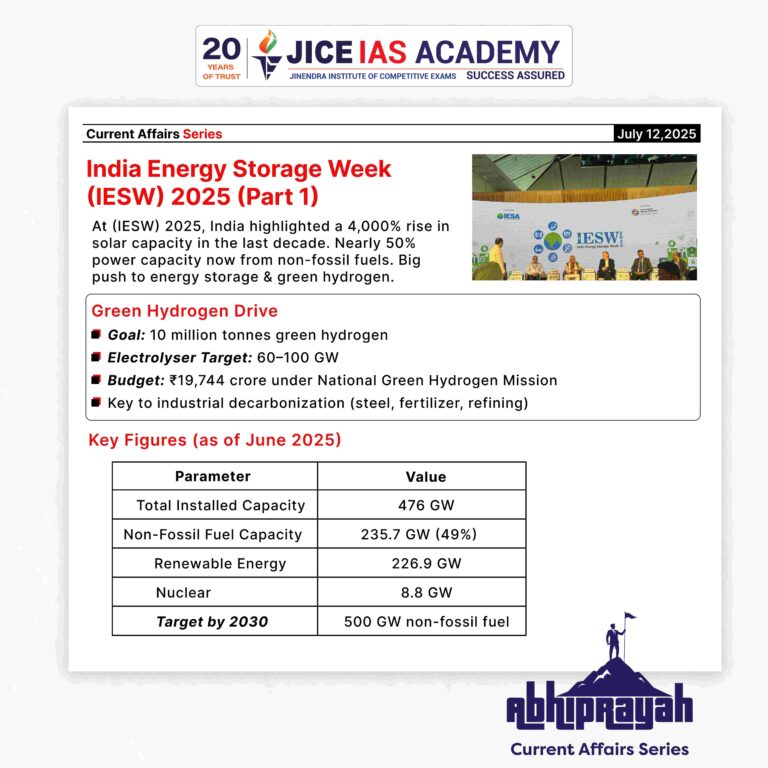
- India showcased its clean energy progress at India Energy Storage Week (IESW) 2025, highlighting a 4,000% rise in solar capacity and its near-achievement of the 50% renewable energy target.
Key Developments in Renewable Energy
- Over the past ten years, India has recorded a 4,000 percent growth in installed solar capacity.
- The country’s solar photovoltaic (PV) module manufacturing capacity has increased by 38 times, and PV cell manufacturing capacity has expanded 21-fold.
- As of June 2025, India’s total installed power capacity stands at 476 gigawatts (GW), out of which 235.7 GW, or 49 percent, is from non-fossil fuel sources.
- Renewable energy: 226.9 GW
- Nuclear energy: 8.8 GW
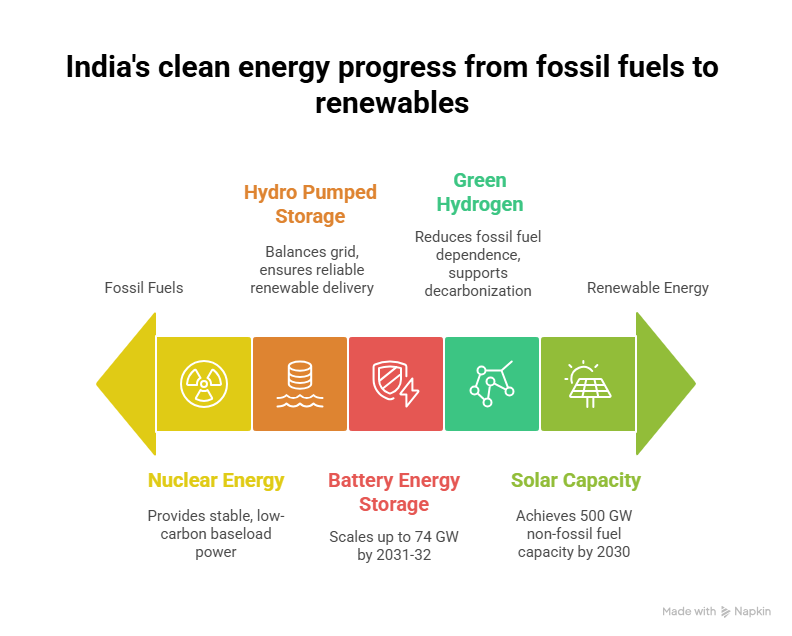
- India aims to achieve 500 GW of non-fossil fuel-based capacity by 2030 as part of its Nationally Determined Contributions (NDCs) under the Paris Agreement.
Energy Storage and Pumped Hydro Initiatives
Battery Energy Storage Systems (BESS)
- Presently, India has only 205 megawatts (MW), or approximately 506 megawatt-hours (MWh), of installed battery energy storage capacity.
- The Central Electricity Authority has set a target of scaling this up to 74 GW by 2031-32.
- In the current year (2025), the government plans to add approximately 3,000 MW through hydro pumped storage projects.
Hydro Pumped Storage Projects (PSPs)
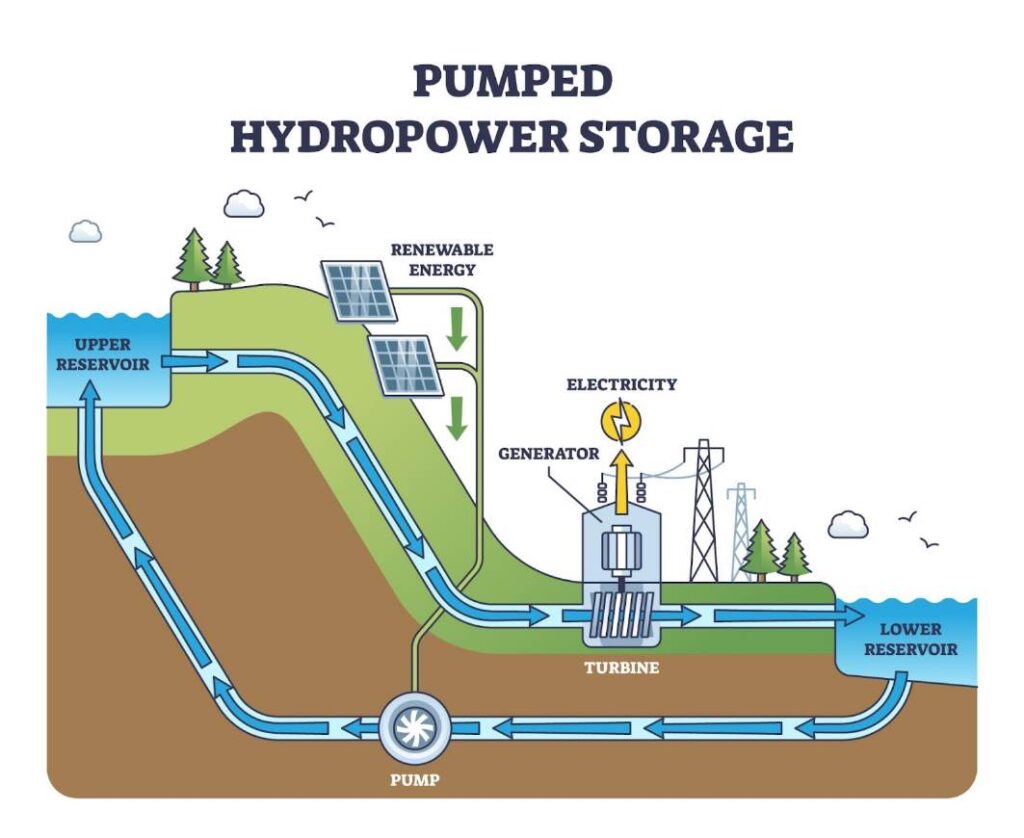
- The current hydro pumped storage capacity stands at 5 GW.
- The government aims to increase this to 50 GW within the next 5 to 6 years, which would provide critical support for grid balancing and ensure reliable renewable power delivery.
Green Hydrogen Mission
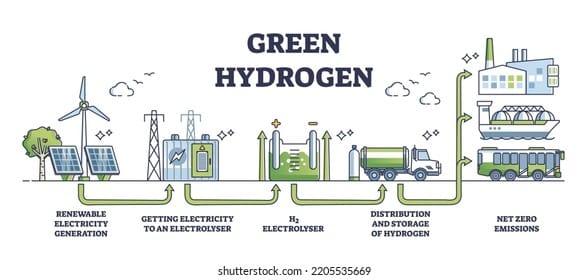
- India has announced ambitious targets for green hydrogen as part of its clean energy transition.
- Key goals include:
- Producing 10 million tonnes of green hydrogen
- Developing electrolyser capacity between 60 GW and 100 GW
- These efforts are supported by the Rs 19,744 crore National Green Hydrogen Mission, which aims to reduce dependence on fossil fuels and support industrial decarbonization.
Alignment with Climate Goals
India’s current trajectory is closely aligned with its international climate obligations. Under the Paris Agreement, India’s NDCs include:
- Achieving 500 GW of non-fossil fuel capacity by 2030
- Reducing emissions intensity of GDP
- Promoting climate resilience and sustainable development
Challenges and Way Forward
Key Challenges | Government Response and Strategy |
Insufficient energy storage infrastructure | Accelerated development of BESS and PSPs |
High dependence on imported critical minerals | Strengthening domestic exploration and diversified sourcing |
Intermittency of renewable sources | Promotion of grid-scale storage and green hydrogen |
Need for robust manufacturing ecosystem | Scaling domestic manufacturing of solar and energy storage components |
India’s strategy now focuses on creating an integrated clean energy ecosystem that supports sustainability, energy security, and economic growth.

3rd UN conference on landlocked countries
UPSC CURRENT AFFAIRS – 08th August 2025 Home / 3rd UN conference on landlocked countries Why in News? At the

Issue of soapstone mining in Uttarakhand’s Bageshwar
UPSC CURRENT AFFAIRS – 08th August 2025 Home / Issue of soapstone mining in Uttarakhand’s Bageshwar Why in News? Unregulated
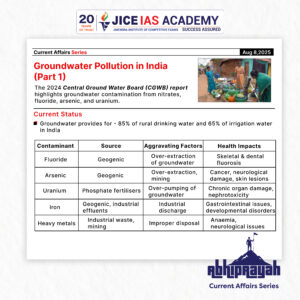
Groundwater Pollution in India – A Silent Public Health Emergency
UPSC CURRENT AFFAIRS – 08th August 2025 Home / Groundwater Pollution in India – A Silent Public Health Emergency Why
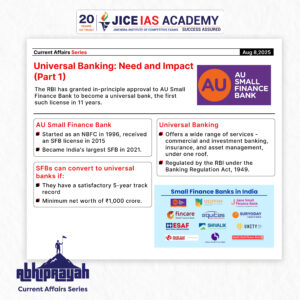
Universal banking- need and impact
UPSC CURRENT AFFAIRS – 08th August 2025 Home / Universal banking- need and impact Why in News? The Reserve Bank

India’s “Goldilocks” Economy: A Critical Appraisal
UPSC CURRENT AFFAIRS – 08th August 2025 Home / India’s “Goldilocks” Economy: A Critical Appraisal Why in News? The Finance

U.S.-India Trade Dispute: Trump’s 50% Tariffs and India’s Oil Imports from Russia
UPSC CURRENT AFFAIRS – 07th August 2025 Home / U.S.-India Trade Dispute: Trump’s 50% Tariffs and India’s Oil Imports from
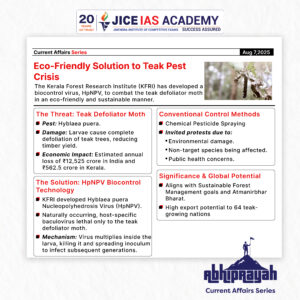
Eco-Friendly Solution to Teak Pest Crisis: KFRI’s HpNPV Technology
UPSC CURRENT AFFAIRS – 07th August 2025 Home / Eco-Friendly Solution to Teak Pest Crisis: KFRI’s HpNPV Technology Why in

New Species of Non-Venomous Rain Snake Discovered in Mizoram
UPSC CURRENT AFFAIRS – 07th August 2025 Home / New Species of Non-Venomous Rain Snake Discovered in Mizoram Why in

Economic Implications
For Indian Exporters
- These reforms reduce transaction costs and compliance hurdles
- Encourage a more competitive and efficient export environment
- Promote value addition in key sectors like leather
For Tamil Nadu
- The reforms particularly benefit the state’s leather industry, a major contributor to employment and exports
- Boost the marketability of GI-tagged E.I. leather, enhancing rural and traditional industries
For Trade Policy
- These decisions indicate a shift from regulatory controls to policy facilitation
Reinforce the goals of Make in India, Atmanirbhar Bharat, and India’s ambition to become a leading export power
Recently, BVR Subrahmanyam, CEO of NITI Aayog, claimed that India has overtaken Japan to become the fourth-largest economy in the world, citing data from the International Monetary Fund (IMF).
India’s rank as the world’s largest economy varies by measure—nominal GDP or purchasing power parity (PPP)—each with key implications for economic analysis.