UPSC CURRENT AFFAIRS – 25th June 2025
India–South Africa Defence Cooperation
Why in News?
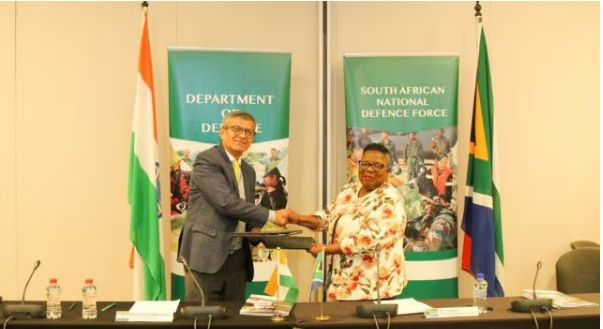
- India and South Africa signed two agreements on submarine cooperation during the 9th Joint Defence Committee (JDC) meeting in Johannesburg to boost bilateral defence ties.
Introduction
- India and South Africa signed two significant agreements related to submarine cooperation during the 9th Joint Defence Committee (JDC) meeting, held in Johannesburg, South Africa, on June 24–25, 2025.
- The meeting marks a key milestone in the ongoing efforts to deepen strategic and defence ties between the two countries.
Key Highlights
- Submarine Cooperation Agreements
- Two new agreements were signed in the domain of submarine cooperation.
- These agreements are expected to enhance mutual capabilities in undersea warfare technology, including training, logistics support, technical collaboration, and potential joint ventures in submarine construction and maintenance.
- Delegation and Leadership
- India’s delegation was led by Defence Secretary Rajesh Kumar Singh, while the South African side was headed by Dr Thobekile Gamede, the Acting Secretary for Defence.
- The meeting reflects India’s growing emphasis on defence diplomacy and South-South cooperation.
- Agenda and Discussions
- The JDC was guided by two co-chairs and comprised two sub-committees:
- Sub-Committee on Defence Policy and Military Cooperation
- Sub-Committee on Defence Acquisition, Production, Research and Development
- These sub-committees reviewed current engagements and presented their reports to the main JDC panel.
- The JDC was guided by two co-chairs and comprised two sub-committees:
Strategic Significance
A. India’s Defence Diplomacy
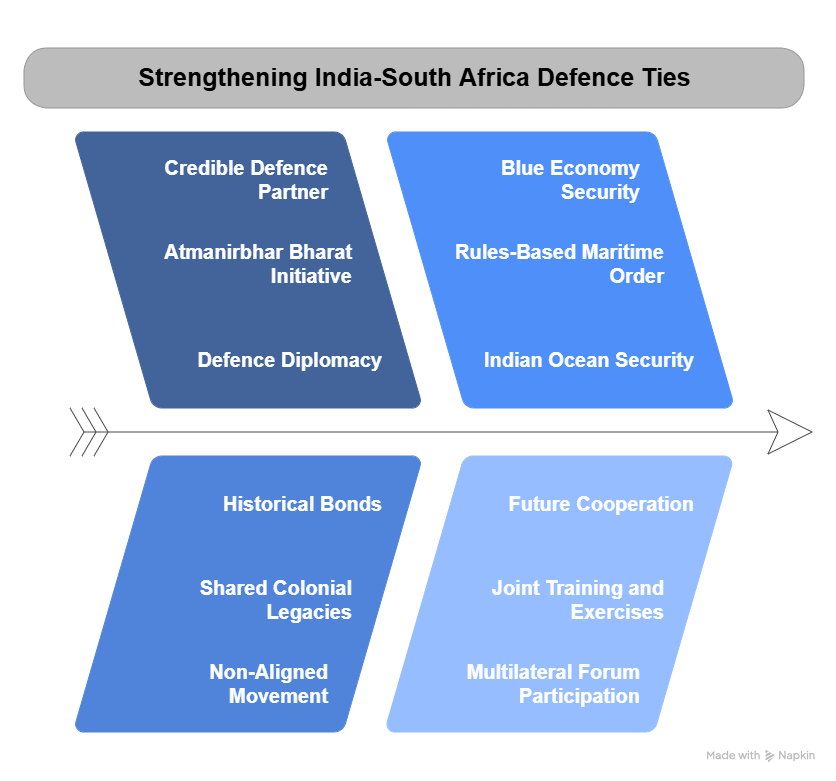
- India highlighted its growing defence manufacturing and export capabilities, especially under the Atmanirbhar Bharat initiative.
- The submarine cooperation is a testament to India’s emergence as a credible defence partner in the Global South.
B. India–South Africa Defence Relations
- The Defence Secretary reaffirmed the historic bonds between India and South Africa, recalling their shared colonial legacies, Non-Aligned Movement (NAM) association, and BRICS membership.
- The meeting expressed satisfaction over the progress in bilateral defence cooperation in recent years.
C. Indian Ocean Security Architecture
- Both countries are key players in the Indian Ocean Region (IOR) and are committed to a rules-based maritime order.
- Submarine cooperation is part of a broader strategy to ensure maritime domain awareness, anti-submarine warfare capability, and blue economy security.
Way Forward
- Operationalisation of the submarine agreements through:
- Joint training and simulation exercises
- Technical exchanges and visits
- Maintenance and dockyard collaboration
- Enhanced participation in multilateral forums like IORA (Indian Ocean Rim Association) and IBSA (India–Brazil–South Africa)
- Further discussions on joint R&D in naval systems, cyber defence, and peacekeeping cooperation in Africa
Conclusion
- The signing of the submarine cooperation agreements during the 9th JDC meeting represents a significant step in advancing India–South Africa strategic defence ties.
- It aligns with India’s broader diplomatic thrust towards engaging with African nations and enhancing its profile as a reliable security partner in the Indo-African maritime landscape.

3rd UN conference on landlocked countries
UPSC CURRENT AFFAIRS – 08th August 2025 Home / 3rd UN conference on landlocked countries Why in News? At the

Issue of soapstone mining in Uttarakhand’s Bageshwar
UPSC CURRENT AFFAIRS – 08th August 2025 Home / Issue of soapstone mining in Uttarakhand’s Bageshwar Why in News? Unregulated

Groundwater Pollution in India – A Silent Public Health Emergency
UPSC CURRENT AFFAIRS – 08th August 2025 Home / Groundwater Pollution in India – A Silent Public Health Emergency Why

Universal banking- need and impact
UPSC CURRENT AFFAIRS – 08th August 2025 Home / Universal banking- need and impact Why in News? The Reserve Bank

India’s “Goldilocks” Economy: A Critical Appraisal
UPSC CURRENT AFFAIRS – 08th August 2025 Home / India’s “Goldilocks” Economy: A Critical Appraisal Why in News? The Finance

U.S.-India Trade Dispute: Trump’s 50% Tariffs and India’s Oil Imports from Russia
UPSC CURRENT AFFAIRS – 07th August 2025 Home / U.S.-India Trade Dispute: Trump’s 50% Tariffs and India’s Oil Imports from

Eco-Friendly Solution to Teak Pest Crisis: KFRI’s HpNPV Technology
UPSC CURRENT AFFAIRS – 07th August 2025 Home / Eco-Friendly Solution to Teak Pest Crisis: KFRI’s HpNPV Technology Why in

New Species of Non-Venomous Rain Snake Discovered in Mizoram
UPSC CURRENT AFFAIRS – 07th August 2025 Home / New Species of Non-Venomous Rain Snake Discovered in Mizoram Why in

Economic Implications
For Indian Exporters
- These reforms reduce transaction costs and compliance hurdles
- Encourage a more competitive and efficient export environment
- Promote value addition in key sectors like leather
For Tamil Nadu
- The reforms particularly benefit the state’s leather industry, a major contributor to employment and exports
- Boost the marketability of GI-tagged E.I. leather, enhancing rural and traditional industries
For Trade Policy
- These decisions indicate a shift from regulatory controls to policy facilitation
Reinforce the goals of Make in India, Atmanirbhar Bharat, and India’s ambition to become a leading export power
Recently, BVR Subrahmanyam, CEO of NITI Aayog, claimed that India has overtaken Japan to become the fourth-largest economy in the world, citing data from the International Monetary Fund (IMF).
India’s rank as the world’s largest economy varies by measure—nominal GDP or purchasing power parity (PPP)—each with key implications for economic analysis.