

UPSC CURRENT AFFAIRS – 02nd August 2025

Home / UPSC / Current Affairs / India-U.K. Free Trade Agreement and the Threat to India’s Digital Sovereignty

India-U.K. Free Trade Agreement and the Threat to India’s Digital Sovereignty

Why in News?

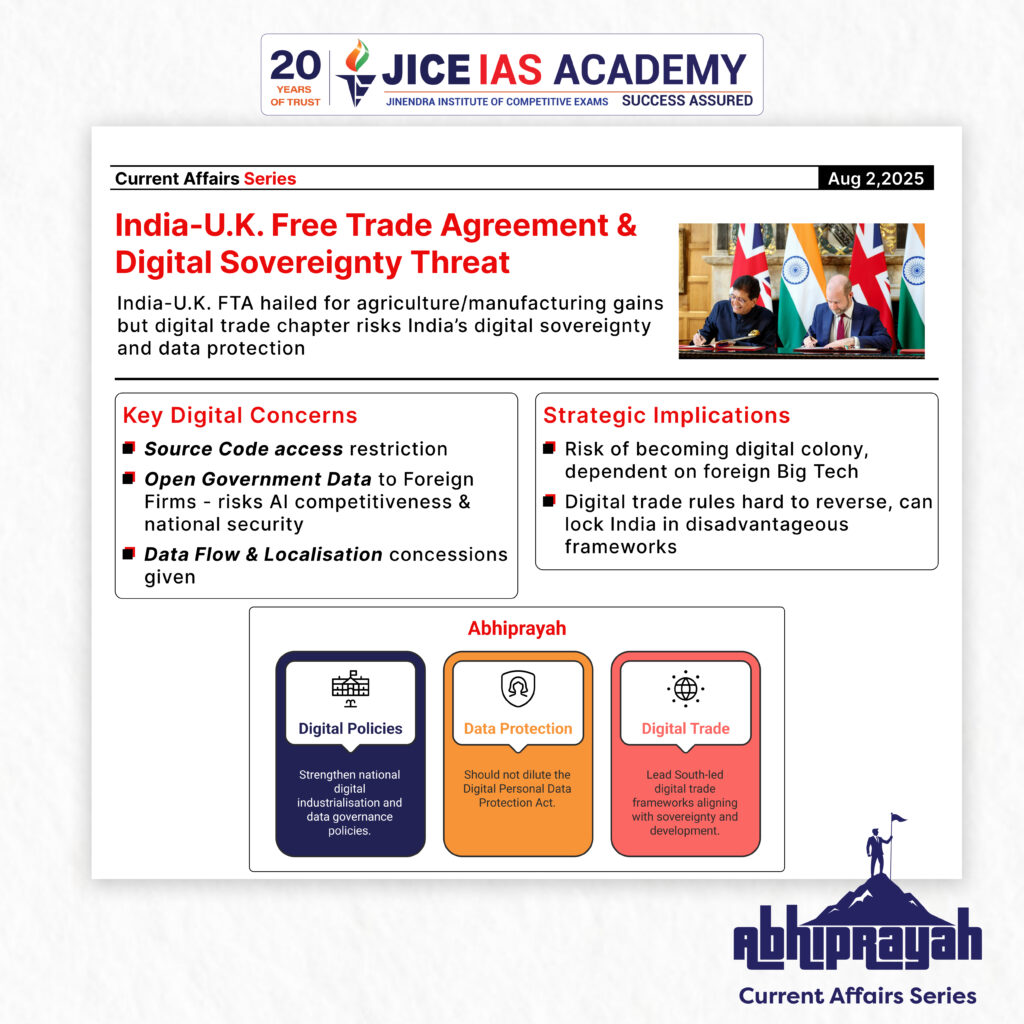
  • The India-U.K. Free Trade Agreement (CETA), hailed as a ‘gold standard’, includes controversial digital trade provisions that may undermine India’s long-held positions on digital sovereignty and national data protection.

Introduction

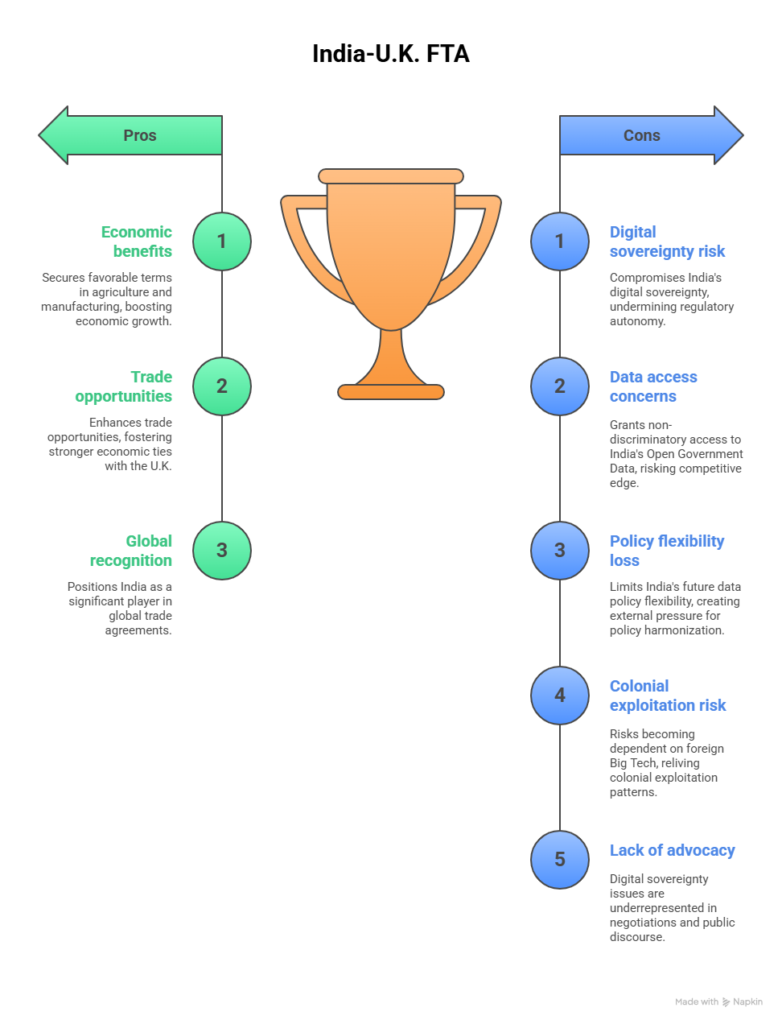
  • The recently concluded Comprehensive Economic and Trade Agreement (CETA) between India and the United Kingdom has been widely celebrated for securing favorable terms in agriculture and manufacturing.
  • However, its digital trade chapter has attracted criticism from experts who argue that it compromises India’s digital sovereignty — a critical concern in today’s data-driven economy.
  • The agreement includes unprecedented concessions that contradict India’s earlier stances at global forums such as the WTO, especially regarding source code access, data governance, and open government data.

Key Digital Sector Concerns in the FTA

1. Source Code Disclosure Concession

  • India’s earlier stance: Sought ex ante (pre-emptive) access to source code for regulatory scrutiny in critical digital sectors like AI, telecom, and health tech.
  • CETA’s provision: Restricts India’s ability to demand such access, allowing only ex post (after-the-fact) access during investigations.
  • Implications:
    • Undermines regulatory autonomy.
    • Hampers real-time monitoring of foreign digital services.
    • Contradicts India’s past WTO position and global trend reversals (e.g., U.S. dropped similar positions in 2023).

2. Open Government Data for Foreign Access

  • CETA grants non-discriminatory access to U.K. firms for India’s Open Government Data.
  • Concerns:
    • Data today is a critical economic and strategic resource, not just for transparency but for AI development and innovation.
    • Foreign access could dilute India’s competitive edge in AI and compromise national security.
    • Even though non-binding, the inclusion sets a precedent for future obligations.

3. Data Flow and Localisation Commitments

  • India has resisted the free flow of data and opposed restrictions on data localisation at the WTO.
  • FTA clause: India commits to enter consultations with the U.K. if similar concessions are granted to any other country.
  • Implication:
    • Introduces vulnerability in India’s future data policy flexibility.
    • Creates external pressure for policy harmonisation that may be detrimental to India’s digital industrialisation.

Strategic Implications

1. Risk of Becoming a ‘Digital Colony’

  • By surrendering data rights and digital policy space, India risks:
    • Losing out in the global AI race.
    • Becoming dependent on foreign Big Tech architectures.
    • Reliving patterns of colonial exploitation, this time in the digital economy.

2. Irreversibility of Digital Trade Rules

  • Unlike tariff concessions in goods, digital trade rules are structural and difficult to reverse.
  • Early commitments can lock India into disadvantageous frameworks, limiting future digital innovation and industrial policy.

3. Absence of Domestic Advocacy

  • The digital sector lacks a political constituency unlike agriculture or textiles.
  • Hence, digital sovereignty issues are underrepresented in negotiations and overlooked in public discourse.

Way Forward: Safeguarding Digital Sovereignty

1. Formulate a Digital Industrialisation Policy

  • Develop a comprehensive national policy on digital sovereignty and data governance.
  • Clarify national objectives on data localisation, platform governance, and digital infrastructure.

2. Integrate Digital Experts in Trade Negotiations

  • Appoint digital economy experts and technologists as part of trade negotiation teams.
  • Ensure top-level political backing to protect long-term strategic interests.

3. Develop India’s Own Digital Trade Framework

  • Lead efforts to craft a South-led digital trade model aligned with developmental and sovereignty goals.
  • Collaborate with other developing nations resisting western digital dominance.

4. Public Awareness and Legislative Backing

  • Create wider awareness about digital sovereignty through public discourse.
  • Pass robust data protection and digital competition laws to reinforce domestic policy strength in negotiations.

Conclusion

While the India-U.K. FTA is a diplomatic and economic milestone, the digital trade concessions present a serious challenge to India’s long-term digital autonomy and technological self-reliance. In the age of data-driven geopolitics, sovereignty is not just about borders — it is about algorithms, access, and infrastructure. India must not repeat the mistakes of the colonial past in the digital future. A clear national roadmap for digital industrialisation, informed policy frameworks, and assertive negotiation strategies are essential to secure a prosperous and independent digital future.

Introduction

Economic Implications

For Indian Exporters

  • These reforms reduce transaction costs and compliance hurdles
  • Encourage a more competitive and efficient export environment
  • Promote value addition in key sectors like leather

For Tamil Nadu

  • The reforms particularly benefit the state’s leather industry, a major contributor to employment and exports
  • Boost the marketability of GI-tagged E.I. leather, enhancing rural and traditional industries

For Trade Policy

  • These decisions indicate a shift from regulatory controls to policy facilitation

Reinforce the goals of Make in India, Atmanirbhar Bharat, and India’s ambition to become a leading export power

Recently, BVR Subrahmanyam, CEO of NITI Aayog, claimed that India has overtaken Japan to become the fourth-largest economy in the world, citing data from the International Monetary Fund (IMF). 

India’s rank as the world’s largest economy varies by measure—nominal GDP or purchasing power parity (PPP)—each with key implications for economic analysis.

Significance and Applications

One Response

Leave a Reply to Registrēties Cancel reply

Your email address will not be published. Required fields are marked *

Call Us Now !

Copyright © JICE ACADEMY FOR EXCELLENCE PRIVATE LIMITED