UPSC CURRENT AFFAIRS – 05th July 2025
India’s Aluminium and Copper Vision Documents 2047
Why in News?
- India unveiled Aluminium and Copper Vision Documents 2047 to scale up metal production and ensure resource security for clean energy and infrastructure development in line with the Viksit Bharat 2047 goal.
Introduction
- On July 4, 2025, the Union Ministry of Mines unveiled two significant policy blueprints — the Aluminium Vision Document 2047 and the Copper Vision Document 2047 — at an international conference organised by the Indian National Committee of the World Mining Congress in Hyderabad.
- The documents aim to strategically scale up India’s aluminium and copper production capacities, strengthen raw material security, and align the metal sectors with the national vision of Viksit Bharat by 2047.
- The release of the vision documents marks a key step toward building a resource-secure, low-carbon, and globally competitive non-ferrous metal industry in India.
Aluminium Vision Document 2047
Objective:
To increase aluminium production six-fold from the current 4.5 million tonnes per annum (MTPA) to approximately 37 MTPA by 2047, in line with the projected surge in demand driven by India’s infrastructure and clean energy goals.
Key Targets and Features:
- Bauxite Production: Scale up domestic bauxite output to:
- 50 MTPA by 2030
- 150 MTPA by 2047
- Recycling: Double the national aluminium recycling rate and promote structured scrap collection mechanisms to support circularity.
- Low-Carbon Technologies: Accelerate adoption of clean energy practices and reduce the sector’s carbon footprint.
- Raw Material Security: Policy reforms to ensure Aatmanirbharta (self-reliance) in bauxite and alumina production.
- Global Market Share: Target a 10% share of global aluminium production by 2047 (from the current 6%).
Strategic Significance:
- Aluminium is critical to India’s energy transition, particularly in:
- Electric vehicles
- Grid-scale battery storage
- Modern infrastructure
- Renewable energy systems
- The vision document is expected to guide investments exceeding ₹20 lakh crore over the next two decades, positioning India as a global aluminium hub.
Copper Vision Document 2047
Objective:
To meet the projected six-fold rise in domestic copper demand by 2047 and enhance India’s self-sufficiency in copper refining and production.
Key Targets and Features:
- Smelting and Refining Capacity: Add 5 million tonnes per annum (MTPA) of capacity by 2030.
- Secondary Refining and Recycling: Expand domestic copper recycling and reduce open-market import dependence.
- Raw Material Access: Secure overseas copper mineral assets via strategic global partnerships.
- Domestic Demand Strategy:
- Copper is essential to green technologies like:
- Electric mobility
- Solar power
- Telecommunications
- The document calls for long-term strategies to ensure raw material supply amid rising demand for clean energy infrastructure.
- Copper is essential to green technologies like:
Strategic Rationale Behind the Vision Documents
- Viksit Bharat by 2047: The roadmap for aluminium and copper supports India’s ambition to become a developed country by 2047, with modern infrastructure, energy security, and global manufacturing competitiveness.
- Energy Transition and Net-Zero Goals: Both metals play a foundational role in India’s shift to low-carbon energy systems. Scaling up their production is essential for achieving net-zero emissions targets.
- Aatmanirbharta in Strategic Metals: These documents reinforce the broader goal of self-reliance in critical minerals and strategic resources, reducing import dependency and enhancing domestic value addition.
- Industrial Growth and Employment: The implementation of these visions can catalyze large-scale investments, create employment opportunities, and boost the MSME ecosystem linked to mining, refining, and recycling.
- Environmental Responsibility: By promoting recycling, low-carbon operations, and sustainable mining, the documents align industrial growth with environmental stewardship.
Industry Response
- Major aluminium producers like Vedanta welcomed the aluminium vision, stating that it provides a clear strategic direction for transforming India into a global aluminium powerhouse.
- The company highlighted the importance of swift policy reforms and infrastructure development to attract the ₹20 lakh crore investments necessary to achieve the goals outlined in the vision.
Conclusion
The Aluminium and Copper Vision Documents 2047 represent a strategic leap in India’s mineral policy and industrial planning. They provide a comprehensive framework for building a sustainable, future-ready, and globally integrated non-ferrous metal industry. In the context of India’s push for green growth, clean energy adoption, and manufacturing expansion, these documents are poised to play a central role in achieving the goals of energy security, economic resilience, and technological self-reliance by the centenary of independence.

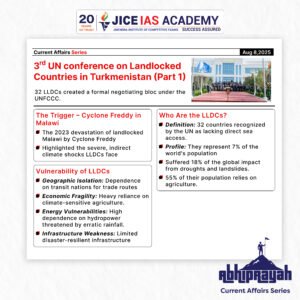
3rd UN conference on landlocked countries
UPSC CURRENT AFFAIRS – 08th August 2025 Home / 3rd UN conference on landlocked countries Why in News? At the
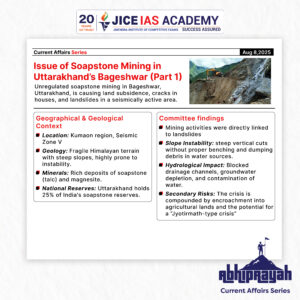
Issue of soapstone mining in Uttarakhand’s Bageshwar
UPSC CURRENT AFFAIRS – 08th August 2025 Home / Issue of soapstone mining in Uttarakhand’s Bageshwar Why in News? Unregulated
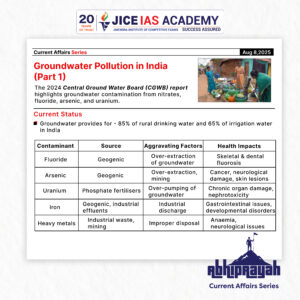
Groundwater Pollution in India – A Silent Public Health Emergency
UPSC CURRENT AFFAIRS – 08th August 2025 Home / Groundwater Pollution in India – A Silent Public Health Emergency Why
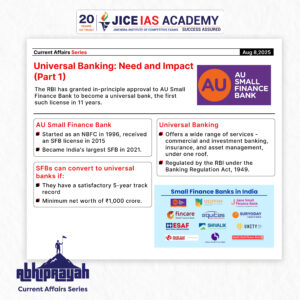
Universal banking- need and impact
UPSC CURRENT AFFAIRS – 08th August 2025 Home / Universal banking- need and impact Why in News? The Reserve Bank
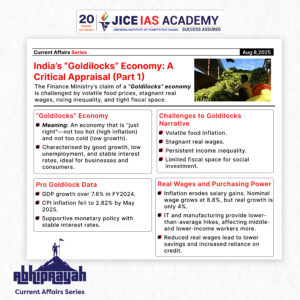
India’s “Goldilocks” Economy: A Critical Appraisal
UPSC CURRENT AFFAIRS – 08th August 2025 Home / India’s “Goldilocks” Economy: A Critical Appraisal Why in News? The Finance

U.S.-India Trade Dispute: Trump’s 50% Tariffs and India’s Oil Imports from Russia
UPSC CURRENT AFFAIRS – 07th August 2025 Home / U.S.-India Trade Dispute: Trump’s 50% Tariffs and India’s Oil Imports from
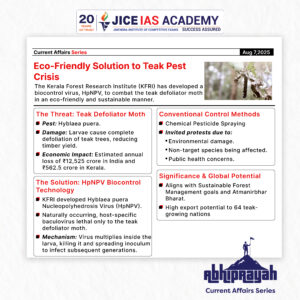
Eco-Friendly Solution to Teak Pest Crisis: KFRI’s HpNPV Technology
UPSC CURRENT AFFAIRS – 07th August 2025 Home / Eco-Friendly Solution to Teak Pest Crisis: KFRI’s HpNPV Technology Why in

New Species of Non-Venomous Rain Snake Discovered in Mizoram
UPSC CURRENT AFFAIRS – 07th August 2025 Home / New Species of Non-Venomous Rain Snake Discovered in Mizoram Why in

Economic Implications
For Indian Exporters
- These reforms reduce transaction costs and compliance hurdles
- Encourage a more competitive and efficient export environment
- Promote value addition in key sectors like leather
For Tamil Nadu
- The reforms particularly benefit the state’s leather industry, a major contributor to employment and exports
- Boost the marketability of GI-tagged E.I. leather, enhancing rural and traditional industries
For Trade Policy
- These decisions indicate a shift from regulatory controls to policy facilitation
Reinforce the goals of Make in India, Atmanirbhar Bharat, and India’s ambition to become a leading export power
Recently, BVR Subrahmanyam, CEO of NITI Aayog, claimed that India has overtaken Japan to become the fourth-largest economy in the world, citing data from the International Monetary Fund (IMF).
India’s rank as the world’s largest economy varies by measure—nominal GDP or purchasing power parity (PPP)—each with key implications for economic analysis.