



UPSC CURRENT AFFAIRS – 21st July 2025
India’s FDI Challenge Amidst Global Realignment
Why in News?
India’s net FDI in FY25 declined sharply due to global structural headwinds and domestic challenges like capital repatriation and weak reinvestment, despite robust gross inflows.
Introduction
- India’s foreign direct investment (FDI) trends in recent years reflect a broader global pattern of declining capital flows to emerging markets and developing economies (EMDEs).
- While India continues to offer robust macroeconomic fundamentals, a widening gap between gross and net FDI inflows signals deeper structural and policy-related issues.
Global FDI Decline: A Persistent and Structural Shift
The world economy is undergoing a significant transformation in cross-border investment flows. According to the World Bank:
- FDI inflows to EMDEs have steadily declined as a share of GDP—from a peak of around 5% in 2008 to just 2% in recent years.
- In absolute terms, EMDEs received only $435 billion in 2023, the lowest since 2005.
This trend is not a temporary disruption but a result of structural and geopolitical challenges:
- Increased protectionism and the rise of barriers to both trade and capital movement.
- Growing geopolitical tensions, which increase risk and discourage long-term investment.
- A noticeable decline in the signing of investment treaties: only 380 treaties came into force between 2010 and 2024, compared to 870 between 2000 and 2009.
- A global slowdown in the negotiation and implementation of trade and investment agreements.
India’s FDI Performance: Strong Gross Inflows but Weak Net Gains
India’s FDI experience is shaped by the same global headwinds, but it also features country-specific challenges:
- Gross FDI Inflows in FY25 reached $81 billion, marking a 14% increase over the previous year, indicating continued interest from foreign investors.
- However, net FDI—which accounts for outflows, repatriations, and reinvestments—plunged by 96%, falling to only $0.35 billion, the lowest level in nearly two decades.
Key reasons for this sharp decline in net FDI include:
- Increased repatriation of profits by foreign companies.
- A significant rise in outward FDI by Indian firms.
- Limited reinvestment of profits by existing foreign investors operating in India.
Structural Challenges in India’s FDI Framework
Area of Concern | Issues Identified |
Policy Stability | Frequent changes in tax regulations, retrospective taxation concerns, and regulatory unpredictability have impacted investor confidence. |
Ease of Doing Business | Despite improvements in global rankings, practical issues such as delays in land acquisition, contract enforcement, and bureaucratic red tape persist. |
Bilateral Investment Treaties | India unilaterally terminated many BITs post-2016, reducing the legal protection available to foreign investors. |
Sectoral Imbalance | FDI is concentrated in services, with manufacturing receiving comparatively lower inflows despite the Production Linked Incentive (PLI) schemes. |
Trade Agreements | India has not concluded significant Free Trade Agreements (FTAs) with major markets like the US or the European Union, limiting investor access to global markets. |
India’s Strengths: Why Investors Still Look to India
Despite the recent trends, India retains multiple long-term advantages that make it an attractive investment destination:
- Demographic Dividend: A large and youthful population with rising consumption potential.
- Digital Infrastructure: Deep digital penetration, rapid growth in fintech, and initiatives like Aadhaar and UPI have created a robust digital backbone.
- Stable Democratic Institutions: A functioning democracy and consistent policy reforms provide a level of predictability.
- Strategic Geopolitical Position: India is increasingly viewed as a reliable alternative to China in global supply chains and is strategically aligned with key global players.
Policy Recommendations to Enhance India’s FDI Attractiveness
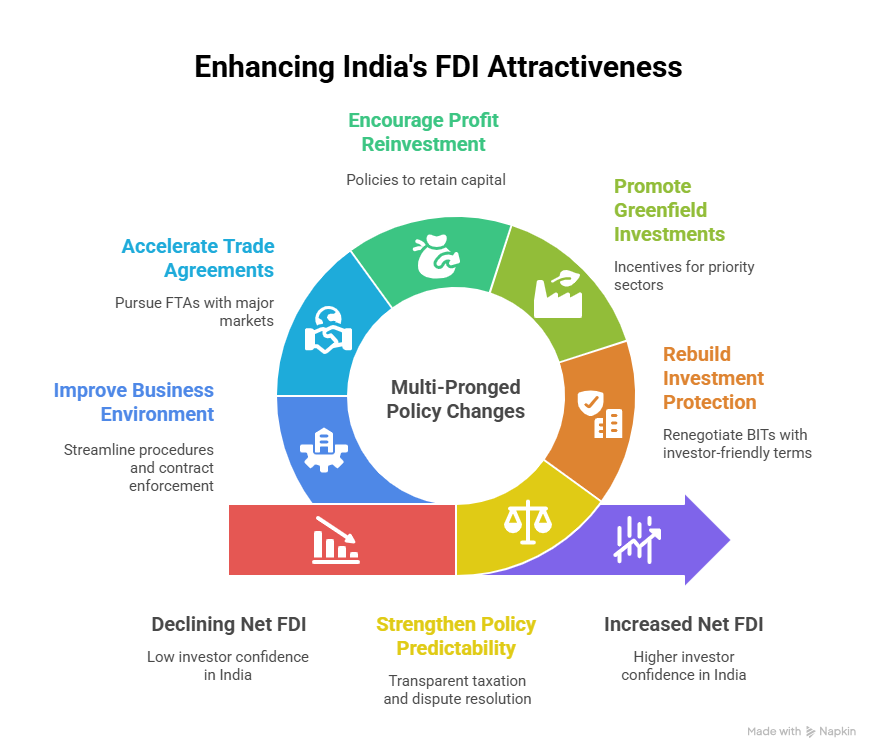
To reverse the trend of declining net FDI and build investor confidence, India must adopt a multi-pronged approach:
- Strengthen Policy Predictability and Transparency: Taxation norms, especially those affecting foreign investors, must be transparent and predictable. Dispute resolution mechanisms should be swift and impartial.
- Rebuild Investment Protection Frameworks: India should re-negotiate Bilateral Investment Treaties (BITs) with investor-friendly terms, offering fair and effective dispute resolution processes.
- Promote Greenfield Investments in High-Priority Sectors: Sectors like semiconductors, clean energy, electronics manufacturing, and electric vehicles should be targeted with tailored incentives and infrastructure support.
- Encourage Reinvestment of Profits: Policies that incentivize foreign companies to reinvest earnings within India could help retain capital and boost net FDI figures.
- Accelerate Trade Agreement Negotiations: India should actively pursue FTAs, especially with high-income markets such as the US, UK, and the European Union, to provide market access and signal openness to global trade.
- Improve On-ground Business Environment: Streamlining procedures at state and local levels, strengthening contract enforcement, and ensuring time-bound clearances can improve the real investment climate.
Conclusion
- India stands at a critical juncture in its investment trajectory. While macroeconomic fundamentals remain strong, sustained FDI inflows will require more than just favourable demographics and digital depth. Investors today are driven by confidence, clarity, and consistency.
- India’s ability to provide a stable, transparent, and investor-friendly environment will determine whether it can attract and retain global capital in an increasingly competitive and uncertain world.

3rd UN conference on landlocked countries
UPSC CURRENT AFFAIRS – 08th August 2025 Home / 3rd UN conference on landlocked countries Why in News? At the

Issue of soapstone mining in Uttarakhand’s Bageshwar
UPSC CURRENT AFFAIRS – 08th August 2025 Home / Issue of soapstone mining in Uttarakhand’s Bageshwar Why in News? Unregulated

Groundwater Pollution in India – A Silent Public Health Emergency
UPSC CURRENT AFFAIRS – 08th August 2025 Home / Groundwater Pollution in India – A Silent Public Health Emergency Why

Universal banking- need and impact
UPSC CURRENT AFFAIRS – 08th August 2025 Home / Universal banking- need and impact Why in News? The Reserve Bank

India’s “Goldilocks” Economy: A Critical Appraisal
UPSC CURRENT AFFAIRS – 08th August 2025 Home / India’s “Goldilocks” Economy: A Critical Appraisal Why in News? The Finance

U.S.-India Trade Dispute: Trump’s 50% Tariffs and India’s Oil Imports from Russia
UPSC CURRENT AFFAIRS – 07th August 2025 Home / U.S.-India Trade Dispute: Trump’s 50% Tariffs and India’s Oil Imports from

Eco-Friendly Solution to Teak Pest Crisis: KFRI’s HpNPV Technology
UPSC CURRENT AFFAIRS – 07th August 2025 Home / Eco-Friendly Solution to Teak Pest Crisis: KFRI’s HpNPV Technology Why in

New Species of Non-Venomous Rain Snake Discovered in Mizoram
UPSC CURRENT AFFAIRS – 07th August 2025 Home / New Species of Non-Venomous Rain Snake Discovered in Mizoram Why in
Economic Implications
For Indian Exporters
- These reforms reduce transaction costs and compliance hurdles
- Encourage a more competitive and efficient export environment
- Promote value addition in key sectors like leather
For Tamil Nadu
- The reforms particularly benefit the state’s leather industry, a major contributor to employment and exports
- Boost the marketability of GI-tagged E.I. leather, enhancing rural and traditional industries
For Trade Policy
- These decisions indicate a shift from regulatory controls to policy facilitation
Reinforce the goals of Make in India, Atmanirbhar Bharat, and India’s ambition to become a leading export power
Recently, BVR Subrahmanyam, CEO of NITI Aayog, claimed that India has overtaken Japan to become the fourth-largest economy in the world, citing data from the International Monetary Fund (IMF).
India’s rank as the world’s largest economy varies by measure—nominal GDP or purchasing power parity (PPP)—each with key implications for economic analysis.