
UPSC CURRENT AFFAIRS – 26th July 2025
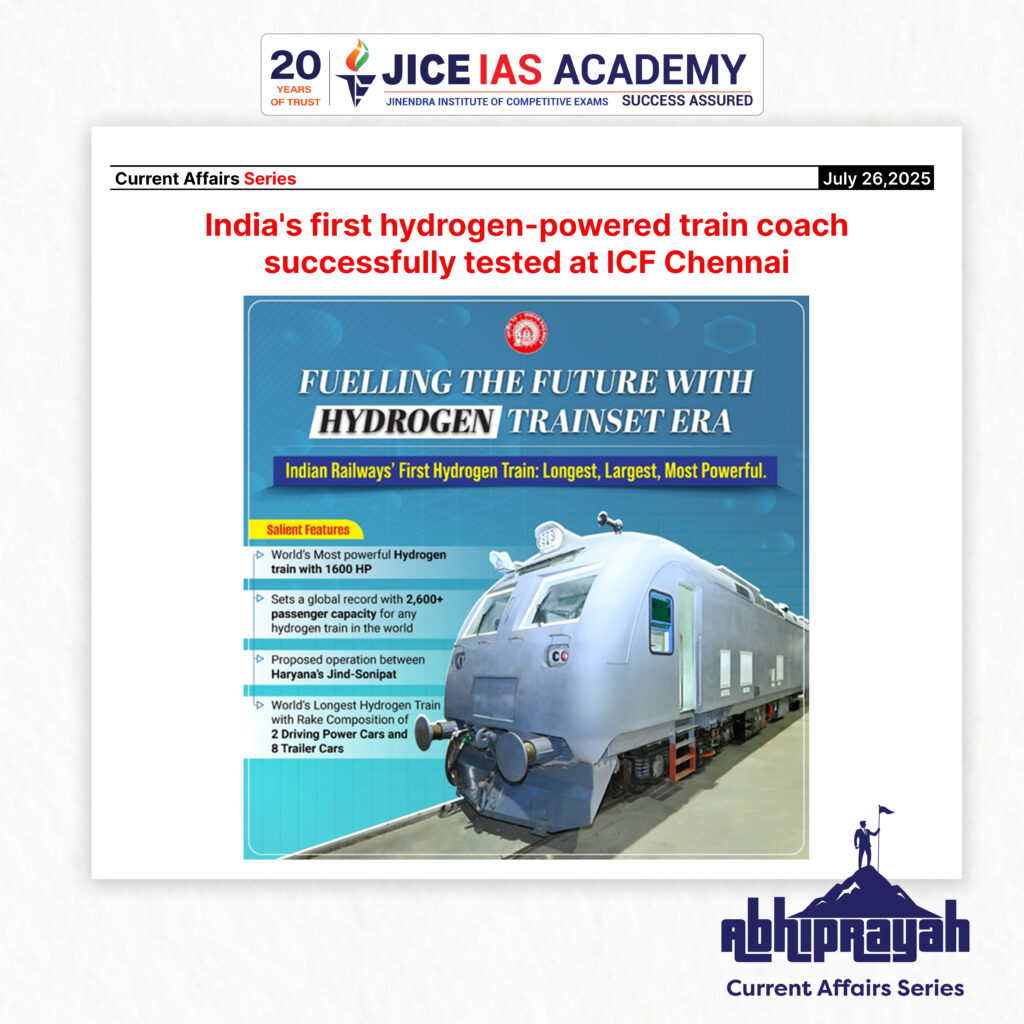
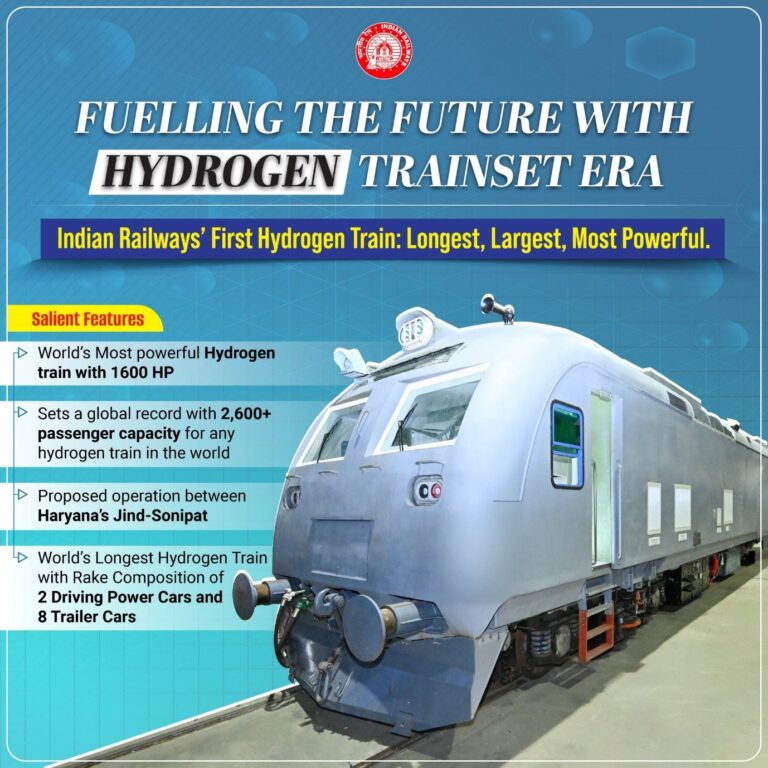
India's first hydrogen-powered train coach successfully tested at ICF Chennai
Why in News?
Union Railway Minister Ashwini Vaishnaw announced that the Indian Railways has successfully tested the country’s First hydrogen-powered coach at the Integral Coach Factory (ICF) in Chennai.
Introduction
- Union Railway Minister Ashwini Vaishnaw announced a significant milestone for Indian Railways — the successful testing of India’s first hydrogen-powered coach, also known as the Driving Power Car, at the Integral Coach Factory (ICF) in Chennai.
- This development places India on the path to becoming a global leader in hydrogen-powered railway technology and supports the nation’s commitment to sustainable and low-carbon transport solutions.
Understanding Hydrogen-Powered Trains
- A hydrogen-powered train uses hydrogen fuel cells to generate electricity, which then powers electric traction motors.
- The primary by-product of this process is water vapor, making it a zero-emission technology. These trains are an alternative to diesel locomotives, particularly useful in non-electrified and ecologically sensitive regions.
Hydrogen for Heritage Scheme
To further promote hydrogen mobility in railways, the Indian government has launched the “Hydrogen for Heritage” scheme.
Trains and Routes
- Under this initiative, Indian Railways has envisaged the deployment of 35 hydrogen-powered trains on heritage and hill routes.
- These routes are often located in environmentally fragile areas where zero-emission transport is crucial.
Cost Estimates
- Each hydrogen-powered train is estimated to cost around ₹80 crore.
- The associated ground infrastructure required per route is estimated at ₹70 crore.
The scheme is intended to support green tourism and protect the ecological integrity of heritage sites and hill regions by replacing diesel-based locomotives with clean energy alternatives.
India’s Green Hydrogen Push
The hydrogen-powered train initiative is part of India’s larger vision under the National Green Hydrogen Mission, launched in 2023.
Broader Demonstrations
- In 2024, Hardeep Singh Puri, the Union Minister of Petroleum & Natural Gas, showcased a hydrogen-fuelled bus developed by Indian Oil Corporation Limited.
- This demonstration was presented to the Prime Minister of Bhutan, underlining India’s growing competence in hydrogen-based mobility solutions across both rail and road sectors.
National Mission Objectives
- Promote the production of green hydrogen using renewable energy.
- Support hydrogen adoption in transportation, refineries, fertilizer production, and steel manufacturing.
- Reduce dependence on fossil fuels and cut carbon emissions significantly.
Challenges and the Way Forward
Challenges
- High initial investment in trains and infrastructure.
- Lack of established hydrogen supply chains and refuelling infrastructure.
- Technical hurdles in retrofitment and maintenance.
- Need for safety protocols and standardisation.
Future Steps
- Accelerate public and private investment in green hydrogen production.
- Develop hydrogen storage and refuelling stations at key railway nodes.
- Promote research and development in indigenous hydrogen technologies.
- Link hydrogen mobility with other green energy initiatives such as rail electrification and renewable power generation.
Conclusion
- The testing of India’s first hydrogen-powered coach is a major milestone in the journey toward sustainable and decarbonised public transport. Through initiatives like “Hydrogen for Heritage” and pilot projects on conventional lines, Indian Railways is preparing to transition from fossil fuel-based mobility to cleaner alternatives. This aligns with India’s broader green development agenda and enhances its global leadership in climate-resilient infrastructure.

3rd UN conference on landlocked countries
UPSC CURRENT AFFAIRS – 08th August 2025 Home / 3rd UN conference on landlocked countries Why in News? At the

Issue of soapstone mining in Uttarakhand’s Bageshwar
UPSC CURRENT AFFAIRS – 08th August 2025 Home / Issue of soapstone mining in Uttarakhand’s Bageshwar Why in News? Unregulated
Groundwater Pollution in India – A Silent Public Health Emergency
UPSC CURRENT AFFAIRS – 08th August 2025 Home / Groundwater Pollution in India – A Silent Public Health Emergency Why
Universal banking- need and impact
UPSC CURRENT AFFAIRS – 08th August 2025 Home / Universal banking- need and impact Why in News? The Reserve Bank
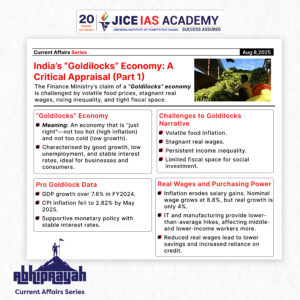
India’s “Goldilocks” Economy: A Critical Appraisal
UPSC CURRENT AFFAIRS – 08th August 2025 Home / India’s “Goldilocks” Economy: A Critical Appraisal Why in News? The Finance

U.S.-India Trade Dispute: Trump’s 50% Tariffs and India’s Oil Imports from Russia
UPSC CURRENT AFFAIRS – 07th August 2025 Home / U.S.-India Trade Dispute: Trump’s 50% Tariffs and India’s Oil Imports from

Eco-Friendly Solution to Teak Pest Crisis: KFRI’s HpNPV Technology
UPSC CURRENT AFFAIRS – 07th August 2025 Home / Eco-Friendly Solution to Teak Pest Crisis: KFRI’s HpNPV Technology Why in

New Species of Non-Venomous Rain Snake Discovered in Mizoram
UPSC CURRENT AFFAIRS – 07th August 2025 Home / New Species of Non-Venomous Rain Snake Discovered in Mizoram Why in

Introduction
Economic Implications
For Indian Exporters
- These reforms reduce transaction costs and compliance hurdles
- Encourage a more competitive and efficient export environment
- Promote value addition in key sectors like leather
For Tamil Nadu
- The reforms particularly benefit the state’s leather industry, a major contributor to employment and exports
- Boost the marketability of GI-tagged E.I. leather, enhancing rural and traditional industries
For Trade Policy
- These decisions indicate a shift from regulatory controls to policy facilitation
Reinforce the goals of Make in India, Atmanirbhar Bharat, and India’s ambition to become a leading export power
Recently, BVR Subrahmanyam, CEO of NITI Aayog, claimed that India has overtaken Japan to become the fourth-largest economy in the world, citing data from the International Monetary Fund (IMF).
India’s rank as the world’s largest economy varies by measure—nominal GDP or purchasing power parity (PPP)—each with key implications for economic analysis.