
UPSC CURRENT AFFAIRS – 28th June 2025
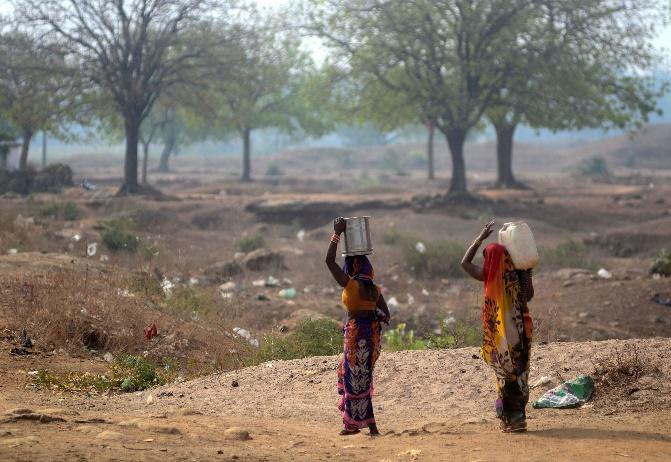
India’s Groundwater Crisis
Introduction
- India is home to the world’s largest groundwater extraction system, accounting for roughly 25% of global groundwater consumption.
- This makes groundwater not just an environmental concern but a national economic and social lifeline, especially as 65% of India’s agriculture and 85% of rural drinking water needs are met through this invisible resource.
- However, rapid extraction, inefficient usage, and weak regulation have led to a deepening groundwater crisis across several parts of the country.
National Groundwater Status
As of 2023, the annual groundwater recharge in India stood at 449 billion cubic metres (BCM), while 241 BCM was extracted. This means India is drawing nearly 60% of its available groundwater every year. While this may appear sustainable on paper, the national average masks severe regional disparities.
According to the Central Ground Water Board (CGWB), 11.2% of India’s 6,553 groundwater assessment units are classified as over-exploited—where the rate of extraction surpasses recharge. Moreover, about 91% of India’s usable groundwater is extractable; the rest is lost through natural discharge. Within this extractable share:
- 87% is used for irrigation
- 11% for domestic use
- 2% for industrial purposes
Regional Trends and State-wise Analysis
1. Northern and Central India: Agriculture-Induced Stress
Punjab and Haryana
- The states of Punjab and Haryana are at the epicentre of India’s groundwater crisis. Satellite data shows that from 2003 to 2020, they collectively lost 64.6 BCM of groundwater.
- In Punjab alone, there are over 15 lakh tubewells, compared to 1.9 lakh in 1970. More than 80% of Punjab’s blocks are now ‘over-exploited’, drawing 164 units of water for every 100 units recharged. Similarly, Haryana extracts 136 units for every 100 units recharged.
- The practice of paddy cultivation in this semi-arid region, encouraged during the Green Revolution, has contributed heavily to this crisis.
- Paddy requires 3,000–5,000 litres of water per kg, making it extremely water-intensive. Subsidised electricity further incentivizes excessive extraction.
- The water table is declining by 0.5 metres annually, with farmers in districts like Sangrur drilling borewells up to 55 metres deep.
- Groundwater contamination is another problem—arsenic, fluoride, uranium, and chloride ions have been detected in several locations, making water unfit for drinking.
Uttar Pradesh
- The state extracts 71 units per 100 units of recharge, but this hides a stark regional disparity.
- Western Uttar Pradesh, especially areas like the Ganga-Yamuna Doab, practices intensive rice and sugarcane cultivation, leading to ‘over-exploited’ aquifers. Urban expansion has worsened the crisis. By contrast, eastern UP, which receives more rainfall, has healthier aquifers.
- In 2017, 11% of UP’s blocks were already over-exploited—a number that has likely grown since.
Rajasthan
- India’s driest state, Rajasthan draws a staggering 149 units of groundwater for every 100 units recharged, making it the most over-exploited state in proportionate terms.
- In 2022, 203 out of 249 blocks were either critical or over-exploited. Though Rajasthan has limited paddy cultivation, its other crops—cotton, mustard, and wheat—are supported by tubewells.
- The use of deep aquifers, often contaminated with fluoride and salt, has led to serious health issues such as fluorosis.
- On a positive note, Rajasthan has made strides in rainwater harvesting and artificial recharge, especially through the Mukhyamantri Jal Swavlamban Abhiyan, which has helped improve water levels in over 50% of monitored wells.
2. Western India: Drought-Prone and Sugarcane-Intensive
Maharashtra
- Although Maharashtra’s average extraction rate is moderate (54 per 100 units recharged), specific regions like Marathwada and western Maharashtra are severely stressed.
- In Marathwada, recurring monsoon failures and the prevalence of cash crops like sugarcane and cotton have caused groundwater depletion. Borewells as deep as 90–250 metres have been dug. In 2016, water had to be transported by train to districts like Latur.
- In western Maharashtra, districts such as Pune, Ahmednagar, Sangli, Solapur, and Satara rely heavily on borewells to support sugarcane and horticulture, despite some canal coverage.
- As of 2023, 16% of talukas were classified as ‘semi-critical’, and **5% as ‘critical’ or ‘over-exploited’’.
3. Southern India: Monsoon-dependent and Urbanising
Tamil Nadu
- Tamil Nadu depends heavily on northeast monsoon and groundwater. Between 2002–2012, extraction exceeded recharge by 8%. In 2017, 89% of wells showed declining levels, especially in northern and western districts like Tiruvallur.
- Despite progressive policies like mandatory rainwater harvesting (2003) and the construction of desalination plants, the state’s groundwater usage remains unsustainable. In 2024, Tamil Nadu extracted 14.45 BCM, of which 13.51 BCM (93.5%) went to irrigation.
- Chennai alone used 127.5% of its recharge in 2023. Coastal aquifers have turned saline due to seawater intrusion, a result of over-pumping.
Groundwater Crisis in Urban India
Groundwater is the primary source for more than 630 urban local bodies, especially in Uttar Pradesh, Rajasthan, Maharashtra, and Karnataka. As cities grow faster than infrastructure development, urban aquifers are being depleted.
Examples of Urban Stress:
- Bengaluru: Lost 79% of lake surface area over five decades; 50% of 14,000 borewells dry
- Chennai: 127.5% of annual recharge extracted in 2023
- Delhi NCR: Noida, Gurugram heavily dependent on borewells
- Ahmedabad, Surat, Pune, Nagpur: Groundwater demand outpacing supply
- Kolkata & Nagapattinam: Saline groundwater due to Bay of Bengal intrusion
This unchecked extraction leads to water scarcity, inequality in access, land subsidence, and deteriorating water quality in metros.
Root Causes of the Groundwater Crisis
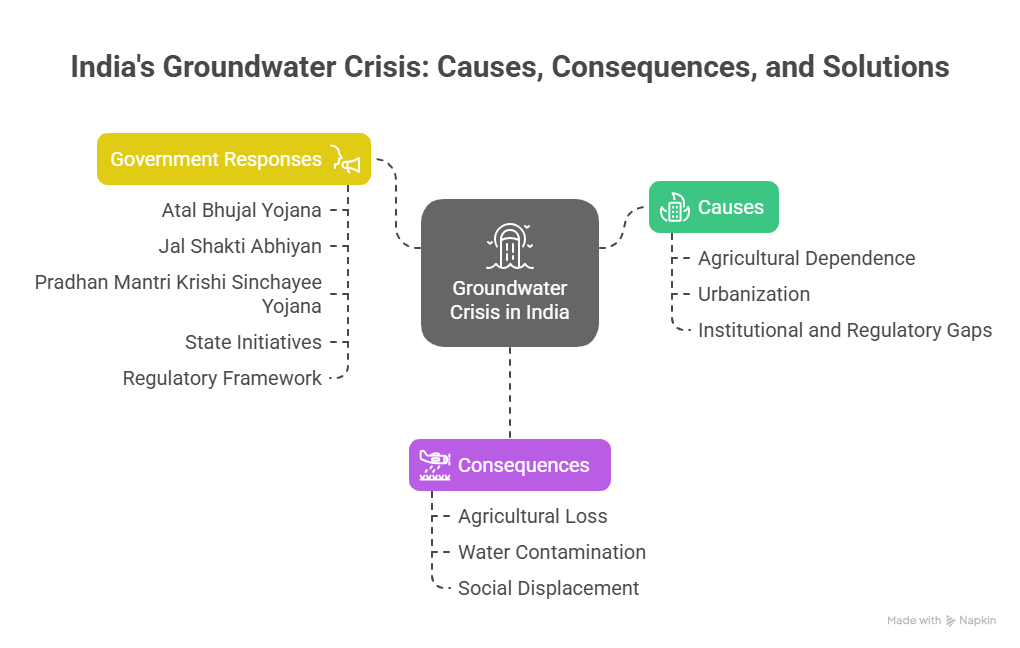
- Agricultural Dependence
- The Green Revolution legacy led to water-intensive monocultures of paddy and sugarcane.
- Subsidised electricity for tubewells encouraged free or excessive pumping.
- Minimum Support Prices (MSP) create perverse incentives to grow unsuitable crops in dry areas.
- Flood irrigation remains dominant despite the availability of micro-irrigation methods.
- Free power misuse: Farmers sometimes run pumps just to exhaust quotas.
- Urbanisation
- Rapid expansion of cities, especially in peri-urban areas, results in unregulated borewell drilling.
- Lack of water pricing or metering in many cities adds to wastage.
- Weak aquifer governance leads to uncoordinated extraction.
- Institutional and Regulatory Gaps
- Enforcement is poor: Only 14% of over-exploited blocks are officially notified as such.
- Lack of community management: Unlike forest or river systems, groundwater is viewed as private, not shared.
- Tragedy of the commons: Everyone extracts excessively for fear of others ‘out-pumping’ them.
Consequences of Groundwater Over-extraction
- Agricultural loss: Crop yields reduce due to poor water quality (e.g., 30% decline in Punjab)
- Higher costs for farmers: Need for deeper pumps, more electricity, larger loans
- Water contamination: Fluoride, arsenic, uranium, salinity
- River drying & deforestation: Roots can no longer reach water table
- Land degradation: Flooding, erosion, surface runoff
- Social displacement: Migration, shrinking rural economy, health impacts
Government Responses
- Atal Bhujal Yojana (2020)
- Outlay: ₹6,000 crore
- Focus: Community-led groundwater management in 7 States
- Status: Low fund disbursal due to pandemic; intended to decentralize water governance
- Jal Shakti Abhiyan (2019 onwards)
- Annual campaign in water-stressed districts
- Between 2019–2023: 98 lakh recharge structures created
- In 2024, 151 districts targeted
- Pradhan Mantri Krishi Sinchayee Yojana (PMKSY)
- Promotes micro-irrigation (drip, sprinkler) under “Per Drop More Crop”
- Over 52 lakh hectares covered with modern irrigation
- Also includes crop diversification support (e.g., paddy to maize/pulses)
- State Initiatives
- Haryana – Mera Pani Meri Virasat: ₹2,800/ha to shift crops
- Punjab – Pani Bachao, Paisa Kamao: Cash rewards for conserving power
- Telangana, Maharashtra, Gujarat: Borewell registration and power control schemes
- Tamil Nadu, Karnataka: Restoration of tanks and ponds
- Regulatory Framework
- Model Groundwater Bill circulated; adopted by 21 States/UTs (as of 2024)
- Aquifer mapping by CGWB: 25 lakh sq. km covered
- 2020 Guidelines mandate rainwater harvesting and NOC for industries in critical blocks
Conclusion
India’s groundwater crisis is not just an environmental problem—it is a social, economic, and ecological emergency. Years of unregulated extraction, driven by policy distortions, inefficient agriculture, and urban mismanagement, have pushed many regions to the brink.
The way forward lies in:
- Reforming incentive structures
- Promoting water-efficient agriculture
- Empowering communities
- Strictly enforcing regulations
- Investing in aquifer recharge and monitoring
Unless groundwater governance is transformed from the ground up, India risks undermining its food, water, and economic security.

3rd UN conference on landlocked countries
UPSC CURRENT AFFAIRS – 08th August 2025 Home / 3rd UN conference on landlocked countries Why in News? At the
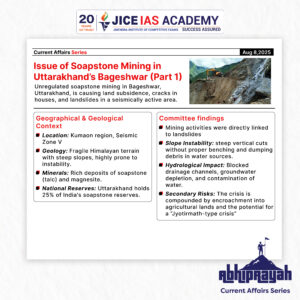
Issue of soapstone mining in Uttarakhand’s Bageshwar
UPSC CURRENT AFFAIRS – 08th August 2025 Home / Issue of soapstone mining in Uttarakhand’s Bageshwar Why in News? Unregulated
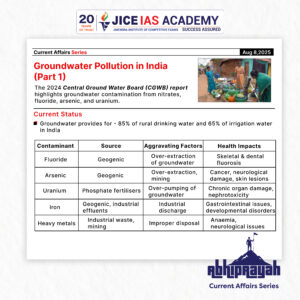
Groundwater Pollution in India – A Silent Public Health Emergency
UPSC CURRENT AFFAIRS – 08th August 2025 Home / Groundwater Pollution in India – A Silent Public Health Emergency Why

Universal banking- need and impact
UPSC CURRENT AFFAIRS – 08th August 2025 Home / Universal banking- need and impact Why in News? The Reserve Bank

India’s “Goldilocks” Economy: A Critical Appraisal
UPSC CURRENT AFFAIRS – 08th August 2025 Home / India’s “Goldilocks” Economy: A Critical Appraisal Why in News? The Finance

U.S.-India Trade Dispute: Trump’s 50% Tariffs and India’s Oil Imports from Russia
UPSC CURRENT AFFAIRS – 07th August 2025 Home / U.S.-India Trade Dispute: Trump’s 50% Tariffs and India’s Oil Imports from

Eco-Friendly Solution to Teak Pest Crisis: KFRI’s HpNPV Technology
UPSC CURRENT AFFAIRS – 07th August 2025 Home / Eco-Friendly Solution to Teak Pest Crisis: KFRI’s HpNPV Technology Why in

New Species of Non-Venomous Rain Snake Discovered in Mizoram
UPSC CURRENT AFFAIRS – 07th August 2025 Home / New Species of Non-Venomous Rain Snake Discovered in Mizoram Why in
Economic Implications
For Indian Exporters
- These reforms reduce transaction costs and compliance hurdles
- Encourage a more competitive and efficient export environment
- Promote value addition in key sectors like leather
For Tamil Nadu
- The reforms particularly benefit the state’s leather industry, a major contributor to employment and exports
- Boost the marketability of GI-tagged E.I. leather, enhancing rural and traditional industries
For Trade Policy
- These decisions indicate a shift from regulatory controls to policy facilitation
Reinforce the goals of Make in India, Atmanirbhar Bharat, and India’s ambition to become a leading export power
Recently, BVR Subrahmanyam, CEO of NITI Aayog, claimed that India has overtaken Japan to become the fourth-largest economy in the world, citing data from the International Monetary Fund (IMF).
India’s rank as the world’s largest economy varies by measure—nominal GDP or purchasing power parity (PPP)—each with key implications for economic analysis.