

UPSC CURRENT AFFAIRS – 29th July 2025

Home / UPSC / Current Affairs / India’s Heatstroke Crisis and the Need for Resilient Public Health Systems

India’s Heatstroke Crisis and the Need for Resilient Public Health Systems

Why in News?

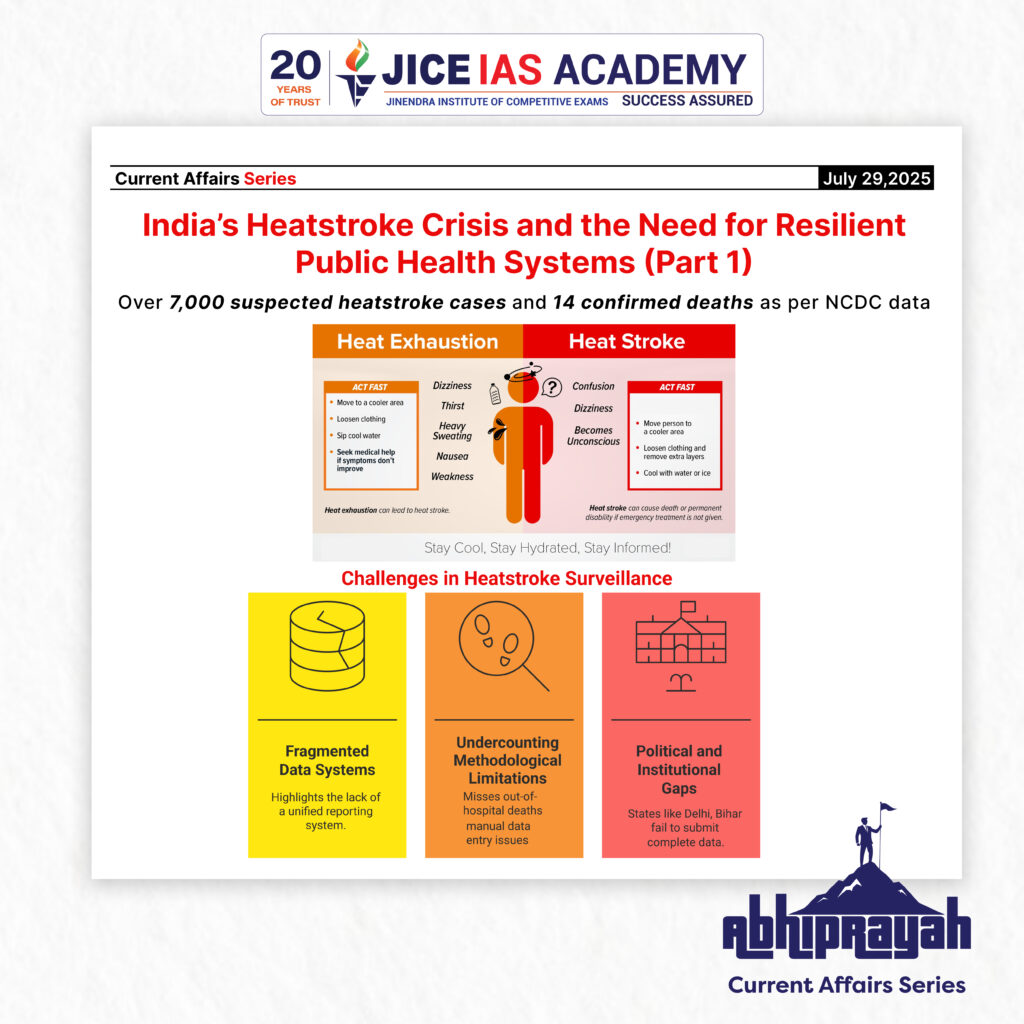
  • India reported over 7,000 suspected heatstroke cases and only 14 confirmed deaths between March and June 2025.

Introduction

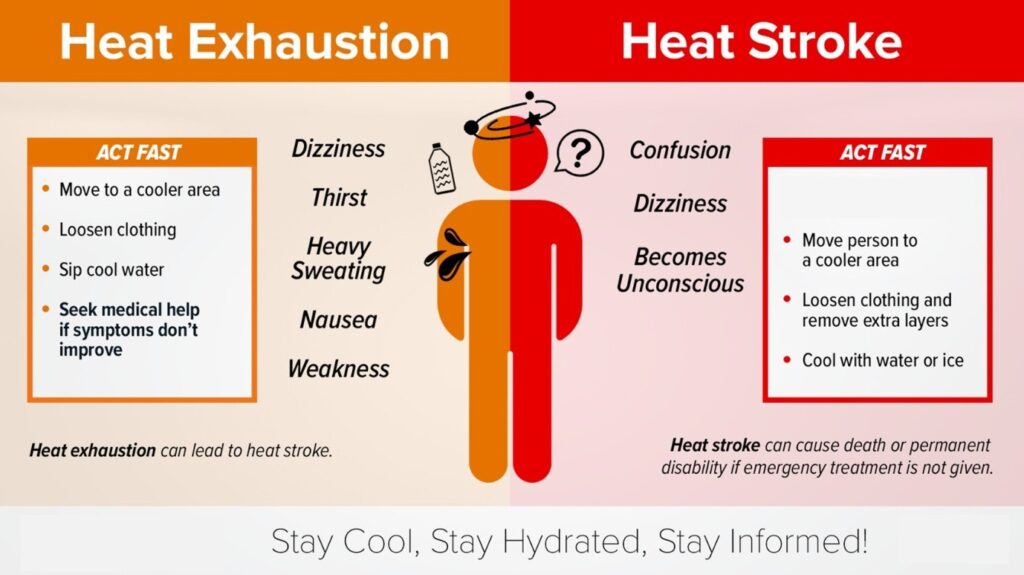
  • India is grappling with rising temperatures and an escalating health crisis due to extreme heat events.
  • According to data shared by the National Centre for Disease Control (NCDC) under the Right to Information (RTI) Act, between March 1 and June 24, 2025, India reported 7,192 suspected heatstroke cases and only 14 confirmed deaths.
  • However, other figures indicate a much higher toll — nearly 48,000 suspected cases and 159 deaths in 2024, making it the warmest year on record since 1901.

Challenges in Heatstroke Surveillance and Reporting

  1. Fragmented Data Systems

Multiple agencies provide conflicting figures:

  • NCDC (2015–2022): 3,812 deaths
  • NCRB: 8,171 deaths
  • IMD: 3,436 deaths

This discrepancy underscores the absence of a unified reporting mechanism.

  1. Undercounting Due to Methodological Limitations

The current surveillance system — the Integrated Disease Surveillance Programme (IDSP) — relies on hospital-based reporting. It often:

  • Misses out-of-hospital deaths
  • Fails to attribute heat as the primary cause (often misclassified as heart attacks, strokes)
  • Suffers from manual data entry issues and staff shortages
  1. Political and Institutional Gaps
  • Several states like Delhi, Bihar, UP, Punjab, Karnataka, and others have failed to submit complete data in recent years.
  • Allegations of data suppression to avoid compensation claims have further eroded trust.

Drivers of Settlement in Floodplains

  • Economic constraints and job accessibility
  • Lack of affordable housing
  • Social vulnerability and forced displacement
  • In contrast to the Global North, where flood insurance and protective infrastructure (e.g., levees) allow affluent residents to reside in flood-prone scenic areas, in the Global South, floodplains equate to affordability for the poor.

Policy Recommendations

  1. Integrated National Heat Illness Registry
    • Establish a centralized and digital heat illness and mortality registry involving NCDC, IMD, NCRB, and health ministries.
  2. Mandatory Reporting Protocols
    • Enforce standardized heatstroke diagnosis and mortality protocols at both public and private healthcare facilities.
  3. Use of Excess Mortality Modelling
    • Adopt models used globally to assess the excess death burden during heatwaves.
  4. Public Awareness and Emergency Preparedness
    • Expand awareness campaigns (e.g. Heat Action Plans) and develop early warning systems using satellite data, especially in heat-prone regions.
  5. Inter-Agency Coordination
    • Create a climate-health task force under the Ministry of Health to coordinate data collection, reporting, and heat adaptation strategies.

Conclusion

  • The rising frequency and intensity of heatwaves in India underscore the urgent need for accurate data collection, robust public health infrastructure, and coordinated institutional mechanisms.
  • Without these, the country remains ill-prepared to mitigate the devastating impacts of extreme heat on human health and productivity.
  • Climate resilience must become a public health priority.

Introduction

Economic Implications

For Indian Exporters

  • These reforms reduce transaction costs and compliance hurdles
  • Encourage a more competitive and efficient export environment
  • Promote value addition in key sectors like leather

For Tamil Nadu

  • The reforms particularly benefit the state’s leather industry, a major contributor to employment and exports
  • Boost the marketability of GI-tagged E.I. leather, enhancing rural and traditional industries

For Trade Policy

  • These decisions indicate a shift from regulatory controls to policy facilitation

Reinforce the goals of Make in India, Atmanirbhar Bharat, and India’s ambition to become a leading export power

Recently, BVR Subrahmanyam, CEO of NITI Aayog, claimed that India has overtaken Japan to become the fourth-largest economy in the world, citing data from the International Monetary Fund (IMF). 

India’s rank as the world’s largest economy varies by measure—nominal GDP or purchasing power parity (PPP)—each with key implications for economic analysis.

Significance and Applications

Leave a Reply

Your email address will not be published. Required fields are marked *

Call Us Now !

Copyright © JICE ACADEMY FOR EXCELLENCE PRIVATE LIMITED