
UPSC CURRENT AFFAIRS – 24th July 2025

Home / UPSC / Current Affairs / India’s Improved Ranking in Henley Passport Index 2025

India’s Improved Ranking in Henley Passport Index 2025

Why in News?

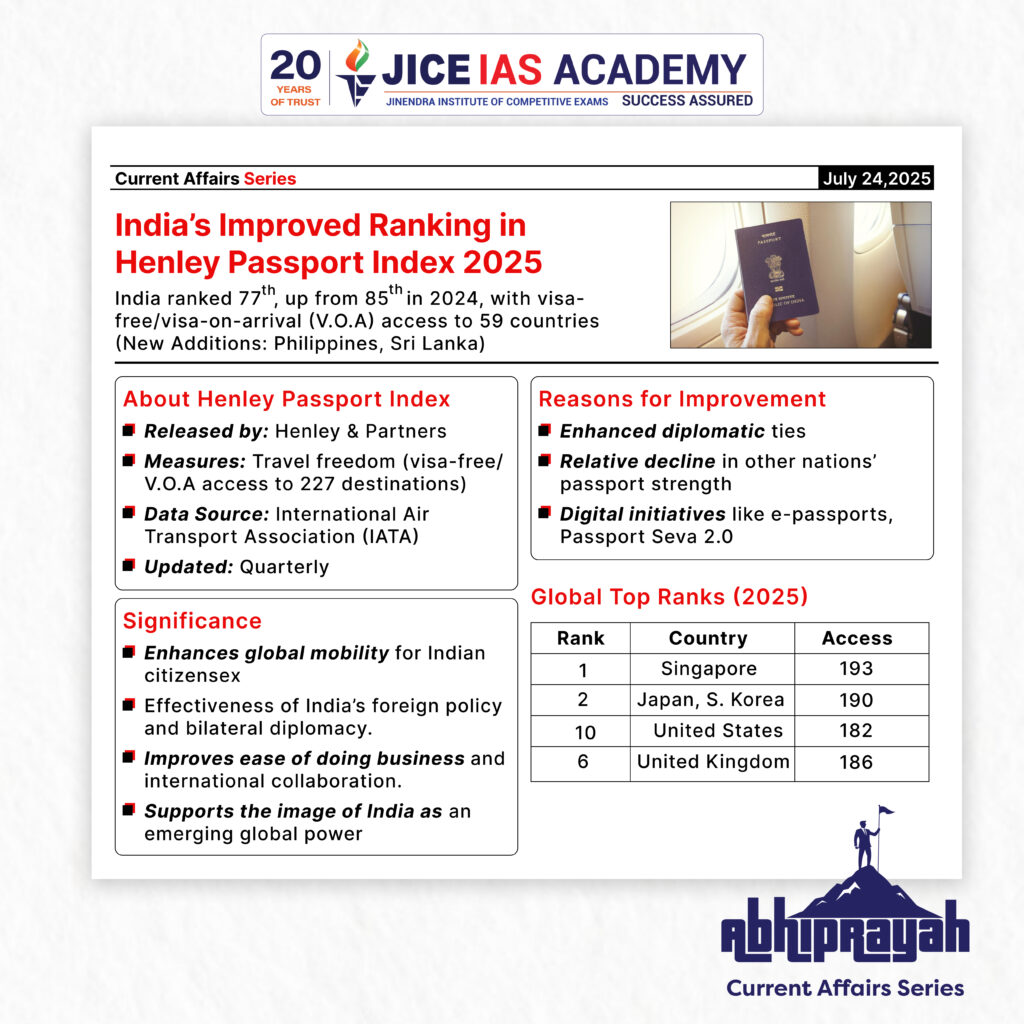
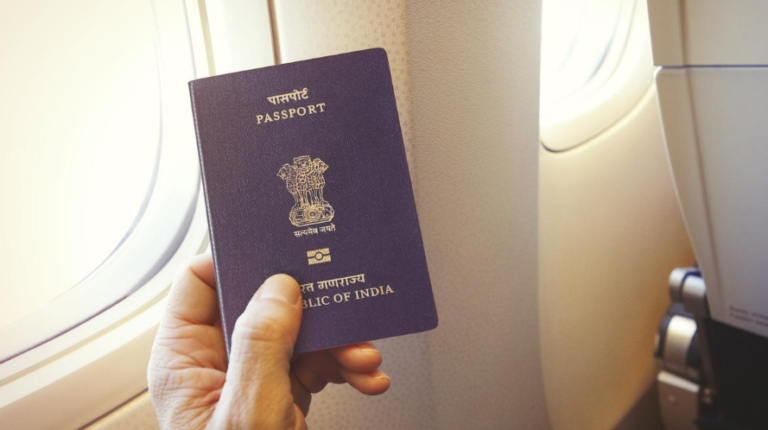
  • India has climbed to 77th rank in the Henley Passport Index 2025, with Indian passport holders now having visa-free or visa-on-arrival access to 59 countries.

Introduction

  • India has made a notable advancement in the Henley Passport Index 2025, moving up eight positions from 85th in 2024 to 77th in 2025.
  • This improvement comes despite a marginal increase in visa-free or visa-on-arrival access, which rose from 57 to 59 countries.
  • The jump is largely attributed to diplomatic engagements and shifting global rankings rather than a significant change in the number of accessible destinations.
  •  

About the Henley Passport Index

  • The Henley Passport Index is a globally recognized ranking of passports based on the freedom of travel they offer to their holders.
  • It evaluates the number of destinations one can access without obtaining a prior visa.
    • Published by: Henley & Partners
    • Data Source: International Air Transport Association (IATA)
    • Coverage: Access to 227 destinations, including visa-free and visa-on-arrival access.
  • The index is updated quarterly and reflects shifts in global mobility, diplomatic relations, and geopolitical developments.

Global Highlights – 2025 Edition

Rank

Country

Visa-Free Destinations

1

Singapore

193

2

Japan, South Korea

190

3

Denmark, Finland, France, Germany, Ireland, Italy, Spain

189

6

United Kingdom

186

10

United States

182

Notably, Asian countries continue to dominate the top rankings, while Western countries like the U.S. and U.K. have seen a gradual decline in passport strength over the years.

India’s Performance in 2025

  • Rank: 77th globally
  • Previous Rank (2024): 85th
  • Visa-free/Visa-on-arrival Access: 59 countries
  • New Additions in 2025:
    • Philippines
    • Sri Lanka

Factors Behind India’s Improved Rank:

  • Positive changes in India’s bilateral relations and diplomatic outreach
  • Relative decline in other countries’ passport rankings
  • India’s engagement in digital passport initiatives and global connectivity efforts

Significance of Improved Passport Strength

  • Enhances global mobility for Indian citizens in terms of business, tourism, education, and emergency migration.
  • Reflects the effectiveness of India’s foreign policy and bilateral diplomacy.
  • Improves ease of doing business and international collaboration.
  • Supports the image of India as an emerging global power with expanding international relationships.

Government Initiatives to Boost Passport Services

  1. Passport Seva 2.0
  • Introduced to enhance the user experience with improved digital interface and tracking features.
  • Expansion of Passport Seva Kendras (PSKs) and Post Office PSKs (POPSKs) for wider accessibility.
  1. e-Passports
  • India has launched chip-embedded e-passports to enhance security and streamline immigration.
  • Features include:
    • Biometric data storage
    • Machine-readable zone (MRZ)
    • Protection against forgery and misuse

These reforms aim to modernize passport issuance, ensure global compatibility, and improve citizen convenience.

Economic Implications

For Indian Exporters

  • These reforms reduce transaction costs and compliance hurdles
  • Encourage a more competitive and efficient export environment
  • Promote value addition in key sectors like leather

For Tamil Nadu

  • The reforms particularly benefit the state’s leather industry, a major contributor to employment and exports
  • Boost the marketability of GI-tagged E.I. leather, enhancing rural and traditional industries

For Trade Policy

  • These decisions indicate a shift from regulatory controls to policy facilitation

Reinforce the goals of Make in India, Atmanirbhar Bharat, and India’s ambition to become a leading export power

Recently, BVR Subrahmanyam, CEO of NITI Aayog, claimed that India has overtaken Japan to become the fourth-largest economy in the world, citing data from the International Monetary Fund (IMF). 

India’s rank as the world’s largest economy varies by measure—nominal GDP or purchasing power parity (PPP)—each with key implications for economic analysis.

Significance and Applications

Leave a Reply

Your email address will not be published. Required fields are marked *

Call Us Now !

Copyright © JICE ACADEMY FOR EXCELLENCE PRIVATE LIMITED