UPSC CURRENT AFFAIRS – 21st July 2025
India’s Increasing Abstentions at the United Nations
Why in News?
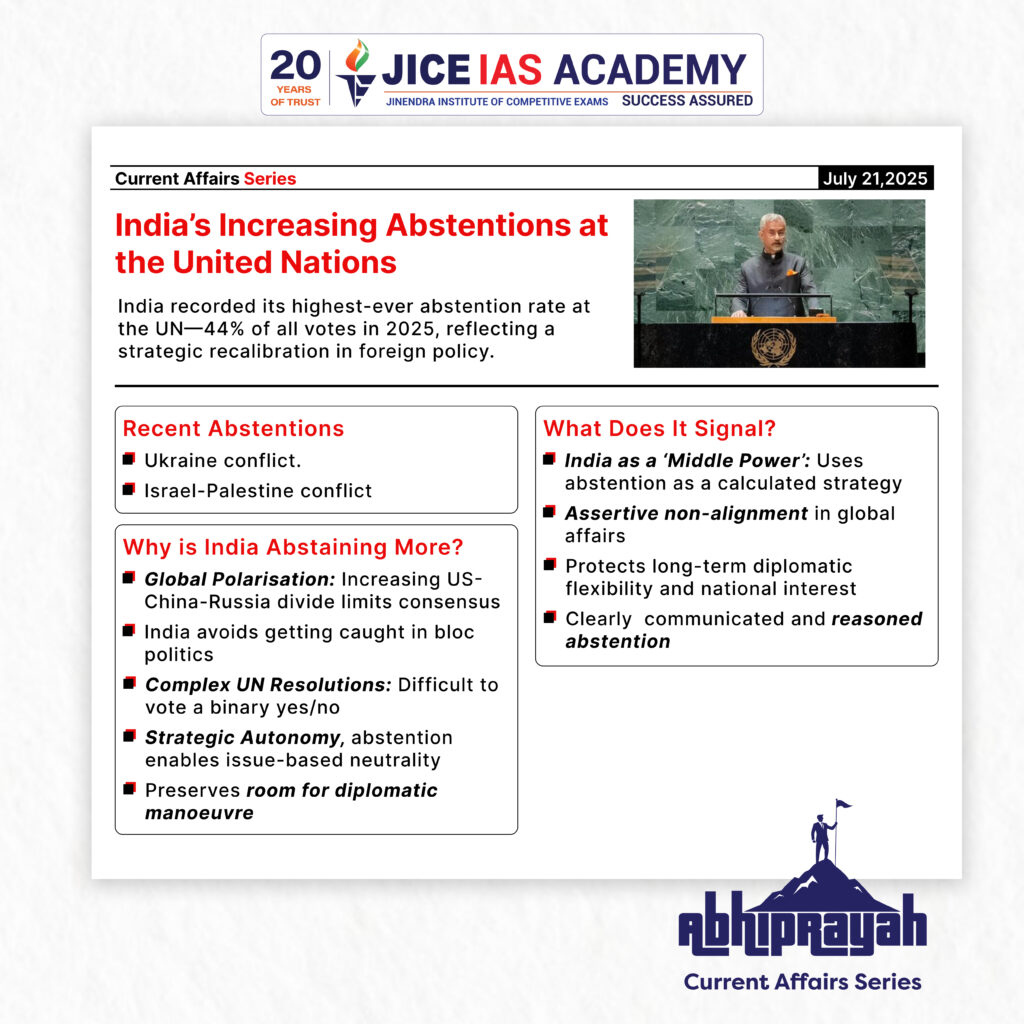
- India’s share of abstentions in U.N. votes reached a record high of 44% in 2025.
Introduction
- India’s voting behavior at the United Nations (U.N.) has undergone a significant transformation in recent years.
- According to an analysis of over 5,500 resolutions voted on by India since 1946, the annual share of ‘yes’ votes has dropped to 56%—the lowest since 1955—while abstentions have reached an all-time high of 44%.
- This shift, especially noticeable since 2019, is indicative of India’s evolving foreign policy approach in a rapidly polarising global environment.
Reasons Behind the Shift
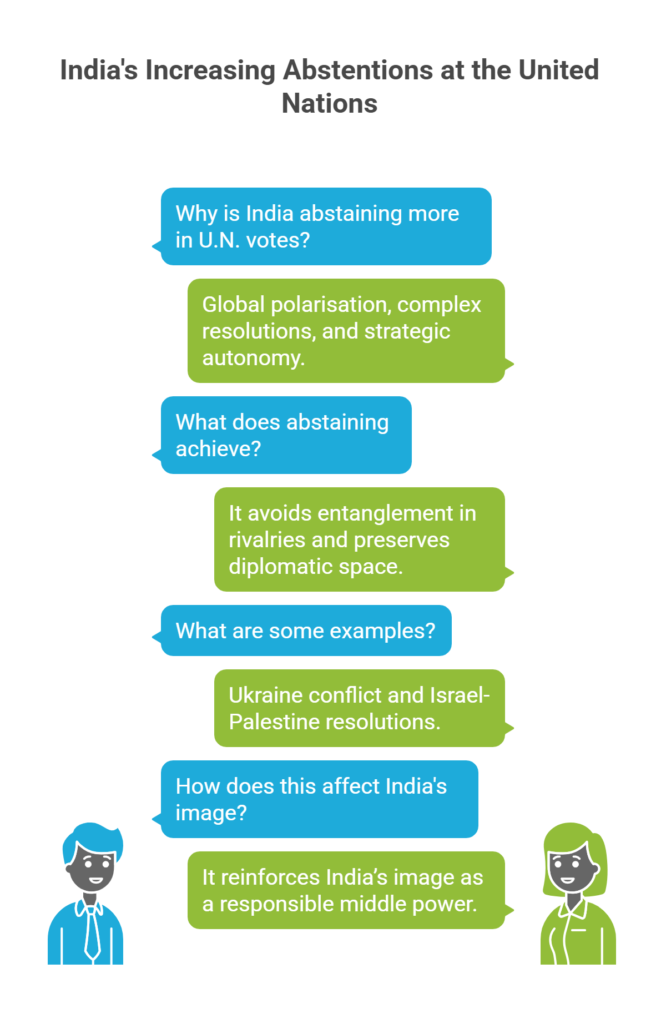
1. Increasing Global Polarisation
- According to T.S. Tirumurti, former Permanent Representative of India to the U.N., the world is witnessing greater polarisation between major powers.
- This reduces the incentive for compromise and consensus-building, making U.N. resolutions more contentious.
2. Complexity of Resolutions
- As per Syed Akbaruddin, another former Indian envoy to the U.N., modern resolutions are “like Christmas trees” — cluttered with multiple, often conflicting, provisions.
- This makes it difficult to offer a binary ‘yes’ or ‘no’ vote, leading India to adopt abstention as a pragmatic option.
3. Strategic Autonomy and Diplomacy
- Abstentions serve as a diplomatic tool allowing India to express nuanced positions without aligning too closely with any geopolitical bloc.
- They enable India to maintain strategic autonomy, especially on sensitive issues like Ukraine, Israel-Palestine, and international sanctions.
Abstentions as a Tool for Middle Powers
- Abstention is not necessarily a sign of indecisiveness. Rather, it is increasingly seen as a deliberate strategy by emerging powers like India to avoid entanglement in great-power rivalries.
- It also provides flexibility in multilateral negotiations and preserves future diplomatic space.
Examples of Recent Abstentions
- Ukraine conflict – India abstained from U.N. resolutions condemning Russia, citing the need for dialogue and de-escalation.
- Israel-Palestine – India abstained from resolutions seen as one-sided, advocating “building bridges” instead.
Implications for India’s Global Image
- While critics may view frequent abstentions as diplomatic fence-sitting, they reflect India’s effort to balance principle with pragmatism.
- This strategy reinforces India’s image as a responsible middle power navigating a fractured international order.
Conclusion
- India’s growing reliance on abstentions at the U.N. underscores its attempt to recalibrate foreign policy in a complex and multipolar world.
- As global tensions deepen, abstentions are becoming a useful diplomatic instrument for expressing independent positions without compromising national interests.
- Understanding this shift is crucial to appreciating India’s evolving role in global governance.

3rd UN conference on landlocked countries
UPSC CURRENT AFFAIRS – 08th August 2025 Home / 3rd UN conference on landlocked countries Why in News? At the

Issue of soapstone mining in Uttarakhand’s Bageshwar
UPSC CURRENT AFFAIRS – 08th August 2025 Home / Issue of soapstone mining in Uttarakhand’s Bageshwar Why in News? Unregulated
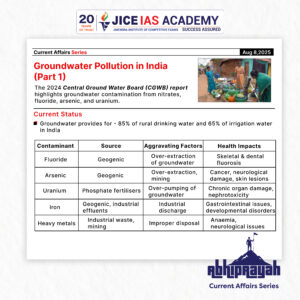
Groundwater Pollution in India – A Silent Public Health Emergency
UPSC CURRENT AFFAIRS – 08th August 2025 Home / Groundwater Pollution in India – A Silent Public Health Emergency Why
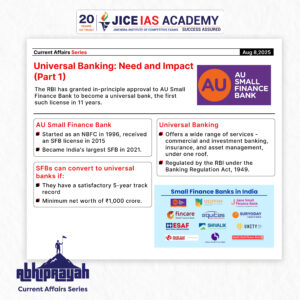
Universal banking- need and impact
UPSC CURRENT AFFAIRS – 08th August 2025 Home / Universal banking- need and impact Why in News? The Reserve Bank

India’s “Goldilocks” Economy: A Critical Appraisal
UPSC CURRENT AFFAIRS – 08th August 2025 Home / India’s “Goldilocks” Economy: A Critical Appraisal Why in News? The Finance
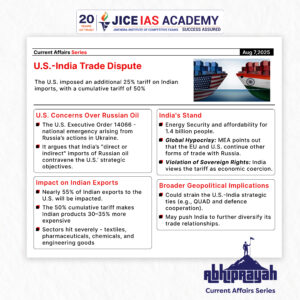
U.S.-India Trade Dispute: Trump’s 50% Tariffs and India’s Oil Imports from Russia
UPSC CURRENT AFFAIRS – 07th August 2025 Home / U.S.-India Trade Dispute: Trump’s 50% Tariffs and India’s Oil Imports from
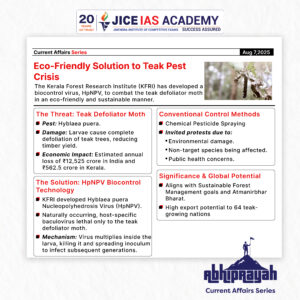
Eco-Friendly Solution to Teak Pest Crisis: KFRI’s HpNPV Technology
UPSC CURRENT AFFAIRS – 07th August 2025 Home / Eco-Friendly Solution to Teak Pest Crisis: KFRI’s HpNPV Technology Why in

New Species of Non-Venomous Rain Snake Discovered in Mizoram
UPSC CURRENT AFFAIRS – 07th August 2025 Home / New Species of Non-Venomous Rain Snake Discovered in Mizoram Why in

Economic Implications
For Indian Exporters
- These reforms reduce transaction costs and compliance hurdles
- Encourage a more competitive and efficient export environment
- Promote value addition in key sectors like leather
For Tamil Nadu
- The reforms particularly benefit the state’s leather industry, a major contributor to employment and exports
- Boost the marketability of GI-tagged E.I. leather, enhancing rural and traditional industries
For Trade Policy
- These decisions indicate a shift from regulatory controls to policy facilitation
Reinforce the goals of Make in India, Atmanirbhar Bharat, and India’s ambition to become a leading export power
Recently, BVR Subrahmanyam, CEO of NITI Aayog, claimed that India has overtaken Japan to become the fourth-largest economy in the world, citing data from the International Monetary Fund (IMF).
India’s rank as the world’s largest economy varies by measure—nominal GDP or purchasing power parity (PPP)—each with key implications for economic analysis.