UPSC CURRENT AFFAIRS – 13th July 2025

Home / UPSC / Current Affairs / India’s boycott of the ruling of Court of Arbitration on Indus Waters Treaty

India’s boycott of the ruling of Court of Arbitration on Indus Waters Treaty

Why in News?

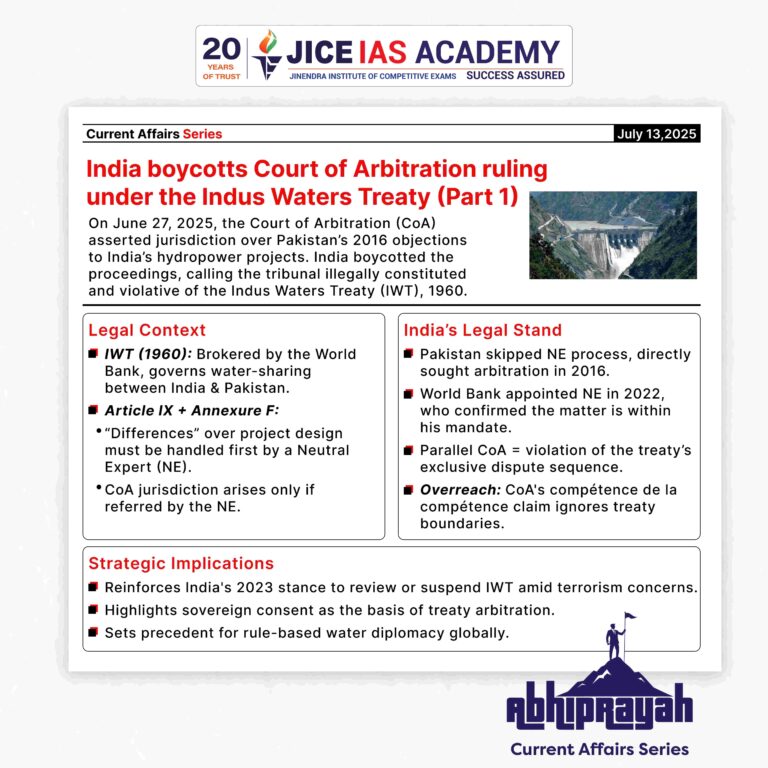
  • The Court of Arbitration (CoA) issued a “supplemental award” on June 27, 2025, asserting its jurisdiction over disputes raised unilaterally by Pakistan in 2016 about India’s hydroelectric projects (HEPs) on Indus basin rivers.
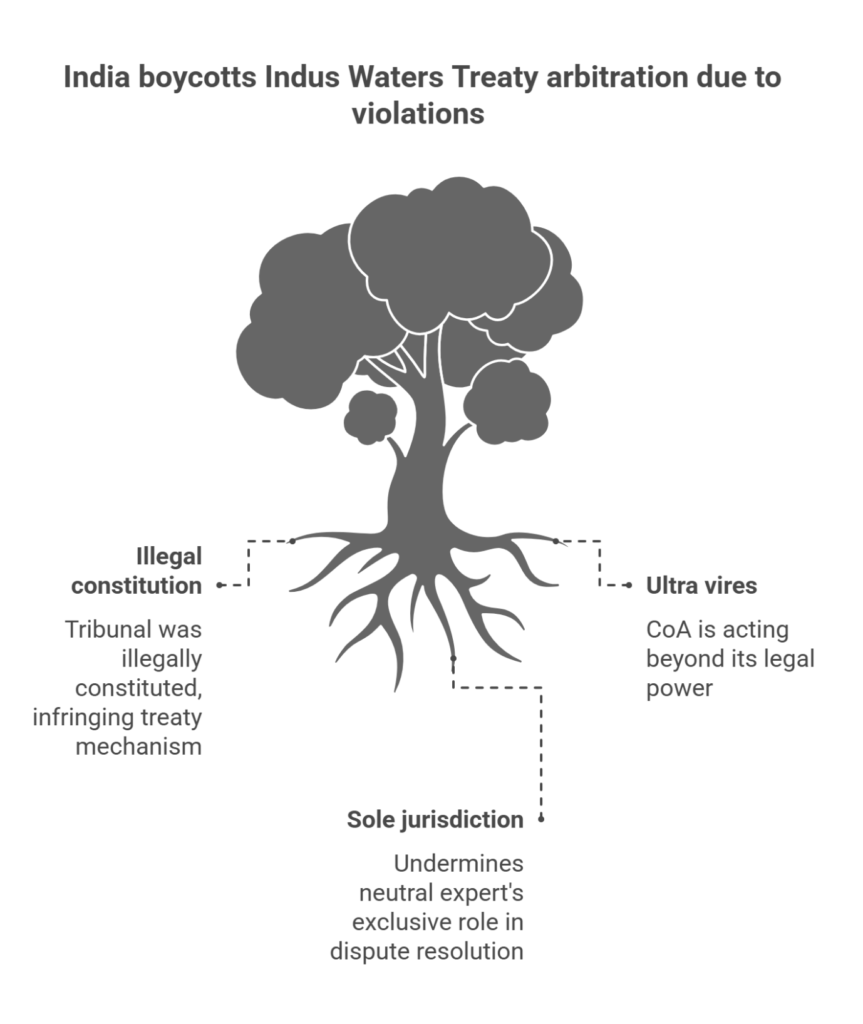
  • India has boycotted the CoA proceedings, arguing that the tribunal is illegally constituted and infringes the dispute resolution mechanism laid down under the Indus Waters Treaty (IWT), 1960.
  • India’s Ministry of External Affairs rejected the ruling, calling it “per se void” as it violates the Treaty’s exclusive mandate for certain disputes to be handled by a neutral expert first.
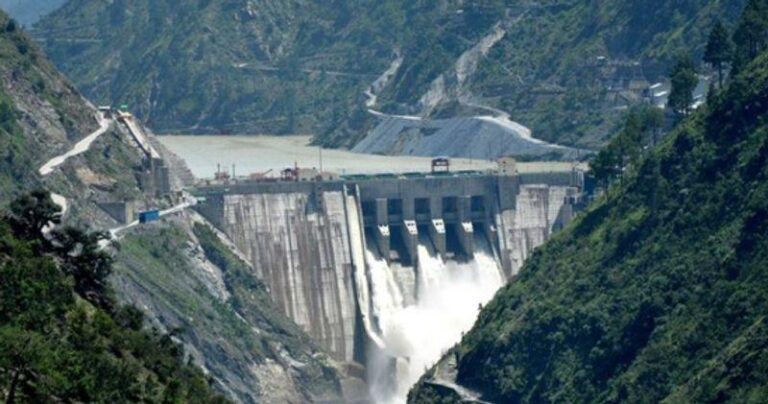
dam nestled between lush green mountains

Background & Treaty Provisions.

  • The IWT (1960), brokered by the World Bank, governs water sharing between India and Pakistan for the Indus River system.
  • Under Article IX (1), any disputes about interpretation or application of the Treaty must first be addressed by the Permanent Indus Commission (PIC).
  • If unresolved, a “difference” arises which must be handled by a neutral expert Appointed by WB for issues listed under Annexure F, Part I — including design and operation of India’s HEPs.
  • Only if the neutral expert refers to the issue for arbitration can a CoA be constituted under Article IX (5) — making the neutral expert’s role exclusive and primary for such technical matters.

India’s Position.

  • India argues that the CoA is ultra vires because the differences Pakistan raised on HEP design must be resolved by the neutral expert alone.
  • Pakistan initially sought a neutral expert but withdrew the request in 2016 and directly filed for arbitration.
  • The World Bank has since appointed a neutral expert (October 2022) who confirmed in January 2023 that the disputes fall within Annexure F’s scope — India is participating in these proceedings.
  • Proceeding with a parallel CoA undermines the sole jurisdiction clause for neutral experts, violating the party autonomy principle that is foundational in any arbitral regime.
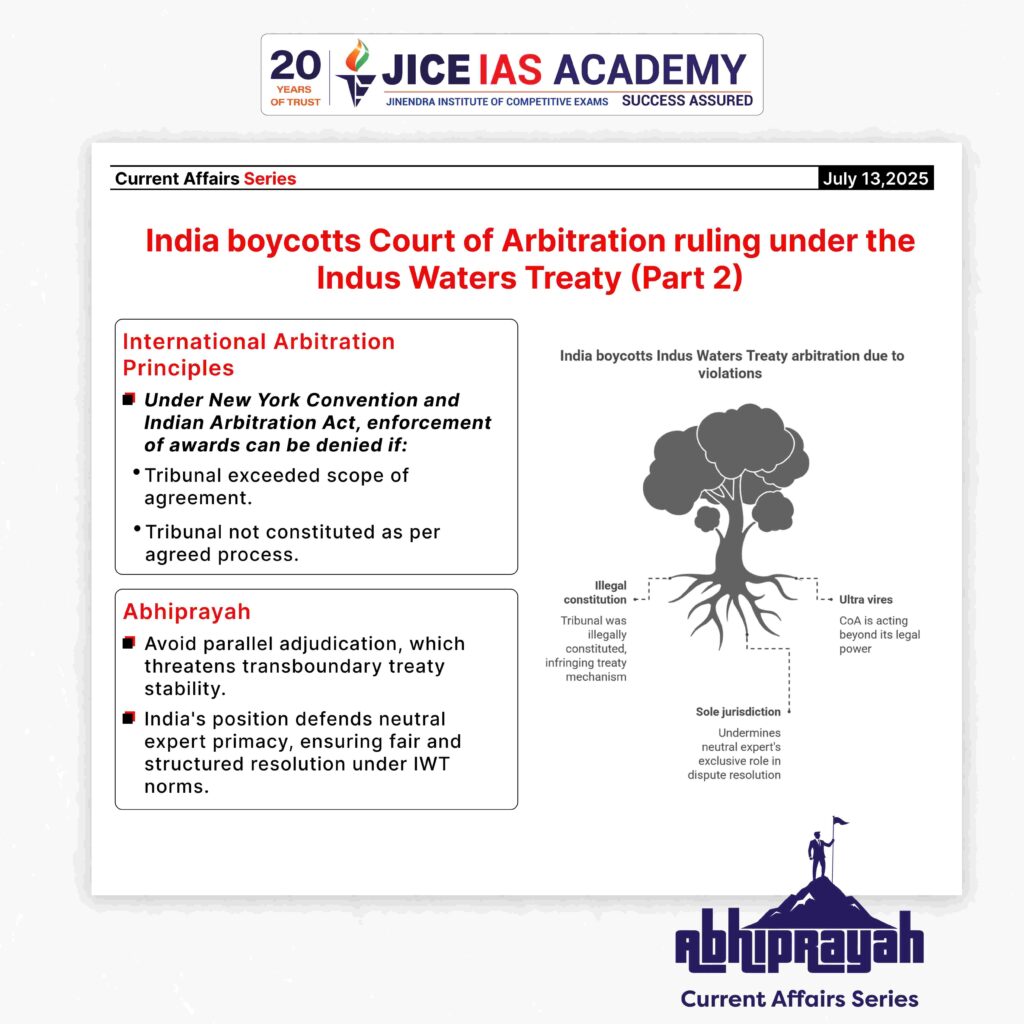
india boycotts court of arbitration ruling under the indus waters treaty

Legal Aspect.

  • Under the New York Convention (NYC) and India’s Arbitration Act, an arbitral award can be refused enforcement if:
    • The award deals with issues beyond the scope of submission to arbitration.
    • The arbitral tribunal was not constituted per the agreement between the parties.
  • India can invoke these grounds if an unfavourable CoA award is ever sought to be enforced internationally.
india boycotts indus waters treaty arbitration due to violations

Implications for India-Pakistan Water Diplomacy.

  • The dispute highlights deeper tensions between treaty obligations and allegations of cross-border terrorism, which India cited as grounds for suspending the IWT in 2023.
  • India’s stand signals that it expects strict adherence to treaty mechanisms and will resist parallel or conflicting dispute resolution paths.
  • The case reiterates the importance of respecting party consent and mutual agreement in international arbitration, a principle that protects state sovereignty in transboundary water governance.

Conclusion

  • India’s boycott underscores that the source of all arbitral competence is party consent, embedded in the treaty text.
  • Circumventing the agreed framework by misusing overlapping jurisdictions threatens the stability of a landmark water-sharing treaty.
  • For India, the legal position preserves its rights under the IWT, upholds the neutral expert’s role, and sets a precedent for rule-based treaty interpretation in other international water or resource-sharing arrangements.

Economic Implications

For Indian Exporters

  • These reforms reduce transaction costs and compliance hurdles
  • Encourage a more competitive and efficient export environment
  • Promote value addition in key sectors like leather

For Tamil Nadu

  • The reforms particularly benefit the state’s leather industry, a major contributor to employment and exports
  • Boost the marketability of GI-tagged E.I. leather, enhancing rural and traditional industries

For Trade Policy

  • These decisions indicate a shift from regulatory controls to policy facilitation

Reinforce the goals of Make in India, Atmanirbhar Bharat, and India’s ambition to become a leading export power

Recently, BVR Subrahmanyam, CEO of NITI Aayog, claimed that India has overtaken Japan to become the fourth-largest economy in the world, citing data from the International Monetary Fund (IMF). 

India’s rank as the world’s largest economy varies by measure—nominal GDP or purchasing power parity (PPP)—each with key implications for economic analysis.

Significance and Applications

Leave a Reply

Your email address will not be published. Required fields are marked *

Call Us Now !

Copyright © JICE ACADEMY FOR EXCELLENCE PRIVATE LIMITED