UPSC CURRENT AFFAIRS – 18th July 2025
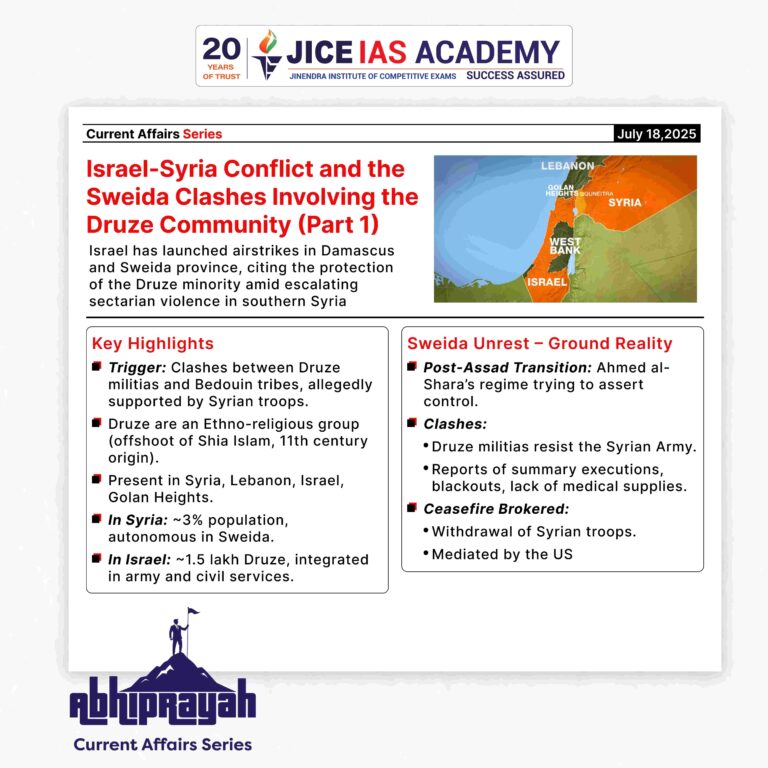
Israel-Syria Conflict and the Sweida Clashes Involving the Druze Community
Why in News?
Israel has launched airstrikes in Syria’s capital and Sweida province, citing the protection of the Druze minority amid escalating sectarian violence in southern Syria.
Introduction
- In a sharp escalation of regional tensions, Israeli fighter jets struck several sites in Syria’s capital, Damascus, including the Syrian Defence Ministry compound and locations near the presidential palace.
- The strikes coincided with fierce clashes in Sweida, a southern Syrian province and the heartland of the Druse minority, highlighting the increasingly complex dynamics post-Assad in Syria.
What Did Israel Hit in Syria?
- Targets: Israeli airstrikes focused on central Damascus, targeting:
- The Syrian Defence Ministry compound and
- General Staff Headquarters, allegedly used for coordinating offensives in Sweida.
- Casualties: At least one civilian was killed and 18 injured, according to the Syrian Health Ministry.
- Eyewitness Accounts: There were reports of chaos and panic during the strikes. A ministry employee confirmed multiple successive attacks, stating that some victims were trapped under rubble.
- Sweida Strikes: Israel also conducted dozens of strikes in Sweida itself, focusing on Syrian military personnel and infrastructure.
Why Is Israel Involved in Sweida?
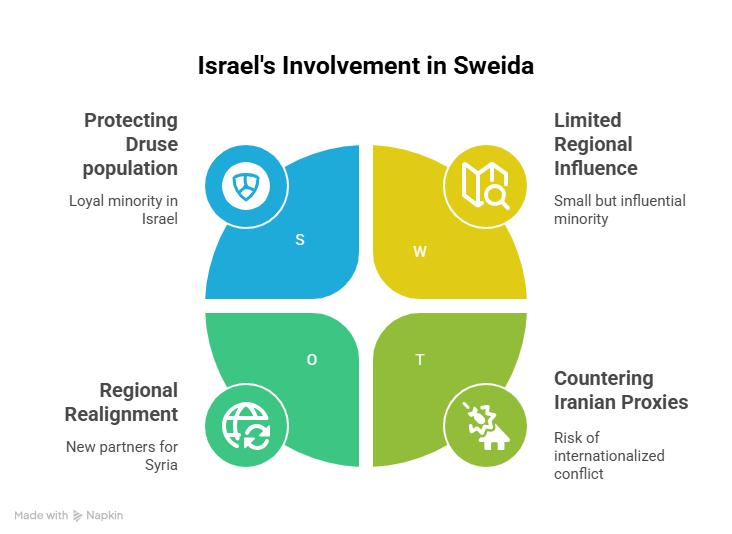
- Protection of Druze Minority: Sweida is the cultural and political center of Syria’s Druze minority. Israel has a significant Druze population (~152,000), many of whom serve in the Israeli military.
- Recent Trigger: Clashes began when Bedouin tribesmen attacked a Druze man, prompting unrest. Syrian government troops moved in, allegedly supporting the Bedouins.
- Israel’s Position:
- Prime Minister Benjamin Netanyahu said Israel is acting to “protect our Druze brothers”.
- Urged Israeli Druze not to cross into Syria to join the fighting.
Who are the Druze?
- Religious Identity: The Druze are an Arabic-speaking, ethno-religious community, whose faith emerged in the 11th century as an offshoot of Shia Islam. It incorporates elements of Gnosticism, Greek philosophy, and Islamic monotheism.
- Geographical Spread: Roughly one million Druze live across Syria, Lebanon, Israel, and the Golan Heights.
- In Syria: Comprising about 3% of the population, Druze communities have historically maintained autonomy, especially in Sweida, resisting both the Assad regime and Islamist rebels.
- In Israel: Druze are recognized as a loyal minority, integrated into the army and public service, unlike many other Arab citizens.
The Political Context in Syria
- Change in Leadership: President Ahmed al-Shara assumed power in December 2024, after overthrowing Bashar al-Assad, who was closely aligned with Iran.
- New Government’s Agenda:
- Aims to reassert state control over fragmented provinces.
- Faces resistance in Sweida where Druze militias have enjoyed de facto autonomy for over a decade.
- Rebel Connections: Some anti-Assad rebels who supported al-Shara are now reportedly in contact with Israel, facilitated by the United States.
What's Happening in Sweida?
- Widespread Conflict:
- Ongoing battles between Druze militias and Bedoun fighters and Syrian troops.
- Reports of summary executions of Druze civilians by government forces.
- Humanitarian crisis: hospitals lack medical supplies, and blackouts affect communication and healthcare.
- Ceasefire Announced:
- A new ceasefire was brokered with local leaders.
- Involves:
- Immediate cessation of hostilities
- Withdrawal of Syrian government forces
- Restoration of state authority in a negotiated form
- US Involvement: Secretary of State Marco Rubio stated the US helped mediate the truce.
Strategic and Geopolitical Implications
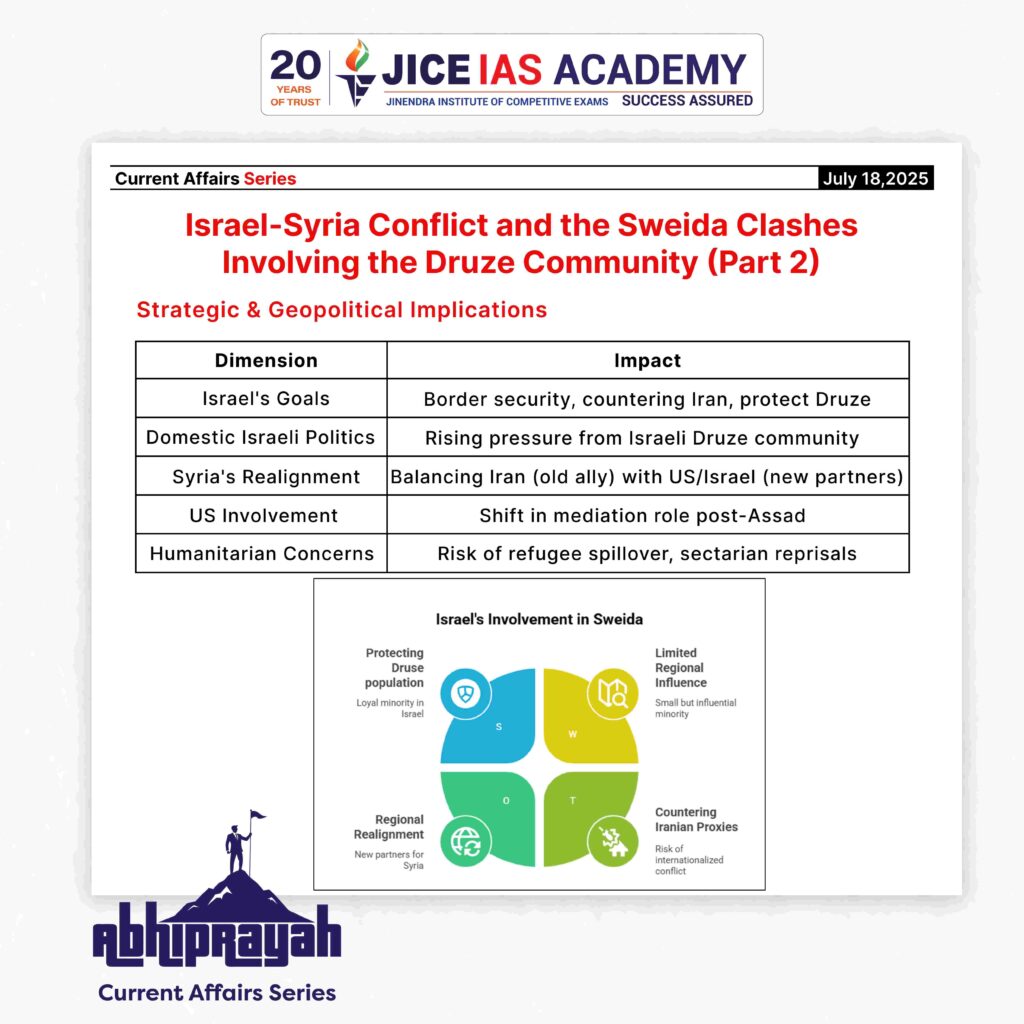
- Israel’s Strategic Goals:
- Counter Iranian proxies in Syria.
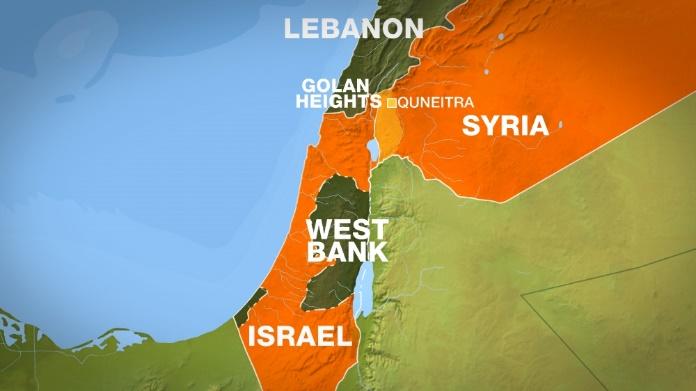
- Secure the northern border and Golan Heights.
- Protect ethnic kin minorities, especially Druse.
- Domestic Pressure in Israel:
- Growing solidarity movements among Israeli Druze.
- Calls for more direct protection of Syrian Druze.
- Regional Realignments:
- Syria’s new regime is attempting to balance between past allies (like Iran) and new partners (like the US and possibly Israel).
- US mediation signals a geopolitical shift in Syria’s post-Assad realignment.
- Humanitarian Fallout:
- Potential refugee outflows from Sweida.
- Risk of sectarian reprisals and internationalized civil conflict.
Conclusion
- The recent Israeli airstrikes and ongoing unrest in Sweida reflect a deeply complex and evolving regional crisis rooted in sectarian identity, post-conflict reconstruction, and strategic rivalry.
- The Druze community stands at the heart of this conflict — a small but influential minority trying to preserve autonomy in a collapsing state structure.
- As Syria rebuilds under a new leadership, its ability to accommodate diverse ethnic identities and manage foreign pressures will determine the country’s trajectory.

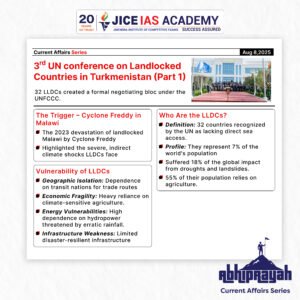
3rd UN conference on landlocked countries
UPSC CURRENT AFFAIRS – 08th August 2025 Home / 3rd UN conference on landlocked countries Why in News? At the
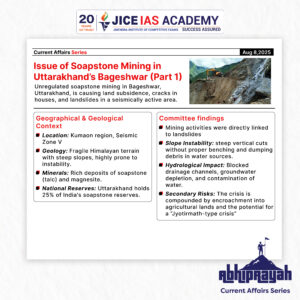
Issue of soapstone mining in Uttarakhand’s Bageshwar
UPSC CURRENT AFFAIRS – 08th August 2025 Home / Issue of soapstone mining in Uttarakhand’s Bageshwar Why in News? Unregulated

Groundwater Pollution in India – A Silent Public Health Emergency
UPSC CURRENT AFFAIRS – 08th August 2025 Home / Groundwater Pollution in India – A Silent Public Health Emergency Why
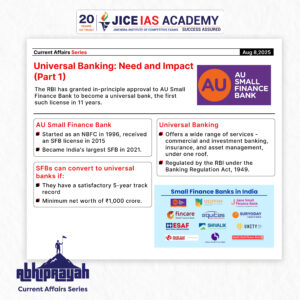
Universal banking- need and impact
UPSC CURRENT AFFAIRS – 08th August 2025 Home / Universal banking- need and impact Why in News? The Reserve Bank
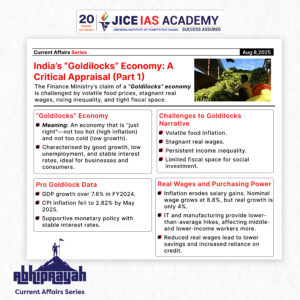
India’s “Goldilocks” Economy: A Critical Appraisal
UPSC CURRENT AFFAIRS – 08th August 2025 Home / India’s “Goldilocks” Economy: A Critical Appraisal Why in News? The Finance
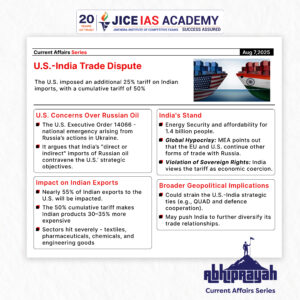
U.S.-India Trade Dispute: Trump’s 50% Tariffs and India’s Oil Imports from Russia
UPSC CURRENT AFFAIRS – 07th August 2025 Home / U.S.-India Trade Dispute: Trump’s 50% Tariffs and India’s Oil Imports from
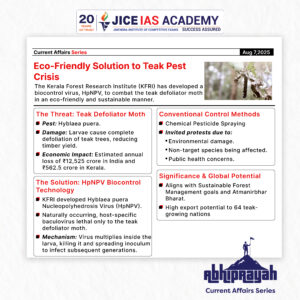
Eco-Friendly Solution to Teak Pest Crisis: KFRI’s HpNPV Technology
UPSC CURRENT AFFAIRS – 07th August 2025 Home / Eco-Friendly Solution to Teak Pest Crisis: KFRI’s HpNPV Technology Why in

New Species of Non-Venomous Rain Snake Discovered in Mizoram
UPSC CURRENT AFFAIRS – 07th August 2025 Home / New Species of Non-Venomous Rain Snake Discovered in Mizoram Why in

Economic Implications
For Indian Exporters
- These reforms reduce transaction costs and compliance hurdles
- Encourage a more competitive and efficient export environment
- Promote value addition in key sectors like leather
For Tamil Nadu
- The reforms particularly benefit the state’s leather industry, a major contributor to employment and exports
- Boost the marketability of GI-tagged E.I. leather, enhancing rural and traditional industries
For Trade Policy
- These decisions indicate a shift from regulatory controls to policy facilitation
Reinforce the goals of Make in India, Atmanirbhar Bharat, and India’s ambition to become a leading export power
Recently, BVR Subrahmanyam, CEO of NITI Aayog, claimed that India has overtaken Japan to become the fourth-largest economy in the world, citing data from the International Monetary Fund (IMF).
India’s rank as the world’s largest economy varies by measure—nominal GDP or purchasing power parity (PPP)—each with key implications for economic analysis.