UPSC CURRENT AFFAIRS – 13th July 2025

Home / UPSC / Current Affairs / Cambodian Sites of Khmer Rouge Brutality Added to UNESCO World Heritage List

Cambodian Sites of Khmer Rouge Brutality Added to UNESCO World Heritage List

current affairs document khmer rouge genocide sites get unesco world heritage status

Why in News?

  • On July 11, 2025, UNESCO inscribed three sites associated with the Khmer Rouge regime onto its World Heritage List during the 47th Session of the World Heritage Committee in Paris.
  • This coincides with the 50th anniversary of the Khmer Rouge’s rise to power in 1975, which led to one of the worst genocides of the 20th century.
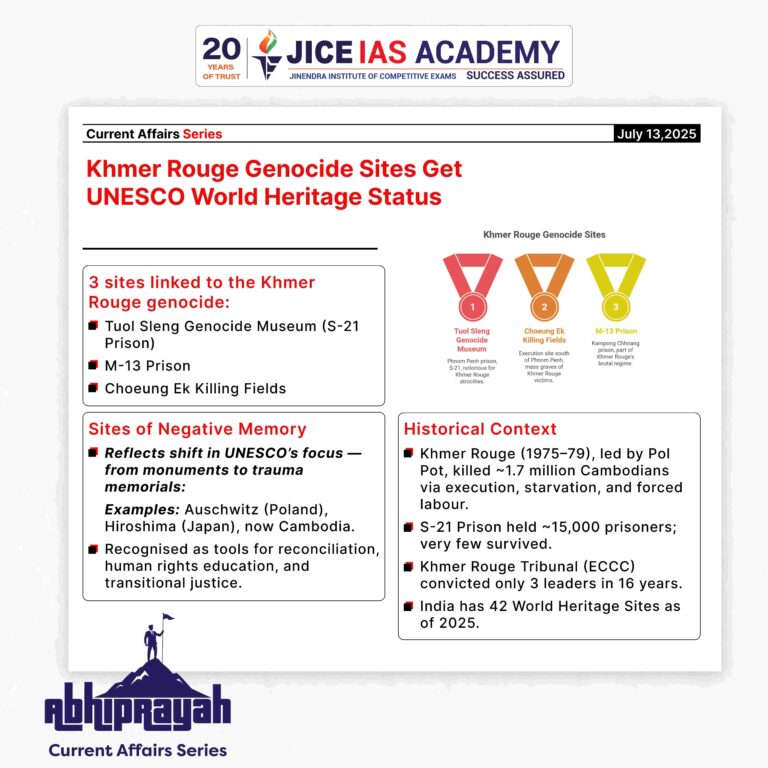
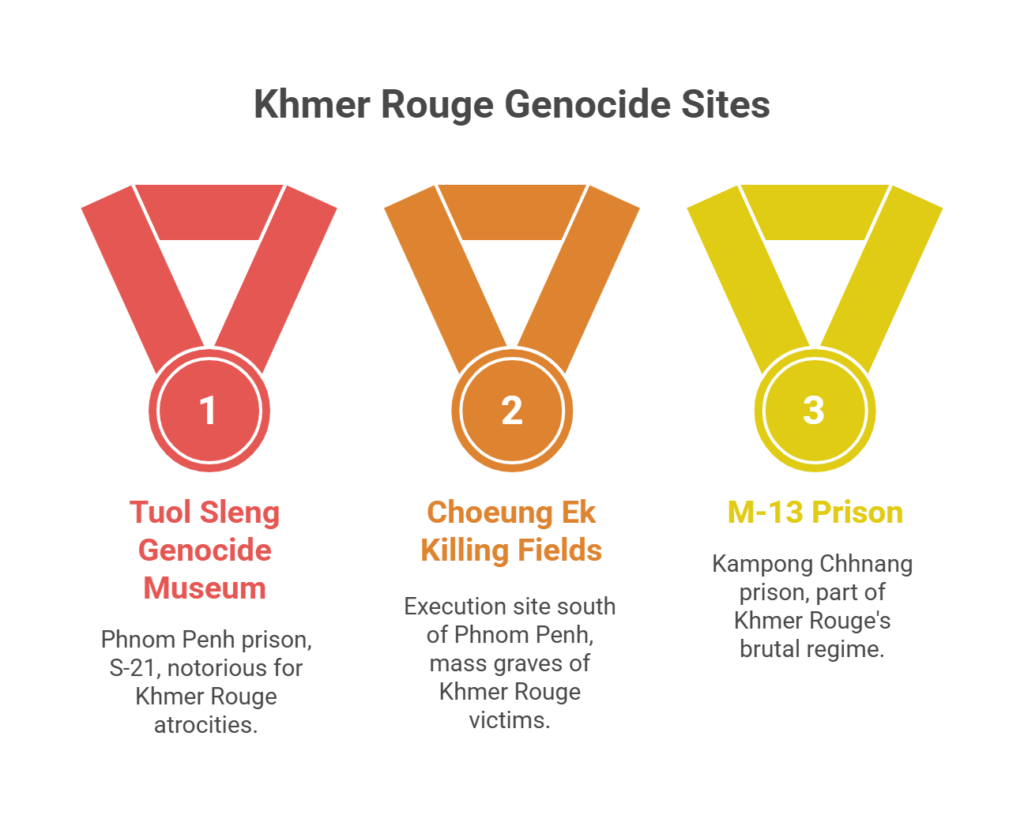
  • The three sites include:
    • Tuol Sleng Genocide Museum (S-21 Prison) in Phnom Penh.
    • M-13 Prison in Kampong Chhnang province.
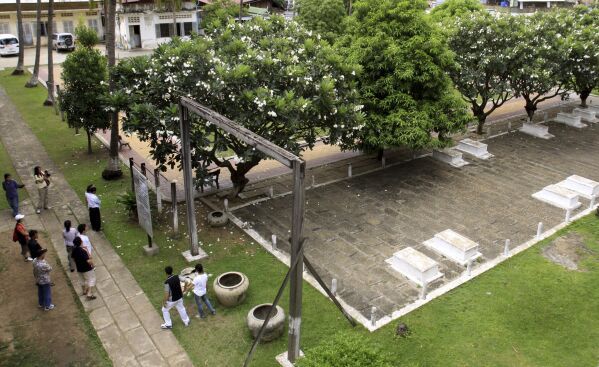
    • Choeung Ek Killing Fields, an execution site south of the capital.
a group of tourists at choeung ek genocidal center

Historical Context.

  • The Khmer Rouge, led by Pol Pot, ruled Cambodia from 1975 to 1979, enforcing radical communist policies that resulted in an estimated 1.7 million deaths due to starvation, forced labour, torture, and execution.
  • Tuol Sleng, originally a high school, became the regime’s most notorious prison (S-21), where about 15,000 people were imprisoned; very few survived.
  • Choeung Ek gained international attention through the film “The Killing Fields”, based on the experiences of journalist Dith Pran.
  • The regime fell to a Vietnamese invasion in 1979, but the legacy of genocide continues to affect Cambodia’s collective memory.
  • The Khmer Rouge Tribunal (Extraordinary Chambers in the Courts of Cambodia, ECCC) was established with UN support but convicted only three leaders in 16 years.
cambodia journey through khmer rouge history

Relevant Concepts.

World Heritage Sites:

  • The UNESCO World Heritage Convention (1972) provides the legal framework for the identification, protection, and preservation of cultural and natural heritage of “outstanding universal value” (OUV).
  • Sites must meet at least one of the ten cultural or natural criteria to qualify. Examples include the Taj Mahal (India), Angkor Wat (Cambodia), and the Great Wall of China.
  • Once inscribed, the site’s conservation becomes the shared responsibility of the global community.

Sites of Negative History (‘Memory and Conscience’):

  • Traditionally, World Heritage focused on monuments, architecture, and biodiversity. Now, UNESCO increasingly recognises sites linked to traumatic or violent histories — like genocide memorials, former concentration camps, or prisons.
  • These sites act as spaces for collective memory, education, and reconciliation, ensuring future generations learn lessons from past atrocities.
  • Examples include Auschwitz-Birkenau (Poland), Hiroshima Peace Memorial (Japan), and now the Khmer Rouge genocide sites in Cambodia.

Cambodia’s New Nomination:

  • Cambodia’s listing of the Tuol Sleng Genocide Museum, M-13 Prison, and Choeung Ek Killing Fields is its first World Heritage nomination focused on modern, non-classical history.
  • This expands the idea of heritage to include painful chapters, shifting focus from ancient archaeological marvels like Angkor or Preah Vihear to difficult memories from the 20th century.
  • It reflects how heritage can promote healing, accountability, and inter-generational dialogue about human rights abuses.
khmer rouge genocide sites

International Legal & Organisational Aspect.

UNESCO World Heritage Committee:

  • The Committee is the operational body under the World Heritage Convention. It decides which sites get inscribed, monitors the conservation status, and can even place sites on the List of World Heritage in Danger.
  • India ratified the Convention in 1977 and currently has 42 World Heritage Sites (as of 2025), showing its strong engagement with UNESCO processes.
  • The Committee works with two key advisory bodies: ICOMOS (International Council on Monuments and Sites) for cultural heritage, and IUCN (International Union for Conservation of Nature) for natural sites.

Extraordinary Chambers in the Courts of Cambodia (ECCC):

  • Also called the Khmer Rouge Tribunal, the ECCC is a hybrid court with both Cambodian and international judges and prosecutors.
  • Established in 2003 with UN support, its mandate was to prosecute senior Khmer Rouge leaders for genocide, crimes against humanity, and war crimes.
  • Despite convicting only three senior leaders over 16 years, it set precedents in international criminal law and transitional justice.

Impact of World Heritage Status:

  • Inscription provides legal protection under international conventions and often mobilises global funding for conservation, museum development, and heritage education.
  • It can boost heritage tourism but must be balanced with respect for the site’s sensitive nature — especially for sites of suffering and atrocity.
  • For communities, such status can reinforce local and national identity, build resilience, and keep alive stories that might otherwise be forgotten.

Conclusion

Inscribing the Khmer Rouge sites is important for transitional justice, collective memory, and educating future generations about the genocide.

  • The sites serve as reminders that peace must always be safeguarded — echoing Cambodian PM Hun Manet’s message: “From the darkest chapters of history, we can draw strength to build a better future for humanity.”
  • For Cambodia, the inscription symbolises a step toward healing, preserving evidence of atrocities, and educating young Cambodians who did not witness that era.
  • Globally, it reflects the evolving role of cultural heritage — recognising not only artistic and architectural achievements but also humanity’s capacity for violence and the lessons it holds for all societies.

Economic Implications

For Indian Exporters

  • These reforms reduce transaction costs and compliance hurdles
  • Encourage a more competitive and efficient export environment
  • Promote value addition in key sectors like leather

For Tamil Nadu

  • The reforms particularly benefit the state’s leather industry, a major contributor to employment and exports
  • Boost the marketability of GI-tagged E.I. leather, enhancing rural and traditional industries

For Trade Policy

  • These decisions indicate a shift from regulatory controls to policy facilitation

Reinforce the goals of Make in India, Atmanirbhar Bharat, and India’s ambition to become a leading export power

Recently, BVR Subrahmanyam, CEO of NITI Aayog, claimed that India has overtaken Japan to become the fourth-largest economy in the world, citing data from the International Monetary Fund (IMF). 

India’s rank as the world’s largest economy varies by measure—nominal GDP or purchasing power parity (PPP)—each with key implications for economic analysis.

Significance and Applications

Leave a Reply

Your email address will not be published. Required fields are marked *

Call Us Now !

Copyright © JICE ACADEMY FOR EXCELLENCE PRIVATE LIMITED