UPSC CURRENT AFFAIRS – 4th June 2025

Home / UPSC / Current Affairs / Ladakh Notifies New Policies on Reservation and Domicile Status

Ladakh Notifies New Policies on Reservation and Domicile Status

ladakh

Why in News?

Recently, the Union Government notified a set of four new regulations for the Union Territory of Ladakh.

Introduction

  • In response to growing demands from Ladakhi civil society groups for constitutional safeguards following the revocation of Article 370 in August 2019, the Union Government on June 3, 2025, notified a set of regulations concerning reservation policy, domicile status, recruitment rules, composition of hill councils, and official languages in the Union Territory of Ladakh. 
  • These notifications mark the most comprehensive administrative framework introduced in Ladakh since its creation as a separate UT.

Key Notifications Issued:

The following regulations were notified by the President of India:

  1. Ladakh Reservation (Amendment) Regulation, 2025
  2. Ladakh Civil Services Decentralisation and Recruitment (Amendment) Regulation, 2025
  3. Ladakh Official Languages Regulation, 2025
  4. Ladakh Autonomous Hill Development Councils (Amendment) Regulation, 2025
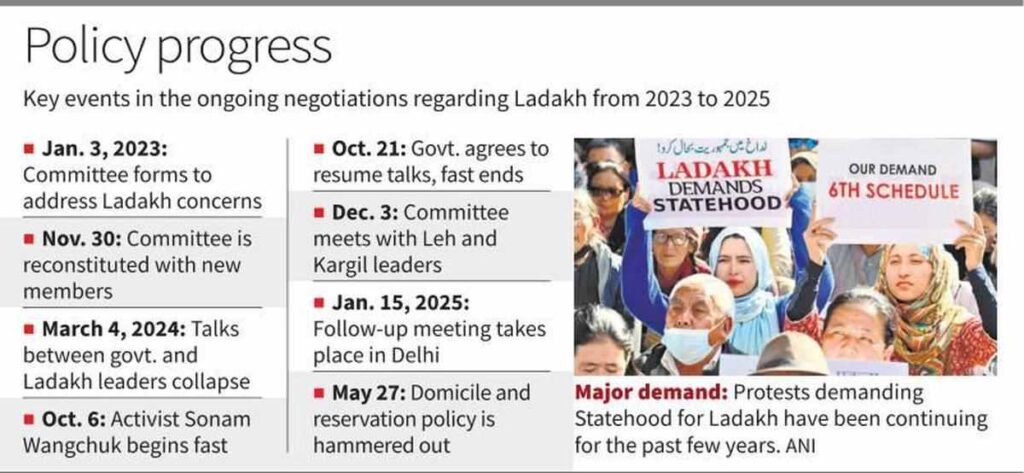
ladakh policy progress

Reservation Policy in Government Employment:

  • The Union Territory of Ladakh has raised the reservation quota in government employment to 85% for resident Ladakhis.
  • With an additional 10% reservation for the Economically Weaker Sections (EWS), the total reservation now stands at 95%, among the highest in the country.
  • This amends the earlier cap of 50% as per the Jammu and Kashmir Reservation Act, 2004.
  • While the official category-wise breakdown is awaited through Rules, preliminary details discussed with local leaders include:
    • 80% for Scheduled Tribes (STs)
    • 4% for residents along the Line of Actual Control (LAC) or Line of Control (LoC)
    • 1% for Scheduled Castes (SCs)
    • 10% for Economically Weaker Sections (EWS)

According to the 2011 Census, approximately 80% of Ladakh’s 2.74 lakh population is classified as tribal, justifying the high proportion reserved for STs.

Domicile Policy:

The domicile policy is governed by amendments to the Jammu and Kashmir Civil Services Decentralisation and Recruitment Act, 2010, as applicable to Ladakh.

To qualify as a domicile of Ladakh for the purposes of government recruitment:

  • A person must have resided continuously for 15 years in Ladakh since October 31, 2019, which is the date Ladakh was established as a Union Territory.
  • Alternatively, those who have studied in Ladakh for at least 7 years and appeared in Class 10 or Class 12 board examinations there are also eligible.
  • Children of Central government employees, All India Services officers, employees of public sector undertakings and autonomous bodies, and public sector bank officials who have served in Ladakh for 10 years since October 31, 2019, are also eligible.

The Tehsildar of the concerned area is the designated authority to issue domicile certificates.

Reservation for Women in Hill Councils:

The amendment to the Ladakh Autonomous Hill Development Councils Act, 1997 provides for:

  • Reservation of not less than one-third of the total number of seats in each hill council for women.
  • These reserved seats will be rotated among different territorial constituencies in successive elections.
  • This reform aims to increase political participation and representation of women in local governance.

Official Language Policy:

Under the Ladakh Official Languages Regulation, 2025, the following languages are declared as official languages of the Union Territory:

  • English
  • Hindi
  • Urdu
  • Bhoti
  • Purgi

In addition, institutional mechanisms will make special efforts to promote and develop other native languages of Ladakh, including:

  • Shina (Dardic)
  • Brokskat (Dardic)
  • Balti
  • Ladakhi

This move reflects cultural sensitivity and linguistic inclusiveness in Ladakh’s governance framework.

Background and Civil Society Demands:

Following the reading down of Article 370 and the creation of Ladakh as a separate Union Territory in August 2019, initial jubilation gave way to concerns regarding the preservation of local identity, land rights, and employment opportunities.

Prominent regional bodies such as the Leh Apex Body (LAB) and the Kargil Democratic Alliance (KDA) led mass protests and shutdowns to press for the following demands:

  1. Statehood for Ladakh
  2. Inclusion of Ladakh in the Sixth Schedule of the Constitution to grant special protections for tribal areas
  3. Job reservations for locals
  4. Separate Lok Sabha seats for Leh and Kargil

In January 2023, the Ministry of Home Affairs constituted a High-Powered Committee headed by the Minister of State for Home, Nityanand Rai, to deliberate on these issues. The committee last met on May 27, 2025, and subsequently met with Home Minister Amit Shah.

Significance of the Notifications:

  • These policy changes address longstanding regional aspirations for protection of employment, land, and cultural rights.
  • By institutionalising high reservation quotas, domicile rules, and language promotion, the government aims to ensure the socio-economic empowerment of Ladakhis.
  • The inclusion of rotational reservation for women in hill councils is a notable step toward gender-inclusive governance.
  • The move balances national integration with local autonomy, particularly in a strategically sensitive region bordering China and Pakistan.

Challenges and Way Forward:

  • While job and domicile concerns have been addressed, the demand for Statehood and inclusion in the Sixth Schedule remains unfulfilled.
  • The success of the new regulations will depend on efficient rule-making, transparency in implementation, and institutional capacity-building at the UT level.
  • Regular consultations with local stakeholders will be critical to sustain peace, trust, and governance in the region.

Economic Implications

For Indian Exporters

  • These reforms reduce transaction costs and compliance hurdles
  • Encourage a more competitive and efficient export environment
  • Promote value addition in key sectors like leather

For Tamil Nadu

  • The reforms particularly benefit the state’s leather industry, a major contributor to employment and exports
  • Boost the marketability of GI-tagged E.I. leather, enhancing rural and traditional industries

For Trade Policy

  • These decisions indicate a shift from regulatory controls to policy facilitation

Reinforce the goals of Make in India, Atmanirbhar Bharat, and India’s ambition to become a leading export power

Recently, BVR Subrahmanyam, CEO of NITI Aayog, claimed that India has overtaken Japan to become the fourth-largest economy in the world, citing data from the International Monetary Fund (IMF). 

India’s rank as the world’s largest economy varies by measure—nominal GDP or purchasing power parity (PPP)—each with key implications for economic analysis.

Significance and Applications

Leave a Reply

Your email address will not be published. Required fields are marked *

Call Us Now !

Copyright © JICE ACADEMY FOR EXCELLENCE PRIVATE LIMITED