UPSC CURRENT AFFAIRS – 12th July 2025

Home / UPSC / Current Affairs / Maratha Military Landscapes of India Inscribed in the UNESCO World Heritage List (2025)

Maratha Military Landscapes of India Inscribed in the UNESCO World Heritage List (2025)

current affairs document maratha military landscapes inscribed as india 44th unesco world heritage site

Why in News?

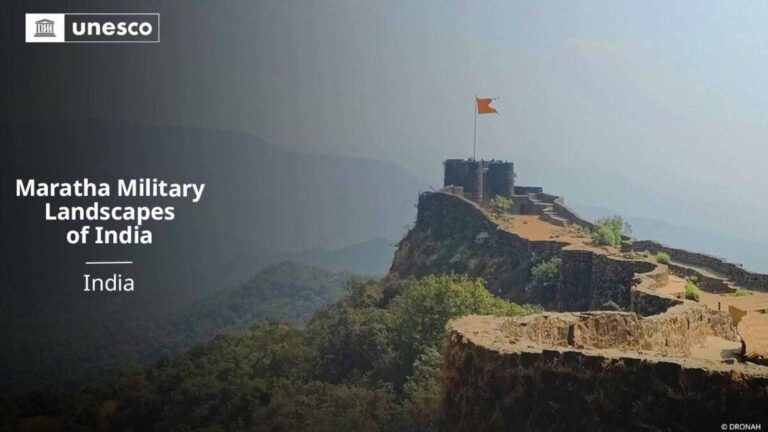
  • The Maratha Military Landscapes of India were inscribed as India’s 44th UNESCO World Heritage Site in July 2025, recognizing their strategic and architectural significance from the 17th–19th centuries.
maratha military landscapes of india

Introduction

  • The Maratha Military Landscapes of India were inscribed into the UNESCO World Heritage List during the 47th session of the World Heritage Committee held in Paris, France. 
  • This became India’s 44th entry on the list and highlights the global recognition of India’s cultural and architectural heritage.

World Heritage List: Overview

The World Heritage List is maintained by UNESCO under the World Heritage Convention, 1972. Its purpose is to identify and protect cultural, natural, and mixed properties of Outstanding Universal Value (OUV) to humanity.

  • India ratified the Convention in 1977.
  • Each member state is allowed to nominate one site per year for inscription.
  • India is a member of the World Heritage Committee for the term 2021–2025.
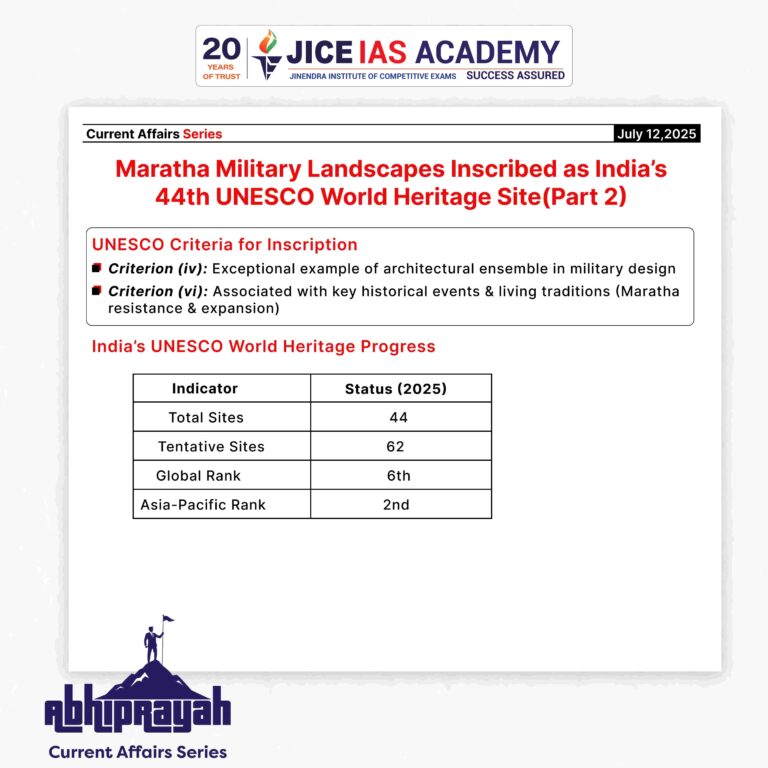
  • As of 2025, India ranks sixth globally and second in the Asia-Pacific region in terms of the number of inscribed sites.
maratha military landscapes inscribed as india 44th unesco world heritage site

Historical Background

  • The Maratha Military Landscapes comprise a network of twelve forts that represent the military vision, architectural ingenuity, and administrative capabilities of the Maratha Empire, which rose to prominence during the 17th to 19th centuries CE.
  • These forts exemplify the Maratha Empire’s ability to strategically harness local geography for defense, surveillance, and regional control. The military landscapes collectively narrate a significant chapter in the history of pre-colonial India.

List of Forts and Geographical Classification

Fort Name

State

Classification/Type of fortifications

Salher

Maharashtra

Hill Fort

Shivneri

Maharashtra

Hill Fort

Lohgad

Maharashtra

Hill Fort

Khanderi

Maharashtra

Island Fort

Raigad

Maharashtra

Hill Fort

Rajgad

Maharashtra

Hill Fort

Pratapgad

Maharashtra

Hill-Forest Fort

Suvarnadurg

Maharashtra

Island Fort

Panhala

Maharashtra

Hill-Plateau Fort

Vijaydurg

Maharashtra

Coastal Fort

Sindhudurg

Maharashtra

Island Fort

Gingee

Tamil Nadu

Hill Fort

These forts are located across a variety of terrains including hills, plateaus, coastal areas, islands, and forested regions. They reflect a deep understanding of military strategy, defensive planning, and resource management.

Types of Fortifications

  • Hill Forts: Salher, Shivneri, Lohgad, Raigad, Rajgad, and Gingee
  • Hill-Forest Fort: Pratapgad
  • Hill-Plateau Fort: Panhala
  • Coastal Fort: Vijaydurg
  • Island Forts: Khanderi, Suvarnadurg, Sindhudurg

Heritage Status and Protection

  • The Archaeological Survey of India (ASI) protects eight of the twelve forts: Shivneri, Lohgad, Raigad, Suvarnadurg, Panhala, Vijaydurg, Sindhudurg, and Gingee.
  • The Directorate of Archaeology and Museums, Government of Maharashtra, protects the remaining four: Salher, Rajgad, Khanderi, and Pratapgad.

UNESCO Recognition: Criteria for Inscription

The site was inscribed under the following criteria:

  • Criterion (iv): Recognizes an outstanding example of a type of building or architectural ensemble that illustrates a significant stage in human history.
  • Criterion (vi): Acknowledges the site’s direct association with events, living traditions, and historical developments of universal significance.

The Maratha forts were selected for their representation of a living cultural tradition, their technological and strategic ingenuity, and their association with major historical events, particularly those related to the Maratha resistance and expansion under Chhatrapati Shivaji Maharaj and his successors. During the 47th session of the World Heritage Committee, 18 out of 20 State Parties supported the nomination.

Significance of the Inscription

  1. Cultural Recognition: The inscription affirms the cultural, historical, and architectural significance of the Maratha legacy on a global platform.
  2. Boost to Heritage Tourism: The inclusion in the UNESCO list is likely to attract greater tourism, generate employment, and promote local economies.
  3. Preservation and Conservation: Enhanced global recognition helps secure funding and expert support for long-term conservation.
  4. International Prestige: Strengthens India’s profile as a custodian of global heritage and cultural diversity.
  5. Academic and Public Awareness: Encourages further study, documentation, and dissemination of Maratha history and military strategy.

India’s World Heritage Progress

Category

Number (2025)

Total World Heritage Sites

44

Tentative List Sites

62

Global Rank

6th

Asia-Pacific Rank

2nd

Recent Additions to the World Heritage List

Year

Site

State

2024

Moidams of Charaideo

Assam

2025

Maratha Military Landscapes

Maharashtra and Tamil Nadu

Institutional Roles and Responsibilities

  • Archaeological Survey of India (ASI) is the nodal agency for all World Heritage-related matters in India. It is responsible for the identification, protection, conservation, and management of cultural heritage sites, including sites nominated for the UNESCO World Heritage List.
  • UNESCO (United Nations Educational, Scientific and Cultural Organization) oversees the World Heritage Convention (1972). Its advisory bodies — such as ICOMOS (International Council on Monuments and Sites) and IUCN (International Union for Conservation of Nature) — provide technical evaluations, recommend sites for inscription, and monitor the conservation status of World Heritage properties worldwide.

Economic Implications

For Indian Exporters

  • These reforms reduce transaction costs and compliance hurdles
  • Encourage a more competitive and efficient export environment
  • Promote value addition in key sectors like leather

For Tamil Nadu

  • The reforms particularly benefit the state’s leather industry, a major contributor to employment and exports
  • Boost the marketability of GI-tagged E.I. leather, enhancing rural and traditional industries

For Trade Policy

  • These decisions indicate a shift from regulatory controls to policy facilitation

Reinforce the goals of Make in India, Atmanirbhar Bharat, and India’s ambition to become a leading export power

Recently, BVR Subrahmanyam, CEO of NITI Aayog, claimed that India has overtaken Japan to become the fourth-largest economy in the world, citing data from the International Monetary Fund (IMF). 

India’s rank as the world’s largest economy varies by measure—nominal GDP or purchasing power parity (PPP)—each with key implications for economic analysis.

Significance and Applications

Leave a Reply

Your email address will not be published. Required fields are marked *

Call Us Now !

Copyright © JICE ACADEMY FOR EXCELLENCE PRIVATE LIMITED