
UPSC CURRENT AFFAIRS – 31th May 2025

Home / UPSC / Current Affairs / Micronutrients and India’s Changing Nutritional Landscape

Micronutrients and India’s Changing Nutritional Landscape

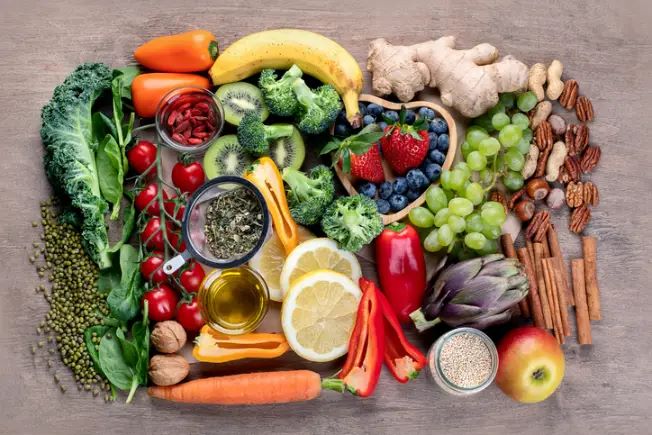
fruits and vegetables

Why in News?

  • While traditional concerns about undernutrition persist, newer challenges like micronutrient deficiencies and obesity have emerged 

Introduction

  • India is undergoing a significant nutritional transition, with changing food habits across urban and rural populations over the past two decades.
  • In this context, it is critical that discussions on nutrition go beyond calorie intake to include what may be missing from the plate — especially essential vitamins and minerals known as micronutrients.

Understanding Nutrition: Macronutrients vs. Micronutrients

As defined by health experts, nutrients are broadly classified into:

  • Macronutrients: Carbohydrates, proteins, and fats — required in large quantities for energy and structural needs.
  • Micronutrients: Vitamins, minerals, and trace elements — required in smaller amounts but vital for physiological functions such as immunity, enzyme activity, and hormone production.

Micronutrients are further categorised into:

  • Water-soluble vitamins: e.g., B-complex, Vitamin C
  • Fat-soluble vitamins: e.g., Vitamins A, D, E, K
  • Macrominerals: e.g., calcium, magnesium, phosphorus
  • Trace elements: e.g., iron, zinc, selenium, iodine

The Micronutrient Deficiency Challenge

Global and National Burden

According to the WHO, over 2 billion people worldwide suffer from micronutrient deficiencies, particularly in iron, vitamin A, iodine, and zinc. These “hidden hungers” have far-reaching consequences, including:

  • Anaemia, particularly among children and pregnant women
  • Impaired cognitive development
  • Vision loss and increased infection susceptibility
  • Poor birth outcomes due to folate and iron deficiency

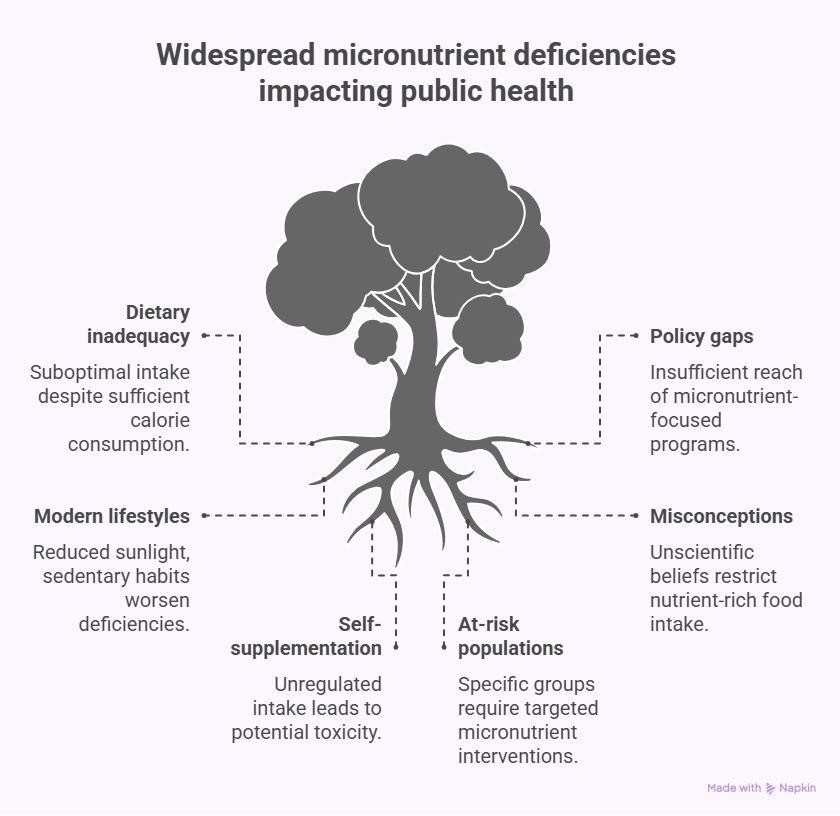
In India, despite dietary diversity in regions like the South, micronutrient intake remains suboptimal. This paradox highlights the mismatch between calorific sufficiency and nutritional adequacy.

Micronutrients in Indian Public Health Policy

Key Initiatives and Guidelines

  • The Indian Council of Medical Research (ICMR) and WHO recommend a diet rich in fruits, vegetables, legumes, and whole grains.
  • These are integrated into national schemes like Anaemia Mukt Bharat, Integrated Child Development Services (ICDS), and the Mid-Day Meal Scheme.
  • Programmes such as free iron and calcium supplements for expectant mothers and fortified weaning blends like sattva maavu are examples of policy interventions targeting micronutrient gaps.
micronutrient deficiencies impacting public health

Micronutrients and Health Outcomes

Micronutrient deficiencies contribute to multiple morbidities:

  • Iron, folate, and B12 deficiency → Anaemia
  • Folate deficiency during pregnancy → Neural tube defects
  • Vitamin A deficiency → Preventable blindness
  • Vitamin D deficiency → Musculoskeletal issues, fatigue
  • Zinc and selenium deficiency → Poor immune response

Notably, Vitamin D is now reported as the most common deficiency among diabetics globally, with magnesium being the second most deficient micronutrient.

Personalised Nutrition and At-Risk Populations

Certain groups require targeted interventions:

  • Children, pregnant women, elderly
  • Post-surgical patients and those with gastrointestinal disorders
  • Individuals with malabsorption or on restrictive diets

Health experts stress that while dietary intake should ideally meet most needs, clinical supplementation based on biochemical assessments (e.g., blood tests) is essential in many cases.

Lifestyle Factors and Misconceptions

Modern Lifestyles

  • Reduced sunlight exposure and sedentary indoor routines contribute to Vitamin D deficiency.
  • Avoidance of dairy or non-vegetarian foods due to personal or cultural reasons limits intake of B12, iron, and zinc.

Myths and Misconceptions

  • Avoiding fruits due to natural sugar content deprives the body of essential fibre, antioxidants, and vitamins.
  • Labeling fruits like papaya, jackfruit, and mango as “hot” foods during pregnancy lacks scientific basis and leads to unnecessary dietary exclusions.

Caution Against Self-Supplementation

The proliferation of supplements through social media and pharmacies has led to unregulated intake, often without medical advice. Overconsumption, especially of fat-soluble vitamins (A, D, E, K), can lead to toxicity. Even Vitamin C, if taken in excess, can cause issues like kidney stones.

Healthcare professionals stress the importance of evidence-based and personalised supplementation, not influenced by anecdotal advice or commercial trends.

Conclusion: Towards Preventive Health Through Nutrition

India’s evolving health and nutrition landscape demands a shift in focus from calorie sufficiency to nutrient adequacy. Micronutrients, though needed in trace amounts, are central to long-term physical, cognitive, and metabolic health.

Efforts must include:

  • Strengthening dietary diversity and awareness at the community level
  • Scaling up food fortification and maternal-child supplementation schemes
  • Promoting culturally sensitive but evidence-backed nutrition education
  • Avoiding unscientific restrictions and self-medication with supplements

As India aspires to meet its SDG targets on health and nutrition, focusing on micronutrient sufficiency is not just timely but essential to building a healthier and more resilient population.

For Indian Exporters

  • These reforms reduce transaction costs and compliance hurdles
  • Encourage a more competitive and efficient export environment
  • Promote value addition in key sectors like leather

For Tamil Nadu

  • The reforms particularly benefit the state’s leather industry, a major contributor to employment and exports
  • Boost the marketability of GI-tagged E.I. leather, enhancing rural and traditional industries

For Trade Policy

  • These decisions indicate a shift from regulatory controls to policy facilitation

Reinforce the goals of Make in India, Atmanirbhar Bharat, and India’s ambition to become a leading export power

Recently, BVR Subrahmanyam, CEO of NITI Aayog, claimed that India has overtaken Japan to become the fourth-largest economy in the world, citing data from the International Monetary Fund (IMF). 

India’s rank as the world’s largest economy varies by measure—nominal GDP or purchasing power parity (PPP)—each with key implications for economic analysis.

Significance and Applications

Leave a Reply

Your email address will not be published. Required fields are marked *

Call Us Now !

Copyright © JICE ACADEMY FOR EXCELLENCE PRIVATE LIMITED