
UPSC CURRENT AFFAIRS – 07th August 2025
Modernising India's Maritime Laws: Carriage of Goods by Sea Bill, 2025 & Merchant Shipping Bill, 2024
Why in News?
- Parliament passed the Carriage of Goods by Sea Bill, 2025 and the Merchant Shipping Bill, 2024 to modernise India’s maritime legal framework.
Introduction
- Parliament passed two important pieces of maritime legislation:
- The Carriage of Goods by Sea Bill, 2025 was passed by the Rajya Sabha (after having already been passed by the Lok Sabha).
- The Merchant Shipping Bill, 2024 was passed by the Lok Sabha.
- Together, these Bills mark a major step forward in updating India’s maritime legal framework and positioning the country as a key player in global maritime trade.
1. Carriage of Goods by Sea Bill, 2025
Purpose
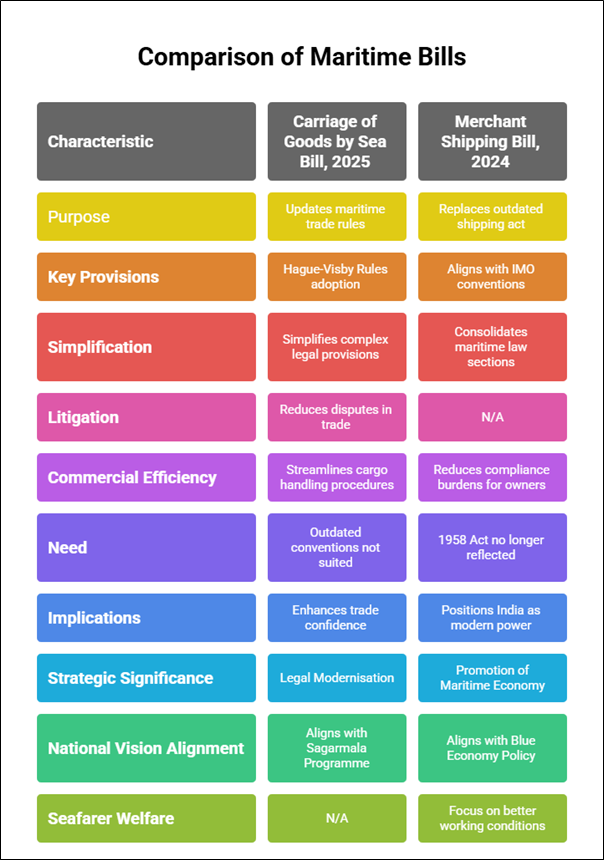
- This Bill replaces the nearly century-old Indian Carriage of Goods by Sea Act, 1925 with legislation that reflects modern international shipping practices.
Key Features
- Adoption of Hague-Visby Rules: These internationally accepted rules govern the responsibilities and liabilities of carriers and shippers in maritime trade. They are already in use by many advanced maritime nations such as the United Kingdom.
- Simplification and Legal Clarity: The Bill simplifies complex provisions of the previous law, providing clearer guidance for stakeholders involved in sea cargo transport.
- Reduction of Litigation: By adopting globally accepted rules and clearer standards, the Bill is expected to reduce the frequency and complexity of disputes in maritime trade.
- Enhancing Commercial Efficiency: The Bill aims to streamline cargo handling procedures and bring uniformity in legal obligations, thereby facilitating smoother operations.
Need for the Bill
- The existing 1925 Act was based on outdated conventions (the original Hague Rules), which were not suited to current trade volumes, digital processes, or India’s international maritime commitments.
- The lack of updated legal standards often led to disputes, delays, and insurance complications in the shipping industry.
Implications
- Enhances legal predictability and trade confidence for foreign and domestic shipping lines.
- Boosts transparency and reduces transaction costs for businesses involved in sea trade.
- Strengthens India’s position as a reliable jurisdiction for cargo-related contracts and dispute resolution.
2. Merchant Shipping Bill, 2024
Purpose
- This Bill aims to replace the Merchant Shipping Act, 1958, which has become outdated, complex, and inadequate in addressing the requirements of a modern maritime nation.
Structural Reform
- The old Act had 561 Sections and had become fragmented through numerous amendments. The new Bill consolidates maritime law into 16 Parts and 325 clauses for clarity, efficiency, and ease of implementation.
Key Provisions
- Alignment with International Maritime Organization (IMO) Conventions: The Bill ensures that India meets its international obligations in maritime safety, pollution control, and vessel registration.
- Maritime Safety and Environment Protection: Includes updated provisions for emergency preparedness, marine accident response, and pollution prevention.
- Ease of Doing Business: Reduces compliance burdens for ship owners, improves digital documentation and processes, and encourages greater Indian tonnage registration.
- Focus on Seafarer Welfare: The Bill incorporates provisions for better working conditions, safety, training, and social protection of Indian seafarers.
Need for the Bill
- The 1958 Act no longer reflected technological developments, global trade dynamics, or India’s maritime growth potential. It also failed to adequately implement the international maritime conventions to which India is a party. The fragmented nature of the legislation created unnecessary legal and procedural hurdles.
Implications
- Positions India as a modern, responsible maritime power.
- Encourages investment in port infrastructure and shipbuilding.
- Enhances maritime employment, technological innovation, and sectoral competitiveness.
- Strengthens India’s capacity for maritime governance in the Indo-Pacific region.
Parliamentary Process and Political Context
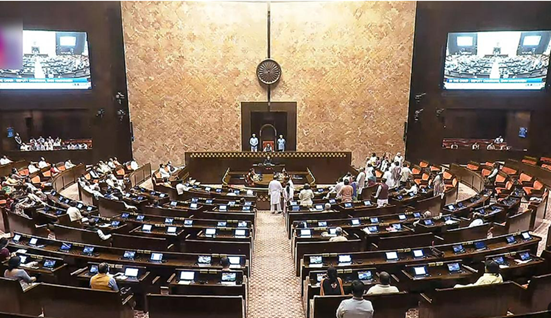
- The Carriage of Goods by Sea Bill, 2025, was passed in the Rajya Sabha amid continued protests by Opposition members, who had entered the well of the House.
- The Bill was passed by a voice vote, as the presiding officer proceeded with legislative business despite the din. Earlier in the day, the Rajya Sabha had been adjourned after tabling of papers and obituary references.
- Simultaneously, in the Lok Sabha, the Merchant Shipping Bill, 2024 was passed, and Finance Minister Nirmala Sitharaman tabled the Demands for Grants for Manipur for the financial year 2025-26. Manipur has been under President’s Rule since February 13, 2025.
Strategic and Economic Significance
- Legal Modernisation: These Bills bring India’s maritime laws in line with international conventions and modern trade practices.
- Promotion of Maritime Economy: They support India’s vision of expanding its role in global maritime trade and integrating more effectively with global supply chains.
- National Maritime Vision: Both Bills align with initiatives such as the Sagarmala Programme, Maritime India Vision 2030, and the Blue Economy Policy, which seek to enhance port connectivity, efficiency, and sustainability.
- Strengthening Maritime Sovereignty: By streamlining governance and safety protocols, India reinforces its maritime security and regulatory capacities in the Indian Ocean Region.

3rd UN conference on landlocked countries
UPSC CURRENT AFFAIRS – 08th August 2025 Home / 3rd UN conference on landlocked countries Why in News? At the

Issue of soapstone mining in Uttarakhand’s Bageshwar
UPSC CURRENT AFFAIRS – 08th August 2025 Home / Issue of soapstone mining in Uttarakhand’s Bageshwar Why in News? Unregulated

Groundwater Pollution in India – A Silent Public Health Emergency
UPSC CURRENT AFFAIRS – 08th August 2025 Home / Groundwater Pollution in India – A Silent Public Health Emergency Why

Universal banking- need and impact
UPSC CURRENT AFFAIRS – 08th August 2025 Home / Universal banking- need and impact Why in News? The Reserve Bank

India’s “Goldilocks” Economy: A Critical Appraisal
UPSC CURRENT AFFAIRS – 08th August 2025 Home / India’s “Goldilocks” Economy: A Critical Appraisal Why in News? The Finance

U.S.-India Trade Dispute: Trump’s 50% Tariffs and India’s Oil Imports from Russia
UPSC CURRENT AFFAIRS – 07th August 2025 Home / U.S.-India Trade Dispute: Trump’s 50% Tariffs and India’s Oil Imports from

Eco-Friendly Solution to Teak Pest Crisis: KFRI’s HpNPV Technology
UPSC CURRENT AFFAIRS – 07th August 2025 Home / Eco-Friendly Solution to Teak Pest Crisis: KFRI’s HpNPV Technology Why in

New Species of Non-Venomous Rain Snake Discovered in Mizoram
UPSC CURRENT AFFAIRS – 07th August 2025 Home / New Species of Non-Venomous Rain Snake Discovered in Mizoram Why in
Introduction
Economic Implications
For Indian Exporters
- These reforms reduce transaction costs and compliance hurdles
- Encourage a more competitive and efficient export environment
- Promote value addition in key sectors like leather
For Tamil Nadu
- The reforms particularly benefit the state’s leather industry, a major contributor to employment and exports
- Boost the marketability of GI-tagged E.I. leather, enhancing rural and traditional industries
For Trade Policy
- These decisions indicate a shift from regulatory controls to policy facilitation
Reinforce the goals of Make in India, Atmanirbhar Bharat, and India’s ambition to become a leading export power
Recently, BVR Subrahmanyam, CEO of NITI Aayog, claimed that India has overtaken Japan to become the fourth-largest economy in the world, citing data from the International Monetary Fund (IMF).
India’s rank as the world’s largest economy varies by measure—nominal GDP or purchasing power parity (PPP)—each with key implications for economic analysis.