UPSC CURRENT AFFAIRS – 30th May 2025
MSC ELSA 3 Sinks Off Kerala Coast
Why in News?
- The sinking of MSC Elsa 3 off Kerala’s coast in May 2025 exposed gaps in hazardous cargo regulation and tested India’s maritime environmental disaster preparedness.
Introduction
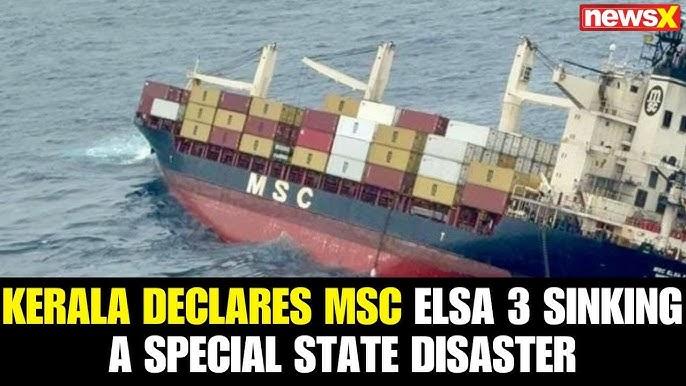
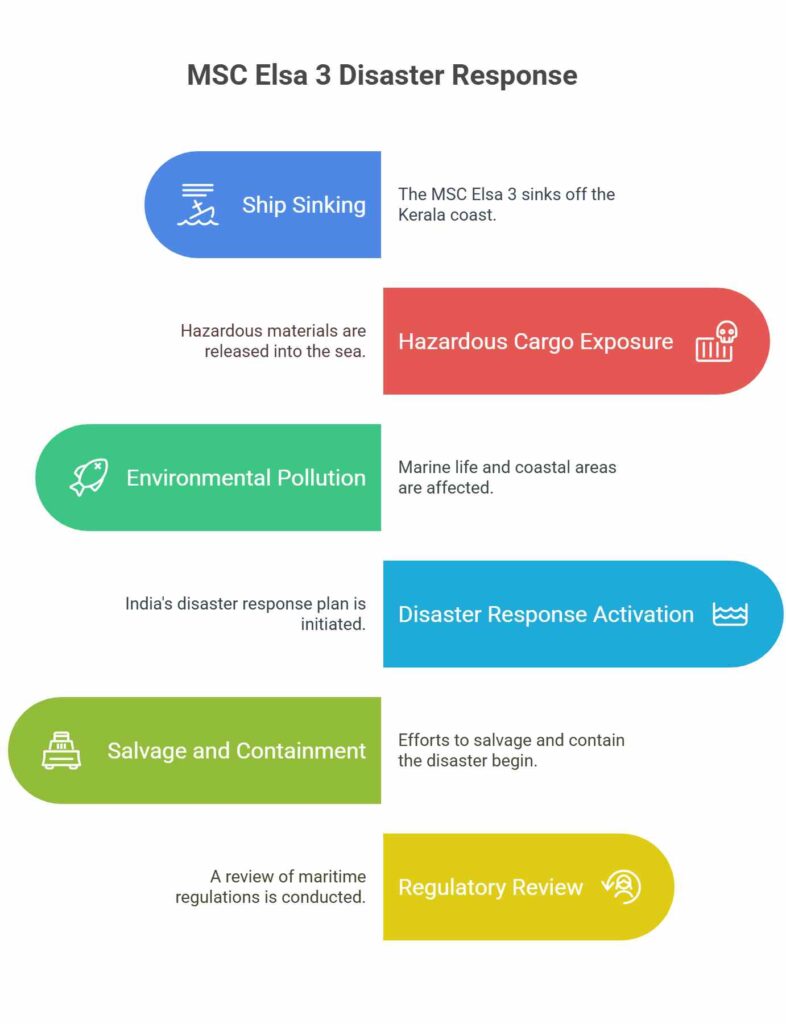
- On May 24, 2025, the cargo vessel MSC Elsa 3, carrying over 640 containers, tilted and eventually sank off the coast of Kochi.
- The ship, nearly 30 years old but reportedly seaworthy, succumbed to an operational failure. Despite efforts, the crew had to abandon the vessel, which now lies 50 metres beneath the Arabian Sea.
- This incident has raised serious concerns regarding marine pollution, hazardous cargo handling, and India’s maritime disaster preparedness.
Environmental Fallout and Immediate Concerns
- According to the cargo manifest, 13 containers held hazardous goods—12 with calcium carbide, a highly reactive compound, and one with rubber solution.
- The interaction of the rubber solution with seawater is believed to have caused the spread of plastic pellets (nurdles) along the Kerala coast, posing a serious threat to marine biodiversity and coastal livelihoods.
In addition:
- Five containers of calcium carbide remain on the seabed, risking chemical leakage.
- An estimated 365 tonnes of heavy fuel oil and 60 tonnes of diesel are still inside the sunken vessel’s tanks.
- Some oil sheen has already been observed, sparking fears of a larger marine oil spill, similar to the 2017 Chennai disaster when 250 tonnes of oil spilled after a tanker collision.
India’s Disaster Response Framework: Strengths and Gaps
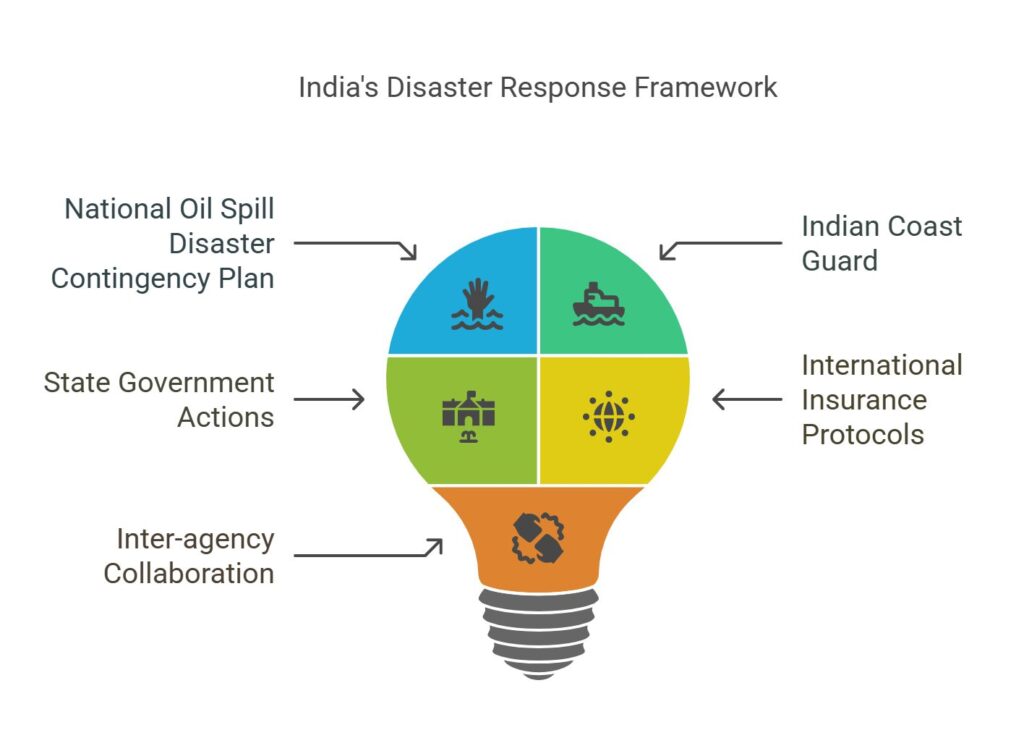
India’s National Oil Spill Disaster Contingency Plan (NOS-DCP) designates the Indian Coast Guard as the nodal agency for oil spill responses. In the case of the Elsa 3, the Kerala government has taken proactive steps, including:
- Declaring the event a state-specific disaster.
- Coordinating with national agencies to begin salvage and containment operations.
- Engaging with international insurance protocols to finance cleanup and recovery.
This contrasts with the delayed and poorly coordinated response seen in the Chennai incident, reflecting a learning curve in inter-agency collaboration.
National Oil Spill Disaster Contingency Plan (NOS-DCP)
- The National Oil Spill Disaster Contingency Plan (NOS-DCP) was first developed in 1996 by the Indian Coast Guard, which was designated as the central coordinating authority for responding to oil spill disasters in India’s maritime zones.
- Indian Coast Guard (ICG) is the nodal agency under NOS-DCP.
- It is responsible for:
- Containment and recovery of spilled oil.
- Coordination with central and state agencies.
- Surveillance, assessment, and initiation of clean-up operations.
Systemic Challenges in Container Oversight
- The MSC Elsa 3 episode also highlights a global regulatory blind spot—the lack of effective oversight on what each container carries.
- Containers change hands across ports, often without thorough inspection, increasing the risk of undisclosed or poorly documented hazardous materials entering national waters.
- As India aspires to become a global transshipment hub and expands its maritime logistics, risk assessment, cargo tracking, and regulatory oversight must be strengthened.
Conclusion: A Test of India’s Maritime Governance
- The MSC Elsa 3 disaster is a wake-up call for India’s maritime administration.
- The containment and cleanup response in Kerala will be a litmus test for India’s readiness to handle complex maritime disasters.
- With increasing global shipping traffic and environmental stakes, proactive policy reform, institutional capacity building, and inter-agency coordination are the need of the hour.

3rd UN conference on landlocked countries
UPSC CURRENT AFFAIRS – 08th August 2025 Home / 3rd UN conference on landlocked countries Why in News? At the
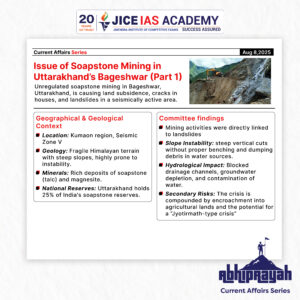
Issue of soapstone mining in Uttarakhand’s Bageshwar
UPSC CURRENT AFFAIRS – 08th August 2025 Home / Issue of soapstone mining in Uttarakhand’s Bageshwar Why in News? Unregulated
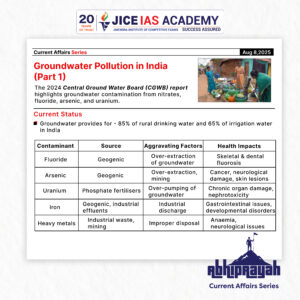
Groundwater Pollution in India – A Silent Public Health Emergency
UPSC CURRENT AFFAIRS – 08th August 2025 Home / Groundwater Pollution in India – A Silent Public Health Emergency Why
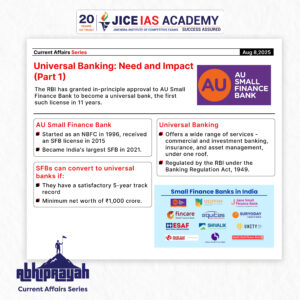
Universal banking- need and impact
UPSC CURRENT AFFAIRS – 08th August 2025 Home / Universal banking- need and impact Why in News? The Reserve Bank
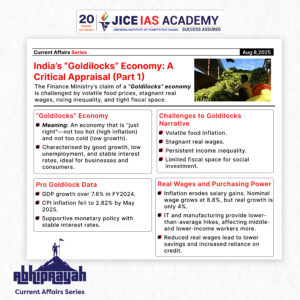
India’s “Goldilocks” Economy: A Critical Appraisal
UPSC CURRENT AFFAIRS – 08th August 2025 Home / India’s “Goldilocks” Economy: A Critical Appraisal Why in News? The Finance
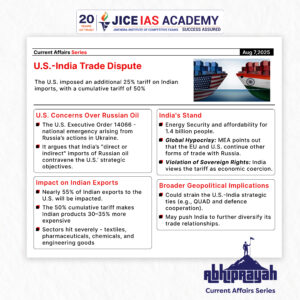
U.S.-India Trade Dispute: Trump’s 50% Tariffs and India’s Oil Imports from Russia
UPSC CURRENT AFFAIRS – 07th August 2025 Home / U.S.-India Trade Dispute: Trump’s 50% Tariffs and India’s Oil Imports from
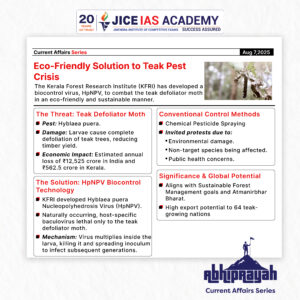
Eco-Friendly Solution to Teak Pest Crisis: KFRI’s HpNPV Technology
UPSC CURRENT AFFAIRS – 07th August 2025 Home / Eco-Friendly Solution to Teak Pest Crisis: KFRI’s HpNPV Technology Why in

New Species of Non-Venomous Rain Snake Discovered in Mizoram
UPSC CURRENT AFFAIRS – 07th August 2025 Home / New Species of Non-Venomous Rain Snake Discovered in Mizoram Why in

For Indian Exporters
- These reforms reduce transaction costs and compliance hurdles
- Encourage a more competitive and efficient export environment
- Promote value addition in key sectors like leather
For Tamil Nadu
- The reforms particularly benefit the state’s leather industry, a major contributor to employment and exports
- Boost the marketability of GI-tagged E.I. leather, enhancing rural and traditional industries
For Trade Policy
- These decisions indicate a shift from regulatory controls to policy facilitation
Reinforce the goals of Make in India, Atmanirbhar Bharat, and India’s ambition to become a leading export power
Recently, BVR Subrahmanyam, CEO of NITI Aayog, claimed that India has overtaken Japan to become the fourth-largest economy in the world, citing data from the International Monetary Fund (IMF).
India’s rank as the world’s largest economy varies by measure—nominal GDP or purchasing power parity (PPP)—each with key implications for economic analysis.