UPSC CURRENT AFFAIRS – 4th June 2025

Home / UPSC / Current Affairs / Mustard Oil, Public Health, and Policy Dilemmas

Mustard Oil, Public Health, and Policy Dilemmas

mustard flower

Why in News?

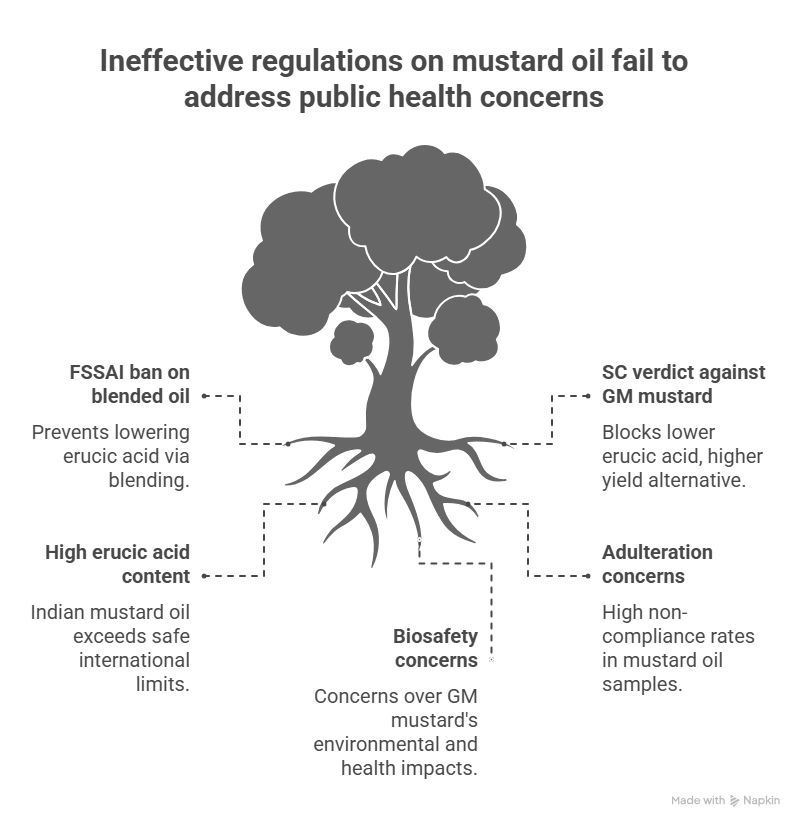
Two major decisions—FSSAI’s 2021 ban on blended mustard oil and the Supreme Court’s 2024 verdict against GM mustard (DMH-11)—have reignited debate on health and policy issues. 

Introduction

  • Mustard oil is the third-largest consumed edible oil in India, playing a crucial role in dietary habits, especially in northern and eastern states.
  • Recently, two major decisions — one by the Food Safety and Standards Authority of India (FSSAI) in 2021 and the other by the Supreme Court in 2024 — have shaped the regulatory landscape of mustard oil in India.

Key Policy Decisions and Their Public Health Implications:

1. FSSAI’s Ban on Blended Mustard Oil (2021):

  • Effective from June 8, 2021, FSSAI prohibited the manufacture and sale of blended mustard oil.
  • As per the Food Safety and Standards Regulations, edible oil blending is permitted up to 20%, but the FSSAI imposed a blanket ban for mustard oil blending.
  • Rationale:
    • To prevent adulteration and contamination.
    • To encourage pure mustard oil consumption and boost domestic mustard production.

2. Supreme Court Verdict on GM Mustard (2024):

  • The SC quashed the Centre’s approval for the environmental release of GM mustard (Dhara Mustard Hybrid-11 or DMH-11).
  • Reason cited: Inadequate assessment of potential human health impacts.
  • This ruling paused the rollout of a lower erucic acid, higher yield GM mustard variety developed indigenously.

Common Objective:

  • Both decisions were ostensibly aimed at safeguarding the public health of mustard oil consumers.
  • However, experts argue that these actions may not effectively address the underlying health concerns.

Health Concern: High Erucic Acid in Mustard Oil

  • Indian mustard oil contains 40–54% erucic acid, compared to the international safe limit of <5%.
  • Health implications (from animal studies):
    • Heart lesions
    • Growth retardation
    • Tissue degeneration
    • Liver and kidney damage
  • Although no conclusive human evidence exists, developed nations such as the US, Canada, and EU nations restrict mustard oil with high erucic acid.
  • Solution adopted by advanced countries: Use of canola oil, a low-erucic acid variety (≤2%).

Edible Oil Blending – Public Health & Regulation

  • Why blending is helpful:
    • Blending mustard oil with low-erucic oils (e.g., rice bran, soybean) reduces overall erucic acid content.
    • Blended oils are richer in unsaturated fats, which improve cholesterol profiles (↓LDL, ↑HDL).
  • Adulteration concern: A 2020 FSSAI survey found 24.2% of 4,461 oil samples non-compliant, with mustard oil topping adulteration charts.
  • Challenge: Instead of banning, allow packaged and labelled blended oils, especially since <30% of edible oil is branded in India.
  • State role: Food safety is a State subject, and enforcement needs strengthened local capacity.

GM Mustard (DMH-11) – Science, Safety & Sovereignty

  • Developed by Indian scientists, DMH-11 is a GM hybrid mustard with:
    • Lower erucic acid (30–35%)
    • Higher yields, supporting oil self-sufficiency
  • Benefits:
    • Requires less blending with other oils → addresses health concerns
    • Can reduce edible oil imports (India is the largest global importer, with $20.56 billion bill)
  • Challenge: Judicial and activist concerns over biosafety, environmental impacts, and food safety data gaps

Way Forward:

  • Scientific Risk Assessment: Conduct transparent, peer-reviewed studies on the health impact of GM mustard and erucic acid in Indian context.
  • Strengthen Regulation, Not Prohibition: Allow labelled blending within legal limits (≤20%) under strict monitoring. Penalize adulteration, not blending itself.
  • Promote Indigenous Crop Innovation: Prioritize plant breeding and genetic interventions to create <5% erucic acid mustard varieties, like Canada and EU did.
  • Public Awareness and Branding: Encourage branded, traceable mustard oil, improving consumer confidence.

Conclusion:

  • While the intent behind the FSSAI and Supreme Court decisions was to safeguard consumer health, blanket bans and judicial halts without enabling alternatives can be counterproductive.
  • A balanced approach focusing on regulated blending, scientific GMO assessment, and crop innovation is essential to align public health, food safety, and economic interests in India’s edible oil sector.

Economic Implications

For Indian Exporters

  • These reforms reduce transaction costs and compliance hurdles
  • Encourage a more competitive and efficient export environment
  • Promote value addition in key sectors like leather

For Tamil Nadu

  • The reforms particularly benefit the state’s leather industry, a major contributor to employment and exports
  • Boost the marketability of GI-tagged E.I. leather, enhancing rural and traditional industries

For Trade Policy

  • These decisions indicate a shift from regulatory controls to policy facilitation

Reinforce the goals of Make in India, Atmanirbhar Bharat, and India’s ambition to become a leading export power

Recently, BVR Subrahmanyam, CEO of NITI Aayog, claimed that India has overtaken Japan to become the fourth-largest economy in the world, citing data from the International Monetary Fund (IMF). 

India’s rank as the world’s largest economy varies by measure—nominal GDP or purchasing power parity (PPP)—each with key implications for economic analysis.

Significance and Applications

Leave a Reply

Your email address will not be published. Required fields are marked *

Call Us Now !

Copyright © JICE ACADEMY FOR EXCELLENCE PRIVATE LIMITED