
UPSC CURRENT AFFAIRS – 31st July 2025

Home / UPSC / Current Affairs / NASA-ISRO NISAR Satellite Successfully Launched

NASA-ISRO NISAR Satellite Successfully Launched

Why in News?

  • Recently, the NASA-ISRO Synthetic Aperture Radar (NISAR) satellite was successfully launched by ISRO’s GSLV-F16 into a sun-synchronous orbit.

Introduction

  • The NASA-ISRO Synthetic Aperture Radar (NISAR) satellite was successfully launched from the Satish Dhawan Space Centre (SDSC), Sriharikota, Andhra Pradesh.
  • The satellite was carried by the Geosynchronous Satellite Launch Vehicle (GSLV)-F16, marking a significant milestone as it is the first satellite developed jointly by the Indian Space Research Organisation (ISRO) and the National Aeronautics and Space Administration (NASA).

Significance of NISAR

    • NISAR is a dual-frequency Earth observation satellite employing advanced Synthetic Aperture Radar (SAR)
    • It is designed to observe and understand complex Earth processes and natural hazards with unprecedented accuracy.
    • Key Features:
    1. First dual-frequency SAR mission with:
      • L-band SAR from NASA
      • S-band SAR from ISRO
    2. Unfurlable 12-metre mesh reflector antenna, a first for both agencies.
    3. SweepSAR technique allows for wide-swath imaging of 242 km with high spatial resolution.
    4. Mission life: 5 years

Applications of NISAR

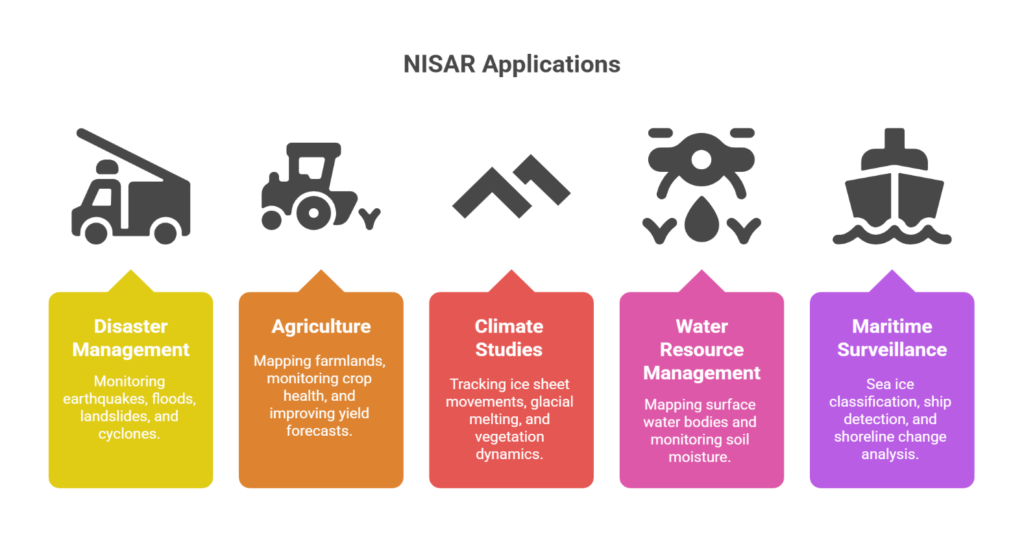
NISAR will generate all-weather, day-and-night data at 12-day intervals. Its ability to detect even minor ground movements makes it invaluable for:

  • Disaster Management: Monitoring of earthquakes, floods, landslides, and cyclones.
  • Agriculture: Mapping farmlands, monitoring crop health, and improving yield forecasts.
  • Climate Studies: Tracking ice sheet movements, glacial melting, and vegetation dynamics.
  • Water Resource Management: Mapping surface water bodies and monitoring soil moisture.
  • Maritime Surveillance: Sea ice classification, ship detection, and shoreline change analysis.

Technical Contributions

NASA:

  • Developed L-band SAR, radar antenna boom, 12-metre reflector, and engineering payload.
  • Managed integration and testing at the Jet Propulsion Laboratory (JPL).

ISRO:

  • Provided the I3K satellite bus, S-band SAR, solar arrays, and the launch vehicle (GSLV-F16).

This collaboration symbolizes technological synergy and international cooperation in space science.

Strategic Importance

  • First GSLV launch into a sun-synchronous orbit, showcasing ISRO’s evolving capabilities.
  • Enhances India’s disaster resilience, climate governance, and geospatial intelligence.
  • Strengthens India-US strategic partnership, particularly in space diplomacy and scientific collaboration.

Conclusion

  • The successful launch of NISAR marks a turning point in Earth observation science and international space partnerships.
  • By combining cutting-edge radar technology from NASA and ISRO, the mission sets a new benchmark for remote sensing and planetary monitoring. NISAR’s multi-disciplinary applications are expected to benefit governance, environmental conservation, agriculture, and disaster management on a global scale.

Introduction

Economic Implications

For Indian Exporters

  • These reforms reduce transaction costs and compliance hurdles
  • Encourage a more competitive and efficient export environment
  • Promote value addition in key sectors like leather

For Tamil Nadu

  • The reforms particularly benefit the state’s leather industry, a major contributor to employment and exports
  • Boost the marketability of GI-tagged E.I. leather, enhancing rural and traditional industries

For Trade Policy

  • These decisions indicate a shift from regulatory controls to policy facilitation

Reinforce the goals of Make in India, Atmanirbhar Bharat, and India’s ambition to become a leading export power

Recently, BVR Subrahmanyam, CEO of NITI Aayog, claimed that India has overtaken Japan to become the fourth-largest economy in the world, citing data from the International Monetary Fund (IMF). 

India’s rank as the world’s largest economy varies by measure—nominal GDP or purchasing power parity (PPP)—each with key implications for economic analysis.

Significance and Applications

Leave a Reply

Your email address will not be published. Required fields are marked *

Call Us Now !

Copyright © JICE ACADEMY FOR EXCELLENCE PRIVATE LIMITED