
UPSC CURRENT AFFAIRS – 15th July 2025
The changing landscape of employment
Why in News?
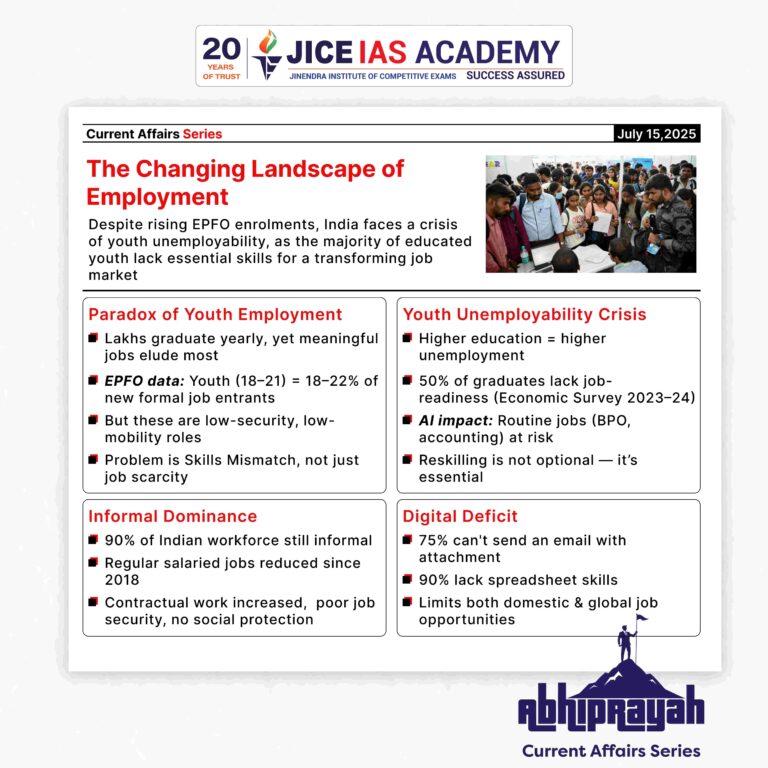
- Despite rising EPFO enrolments, India faces a crisis of youth unemployability, as the majority of educated youth lack essential skills for a transforming job market.
Introduction
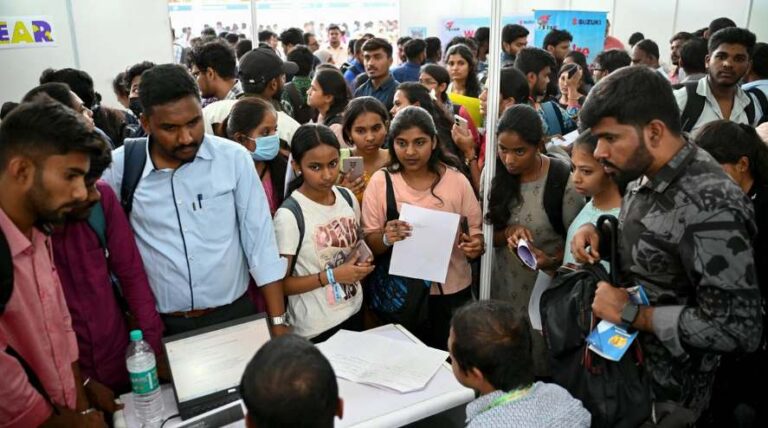
- Each year, lakhs of students graduate from universities, colleges, Industrial Training Institutes (ITIs), and various skill development programmes across India.
- However, the higher education and skilling ecosystem continues to face persistent challenges—not merely in accommodating the growing number of students, but more importantly, in integrating them into meaningful and stable employment.
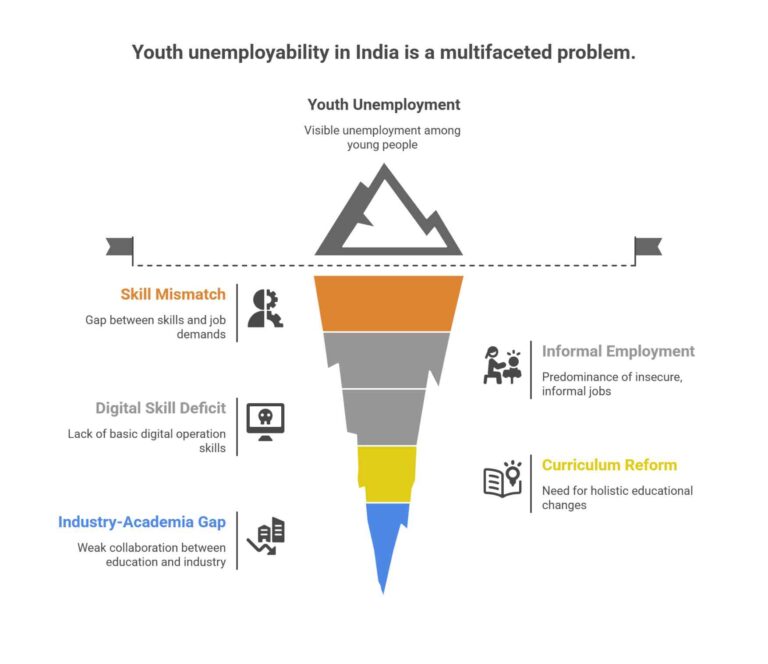
- The problem lies not only in unemployment but also in unemployability—a structural gap between the skills possessed by graduates and those demanded by a rapidly evolving job market.
The Role of EPFO and Insights into Formal Employment Trends
- The Employees’ Provident Fund Organisation (EPFO) serves as a vital indicator of formal sector employment in India.
- Managing retirement savings for over 7 crore workers, it remains one of the largest social security organisations in the world. Post-2019, EPFO data reflected the contraction in formal employment due to the COVID-19 pandemic.
- However, a gradual recovery is underway. The March 2025 data reveals a positive trend—an increase in new enrolments, especially among young professionals aged 18–25, with the 18–21 subgroup alone accounting for 18%–22% of new subscribers in recent months.
- While this trend signals a move toward formalisation, it raises deeper concerns regarding job stability, income security, and long-term career progression.
- Mere enrolment in the formal sector does not guarantee a sustainable livelihood without addressing issues related to skills, technological disruption, and structural informality in the job market.
Youth Unemployment and Unemployability: A Worsening Crisis
- The India Employment Report 2024, jointly published by the International Labour Organization (ILO) and the Institute for Human Development, paints a concerning picture.
- Youth accounts for 83% of India’s unemployed population. Alarmingly, the unemployment rate is higher among those with secondary or higher education, highlighting a mismatch between educational qualifications and labour market needs.
- The Economic Survey 2023–24 echoes similar concerns. It observes that only about 50% of youth graduating from higher education are job-ready. One in two young individuals lacks essential digital and professional skills, which are critical in a technology-driven economy.
- The risk is further compounded by the growing influence of artificial intelligence (AI), which threatens to automate traditional roles in sectors like information technology, customer service, and even accounting.
The Predominance of Informal Employment
- Despite India’s economic advancement, the nature of employment remains largely informal.
- According to the India Employment Report 2024, around 90% of India’s workforce is still engaged in informal employment, with regular salaried jobs declining since 2018.
- Although contractual jobs have increased, they come with limited job security, negligible social protection, and no long-term financial safety nets.
Digital Skill Deficit: A Barrier to Employment
A significant share of Indian youth face difficulties with even basic digital operations. The report highlights that:
- 75% cannot send an email with an attachment
- Over 60% struggle with simple file operations like copy-paste
- 90% lack basic spreadsheet skills such as using formulas
Such statistics are alarming, especially given the increasing reliance on digital tools across all sectors of the economy. This lack of digital fluency restricts access to both local and global employment opportunities.
The Future of Jobs: Opportunities and Displacement
The World Economic Forum’s Future of Jobs Report 2025 estimates that by 2030:
- 170 million new jobs (14% of total employment) will be created globally.
- However, 92 million existing jobs (8% of total employment) will be displaced.
- The net gain will be around 78 million jobs, signifying a 7% rise in total employment.
While this outlook provides cautious optimism, it highlights an urgent need for reskilling and upskilling initiatives to prepare India’s workforce for this transformation. Without adequate interventions, millions will remain unemployable despite job availability.
The Way Forward: Policy Measures and Structural Reforms
India stands at a crucial crossroads. To harness its demographic dividend and avoid a demographic disaster, the following reforms are necessary:
- Stronger Industry-Academia Linkages
- There must be legally mandated collaborations between industries and educational institutions.
- Every higher education institute should have at least one formal industry partner to ensure that the curriculum remains relevant and aligned with job market demands.
- This partnership can facilitate internships, on-the-job training, and real-time project exposure.
- Accountability of Educational Institutions
- Institutes should be made accountable not only for academic degrees but also for employment outcomes.
- Accreditation systems must incorporate placement records as a core metric.
- Educational rankings should reflect employability outcomes, not just infrastructure or faculty ratios.
- Mandatory Integration of Innovation and Skill Labs
- Establishing Idea Labs and Tinker Labs across all high schools and higher education institutions should be a national priority.
- These labs can encourage practical learning, innovation, and entrepreneurial thinking from an early age.
- Holistic Curriculum Reform
The educational curriculum must be broadened to include:
- Humanities and liberal arts for critical thinking
- Foreign languages to aid international employment
- Soft skills including communication, problem-solving, and teamwork
Such a holistic approach will create well-rounded professionals who are adaptive to multiple job markets.
- Global Skilling for International Markets
- India must design global-standard skilling and certification programmes, especially for countries facing demographic decline and skill shortages, such as Japan, Germany, and Canada.
- Programs like the EU’s Link4Skills, in which India is already participating, can be scaled up.
- Migration corridor frameworks can help assess skill demands in other countries and facilitate the mobility of Indian workers.
- Establishment of Indian Education Services (IES)
- Like the Indian Administrative Services, an Indian Education Services cadre should be formed to attract the brightest minds into education policy, implementation, and administration.
- This could professionalise and standardise the delivery of quality education across states.
- Inclusion of Industry Professionals in Teaching
- Professionals from various industries should be formally integrated into teaching roles, particularly in technical and management institutes.
- This would bridge the gap between academic theory and practical industry application, ensuring that students gain real-world insights alongside classroom learning.
Conclusion
- India’s youth represent its greatest asset, but they are increasingly becoming its most underutilised resource.
- The solution to youth unemployment and underemployment lies not merely in job creation, but in making the youth employable and future-ready.
- This requires bold and urgent action across multiple domains—education, skilling, policy, and global integration.
- Investing in the right skills, aligning education with employment, and enabling global mobility can transform India’s youth from passive job seekers to active contributors in both national and international economies. The time to act is now.

3rd UN conference on landlocked countries
UPSC CURRENT AFFAIRS – 08th August 2025 Home / 3rd UN conference on landlocked countries Why in News? At the

Issue of soapstone mining in Uttarakhand’s Bageshwar
UPSC CURRENT AFFAIRS – 08th August 2025 Home / Issue of soapstone mining in Uttarakhand’s Bageshwar Why in News? Unregulated

Groundwater Pollution in India – A Silent Public Health Emergency
UPSC CURRENT AFFAIRS – 08th August 2025 Home / Groundwater Pollution in India – A Silent Public Health Emergency Why
Universal banking- need and impact
UPSC CURRENT AFFAIRS – 08th August 2025 Home / Universal banking- need and impact Why in News? The Reserve Bank
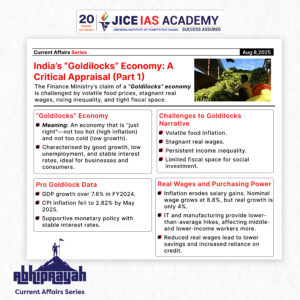
India’s “Goldilocks” Economy: A Critical Appraisal
UPSC CURRENT AFFAIRS – 08th August 2025 Home / India’s “Goldilocks” Economy: A Critical Appraisal Why in News? The Finance

U.S.-India Trade Dispute: Trump’s 50% Tariffs and India’s Oil Imports from Russia
UPSC CURRENT AFFAIRS – 07th August 2025 Home / U.S.-India Trade Dispute: Trump’s 50% Tariffs and India’s Oil Imports from
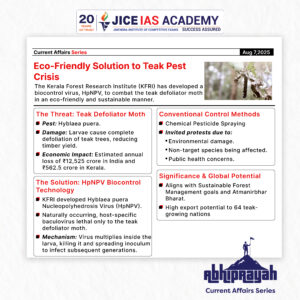
Eco-Friendly Solution to Teak Pest Crisis: KFRI’s HpNPV Technology
UPSC CURRENT AFFAIRS – 07th August 2025 Home / Eco-Friendly Solution to Teak Pest Crisis: KFRI’s HpNPV Technology Why in

New Species of Non-Venomous Rain Snake Discovered in Mizoram
UPSC CURRENT AFFAIRS – 07th August 2025 Home / New Species of Non-Venomous Rain Snake Discovered in Mizoram Why in
Economic Implications
For Indian Exporters
- These reforms reduce transaction costs and compliance hurdles
- Encourage a more competitive and efficient export environment
- Promote value addition in key sectors like leather
For Tamil Nadu
- The reforms particularly benefit the state’s leather industry, a major contributor to employment and exports
- Boost the marketability of GI-tagged E.I. leather, enhancing rural and traditional industries
For Trade Policy
- These decisions indicate a shift from regulatory controls to policy facilitation
Reinforce the goals of Make in India, Atmanirbhar Bharat, and India’s ambition to become a leading export power
Recently, BVR Subrahmanyam, CEO of NITI Aayog, claimed that India has overtaken Japan to become the fourth-largest economy in the world, citing data from the International Monetary Fund (IMF).
India’s rank as the world’s largest economy varies by measure—nominal GDP or purchasing power parity (PPP)—each with key implications for economic analysis.