UPSC CURRENT AFFAIRS – 17th July 2025
Prime Minister Dhan-Dhaanya Krishi Yojana (PMDDKY)
Why in News?
The Union Cabinet approved the Prime Minister Dhan-Dhaanya Krishi Yojana (PMDDKY) to enhance agricultural productivity and promote sustainable farming through convergence of existing schemes.
Introduction
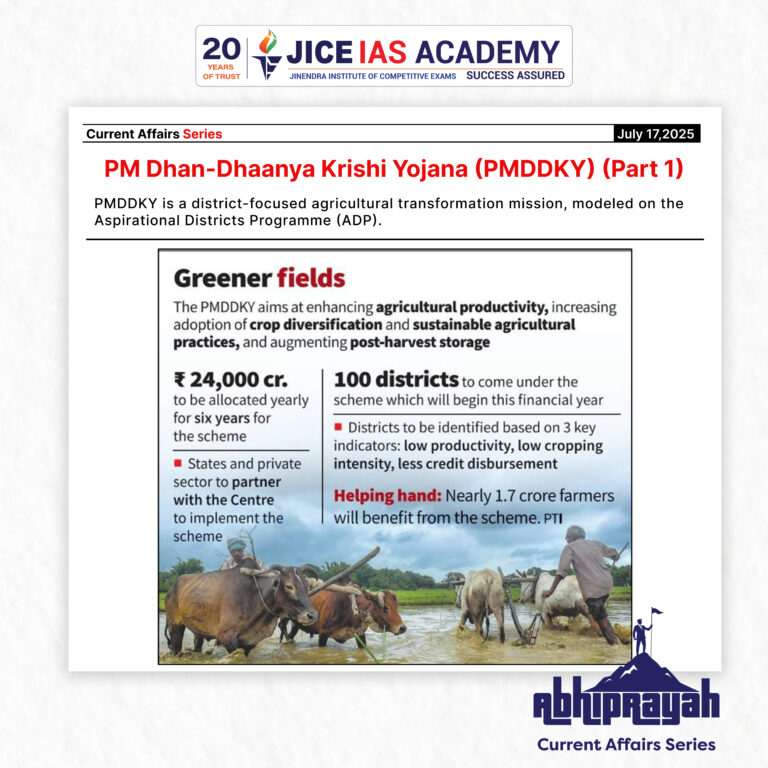
- The Union Cabinet approved the Prime Minister Dhan-Dhaanya Krishi Yojana (PMDDKY), a comprehensive initiative aimed at enhancing agricultural productivity, promoting sustainable practices, and improving the resilience of India’s agricultural sector.
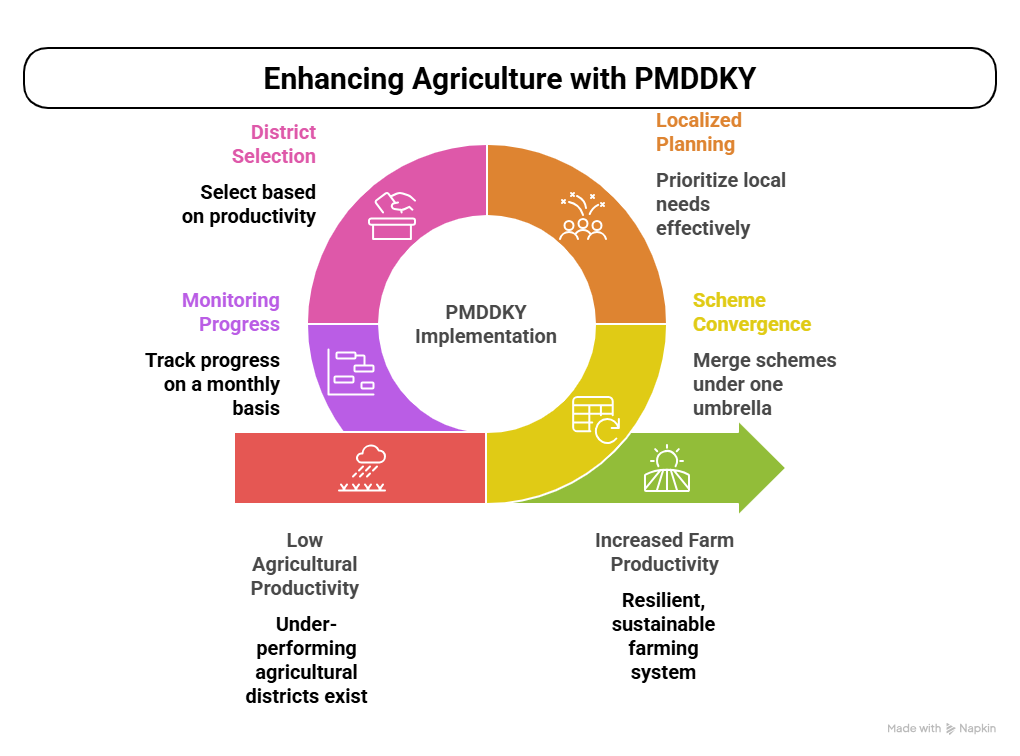
- Announced earlier in the Union Budget 2025-26, the scheme seeks to transform the under-performing agricultural districts of India through convergence, innovation, and localized planning.
Key Features of PMDDKY
- Massive Scheme Convergence
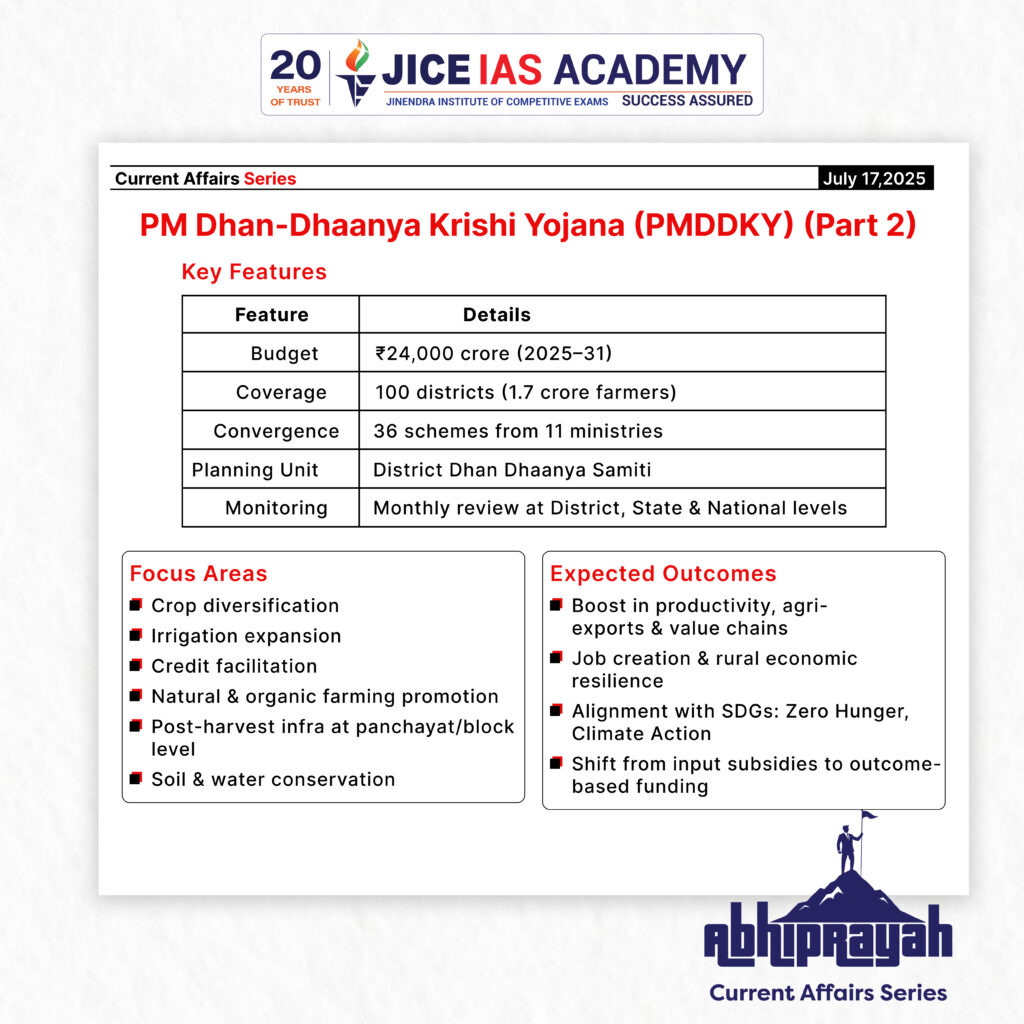
- 36 schemes from 11 Ministries merged under one umbrella scheme.
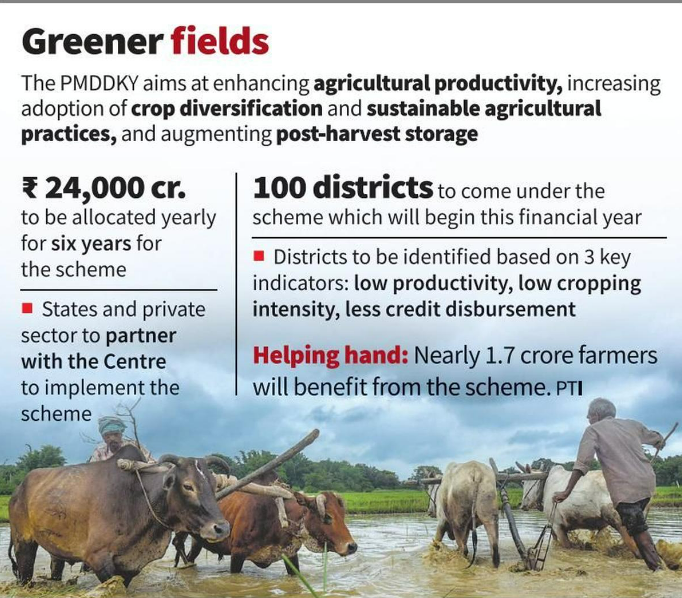
- Annual outlay of ₹24,000 crore for six years, starting from 2025-26.
- Target beneficiaries: 1.7 crore farmers across India.
- Modelled on Aspirational District Programme
- PMDDKY follows the framework of the Aspirational District Programme (ADP) and focuses exclusively on agriculture and allied sectors.
- Prioritizes local needs and decentralized planning.
- District Selection Criteria
- 100 districts to be selected using:
- Low agricultural productivity,
- Low cropping intensity,
- Low credit disbursement.
- At least one district per State/UT will be selected.
- Districts allocated based on Net Cropped Area and operational holdings.
- Planning and Monitoring Mechanism
- District Dhan Dhaanya Samiti to prepare District Agriculture and Allied Activities Plans.
- Committees at district, State, and national levels to ensure effective planning and implementation.
- Progress monitoring on a monthly basis.
- Core Focus Areas
- Post-harvest infrastructure at panchayat/block level.
- Irrigation enhancement and credit facilitation.
- Promotion of natural and organic farming.
- Emphasis on crop diversification, soil and water conservation, and self-sufficiency in agriculture.
Expected Outcomes
- Increased productivity and value addition in agriculture and allied sectors.
- Enhanced local livelihoods and domestic self-reliance in food production.
- Transition towards a resilient, sustainable farming system through diversification and better resource use.
Significance of the Scheme
- Agricultural Transformation: PMDDKY marks a structural shift from fragmented schemes to a unified, outcome-driven model.
- Inclusive Development: With special attention to low-performing districts, the scheme aims to bridge regional gaps in agricultural development.
- Alignment with National Goals: Supports Doubling Farmers’ Income, Atmanirbhar Bharat, and the UN Sustainable Development Goals (SDGs) on food security and climate resilience.
Conclusion
- The Prime Minister Dhan-Dhaanya Krishi Yojana represents a strategic effort to modernize India’s agriculture sector by leveraging convergence, community involvement, and sustainability.
- If implemented effectively, the scheme has the potential to revitalize rural economies, empower farmers, and lay the foundation for a resilient agricultural future.

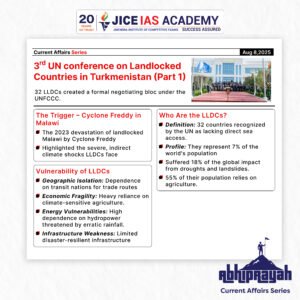
3rd UN conference on landlocked countries
UPSC CURRENT AFFAIRS – 08th August 2025 Home / 3rd UN conference on landlocked countries Why in News? At the

Issue of soapstone mining in Uttarakhand’s Bageshwar
UPSC CURRENT AFFAIRS – 08th August 2025 Home / Issue of soapstone mining in Uttarakhand’s Bageshwar Why in News? Unregulated
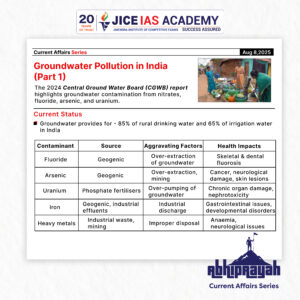
Groundwater Pollution in India – A Silent Public Health Emergency
UPSC CURRENT AFFAIRS – 08th August 2025 Home / Groundwater Pollution in India – A Silent Public Health Emergency Why
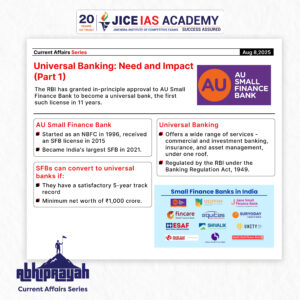
Universal banking- need and impact
UPSC CURRENT AFFAIRS – 08th August 2025 Home / Universal banking- need and impact Why in News? The Reserve Bank
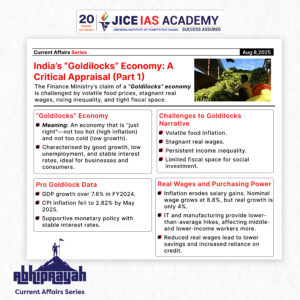
India’s “Goldilocks” Economy: A Critical Appraisal
UPSC CURRENT AFFAIRS – 08th August 2025 Home / India’s “Goldilocks” Economy: A Critical Appraisal Why in News? The Finance
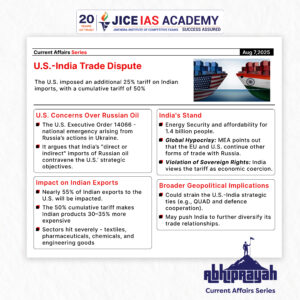
U.S.-India Trade Dispute: Trump’s 50% Tariffs and India’s Oil Imports from Russia
UPSC CURRENT AFFAIRS – 07th August 2025 Home / U.S.-India Trade Dispute: Trump’s 50% Tariffs and India’s Oil Imports from
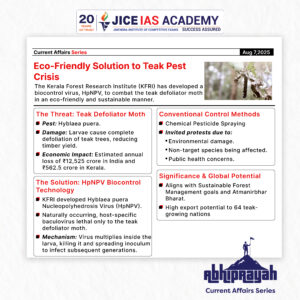
Eco-Friendly Solution to Teak Pest Crisis: KFRI’s HpNPV Technology
UPSC CURRENT AFFAIRS – 07th August 2025 Home / Eco-Friendly Solution to Teak Pest Crisis: KFRI’s HpNPV Technology Why in

New Species of Non-Venomous Rain Snake Discovered in Mizoram
UPSC CURRENT AFFAIRS – 07th August 2025 Home / New Species of Non-Venomous Rain Snake Discovered in Mizoram Why in

Economic Implications
For Indian Exporters
- These reforms reduce transaction costs and compliance hurdles
- Encourage a more competitive and efficient export environment
- Promote value addition in key sectors like leather
For Tamil Nadu
- The reforms particularly benefit the state’s leather industry, a major contributor to employment and exports
- Boost the marketability of GI-tagged E.I. leather, enhancing rural and traditional industries
For Trade Policy
- These decisions indicate a shift from regulatory controls to policy facilitation
Reinforce the goals of Make in India, Atmanirbhar Bharat, and India’s ambition to become a leading export power
Recently, BVR Subrahmanyam, CEO of NITI Aayog, claimed that India has overtaken Japan to become the fourth-largest economy in the world, citing data from the International Monetary Fund (IMF).
India’s rank as the world’s largest economy varies by measure—nominal GDP or purchasing power parity (PPP)—each with key implications for economic analysis.