UPSC CURRENT AFFAIRS – 25th July 2025

Home / UPSC / Current Affairs / Reforming Education for Inclusive Future

Reforming Education for Inclusive Future

Why in News?

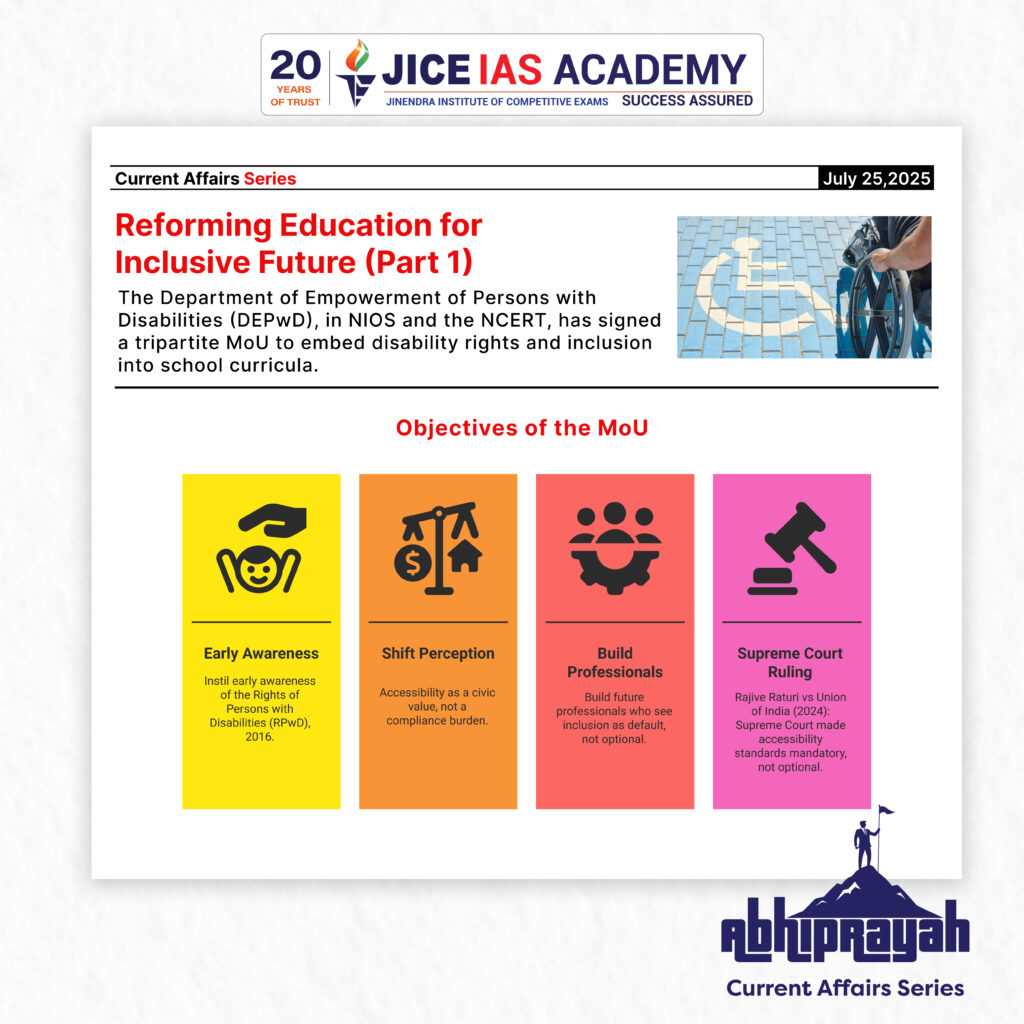
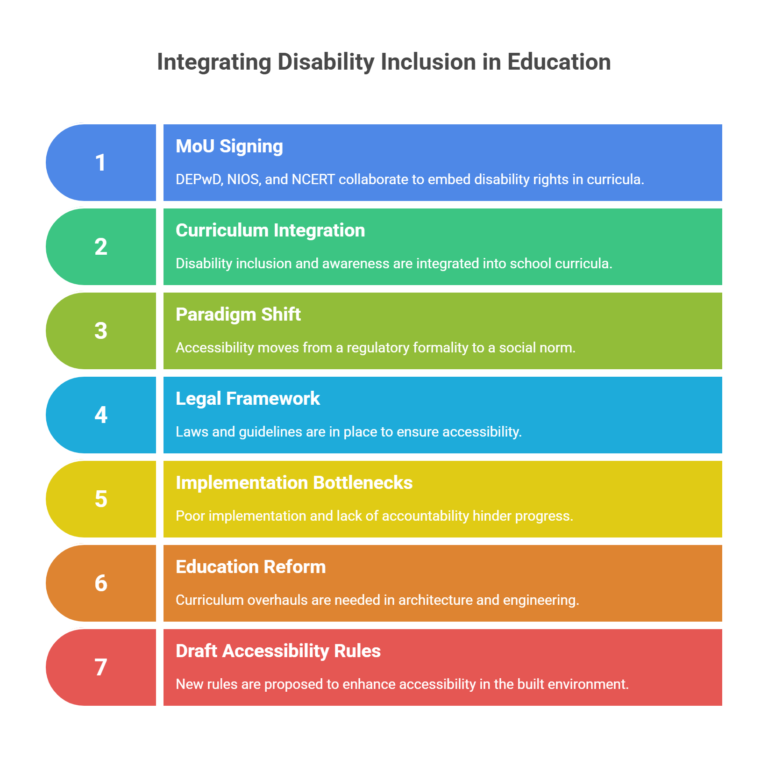
  • Department of Empowerment of Persons with Disabilities (DEPwD), in collaboration with the National Institute of Open Schooling (NIOS) and the National Council of Educational Research and Training (NCERT), has signed a tripartite Memorandum of Understanding (MoU) to embed disability rights and inclusion into school curricula.

  • This aims to integrate the values of disability inclusion and awareness of the Rights of Persons with Disabilities (RPwD) Act, 2016 into school curricula — a much-needed recognition that inclusion begins in the classroom, not in courtrooms or construction sites.

The Missing Link in Built Environment: Education

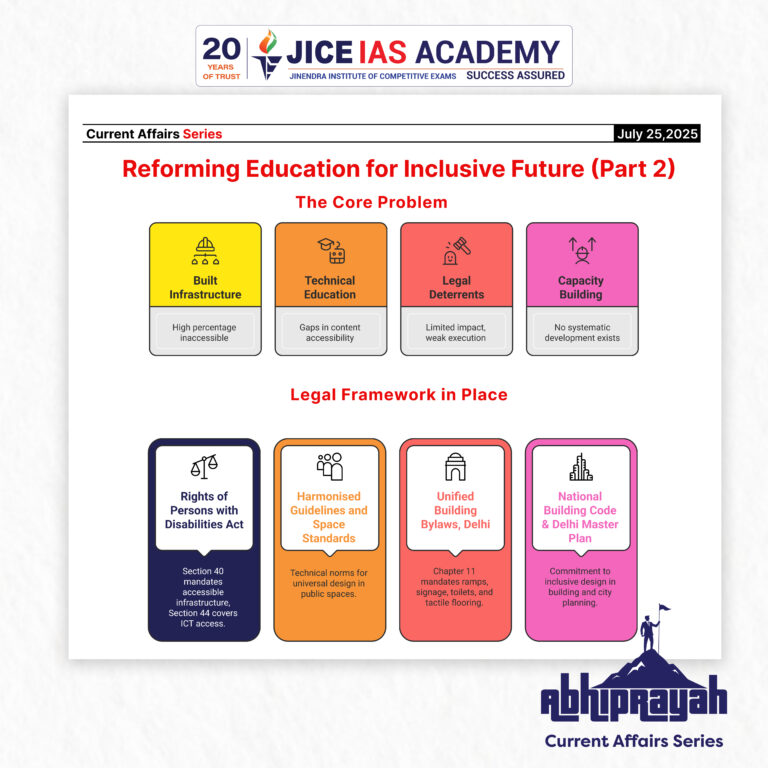
Despite legal mandates, India’s built environment remains largely inaccessible:

  • A 2016 audit under the Accessible India Campaign found that in Delhi:
    • 30% of government buildings lacked ramps.
    • 82% of public toilets were inaccessible.
    • 94% of healthcare facilities were not designed for persons with disabilities.

These statistics reveal a deep-rooted design bias — not from intent but from lack of knowledge and training among architects, engineers, developers, and contractors.

Gaps in Technical Education

  • Prestigious institutions like IIT Delhi (B.Tech. in Computer Science) and School of Planning and Architecture (B.Arch) do not mandate accessibility education.
  • Unlike fire safety, which is institutionalized in curricula and compliance frameworks, accessibility is marginalized or elective.
  • Professionals graduate without skills to design tactile paths, usable ramps, or accessible digital tools, despite being tasked with building infrastructure for all.

Strong Laws, Weak Enforcement

Legal Framework in Place

India’s legislative and regulatory environment is not lacking in guidance:

  • Rights of Persons with Disabilities Act, 2016:
    • Section 40: Mandatory standards for accessible public infrastructure.
    • Section 44: Access to information and communication technology.
  • Harmonised Guidelines and Space Standards (2021): Technical norms for universal design.
  • Unified Building Bylaws (UBBL), Delhi:
    • Chapter 11 includes mandates for ramps, signage, toilets, tactile flooring.
  • National Building Code & Delhi Master Plan 2041: Commit to inclusive design.

Implementation Bottlenecks

  • Rajive Raturi vs Union of India (2024): Supreme Court made accessibility standards mandatory, not optional.
  • But the ground reality remains unchanged — poor implementation, fragmented accountability, and token compliance.
  • Developers, who play a crucial role, are not explicitly accountable under current frameworks like the UBBL.
  • There is no systematic capacity-building of officials, engineers, or masons — a gap even courts have repeatedly noted.

Penalty vs Pedagogy: What’s Missing

Penalties Exist but Don’t Work Alone

  • Section 89, RPwD Act: Fines up to ₹5 lakh for non-compliance.
  • Delhi Municipal Corporation Act (1957): Penal provisions for unauthorized constructions.
  • UBBL provisions: Threaten license cancellations and public blacklisting.

But legal deterrents alone have limited impact in the absence of:

  • Education and training
  • Monitoring capacity
  • Design thinking for accessibility

Courts’ Emphasis on Sensitisation

  • In Nipun Malhotra vs GNCTD (2018), Delhi HC stressed the need for training of municipal authorities and planners.
  • The Delhi State Commissioner for PwDs has also ordered training for masons and contractors, not just officers.

Textbook Before Rulebook: Making Inclusion Foundational

MoU as a Template for Wider Reform

The school-level reform is a first step — but cannot be isolated. There must be:

  • Curriculum overhauls in architecture, engineering, planning, and computer science.
  • Regulatory bodies like AICTE and Council of Architecture must make accessibility training mandatory, not optional.
  • Inclusion must become a core design competency, like safety or sustainability.

Current Opportunity: Draft Accessibility Rules, 2025

  • In response to the SC’s directive, DEPwD released a draft of the Built Environment Accessibility Rules (May 2025).
  • But without corresponding education reforms, these new rules risk becoming another bureaucratic exercise — more paper, no change.

Introduction

Economic Implications

For Indian Exporters

  • These reforms reduce transaction costs and compliance hurdles
  • Encourage a more competitive and efficient export environment
  • Promote value addition in key sectors like leather

For Tamil Nadu

  • The reforms particularly benefit the state’s leather industry, a major contributor to employment and exports
  • Boost the marketability of GI-tagged E.I. leather, enhancing rural and traditional industries

For Trade Policy

  • These decisions indicate a shift from regulatory controls to policy facilitation

Reinforce the goals of Make in India, Atmanirbhar Bharat, and India’s ambition to become a leading export power

Recently, BVR Subrahmanyam, CEO of NITI Aayog, claimed that India has overtaken Japan to become the fourth-largest economy in the world, citing data from the International Monetary Fund (IMF). 

India’s rank as the world’s largest economy varies by measure—nominal GDP or purchasing power parity (PPP)—each with key implications for economic analysis.

Significance and Applications

Leave a Reply

Your email address will not be published. Required fields are marked *

Call Us Now !

Copyright © JICE ACADEMY FOR EXCELLENCE PRIVATE LIMITED