UPSC CURRENT AFFAIRS – 28th July 2025

Home / UPSC / Current Affairs / Revisiting the Age of Consent under POCSO for Protection of Adolescent Autonomy

Revisiting the Age of Consent under POCSO for Protection of Adolescent Autonomy

Why in News?

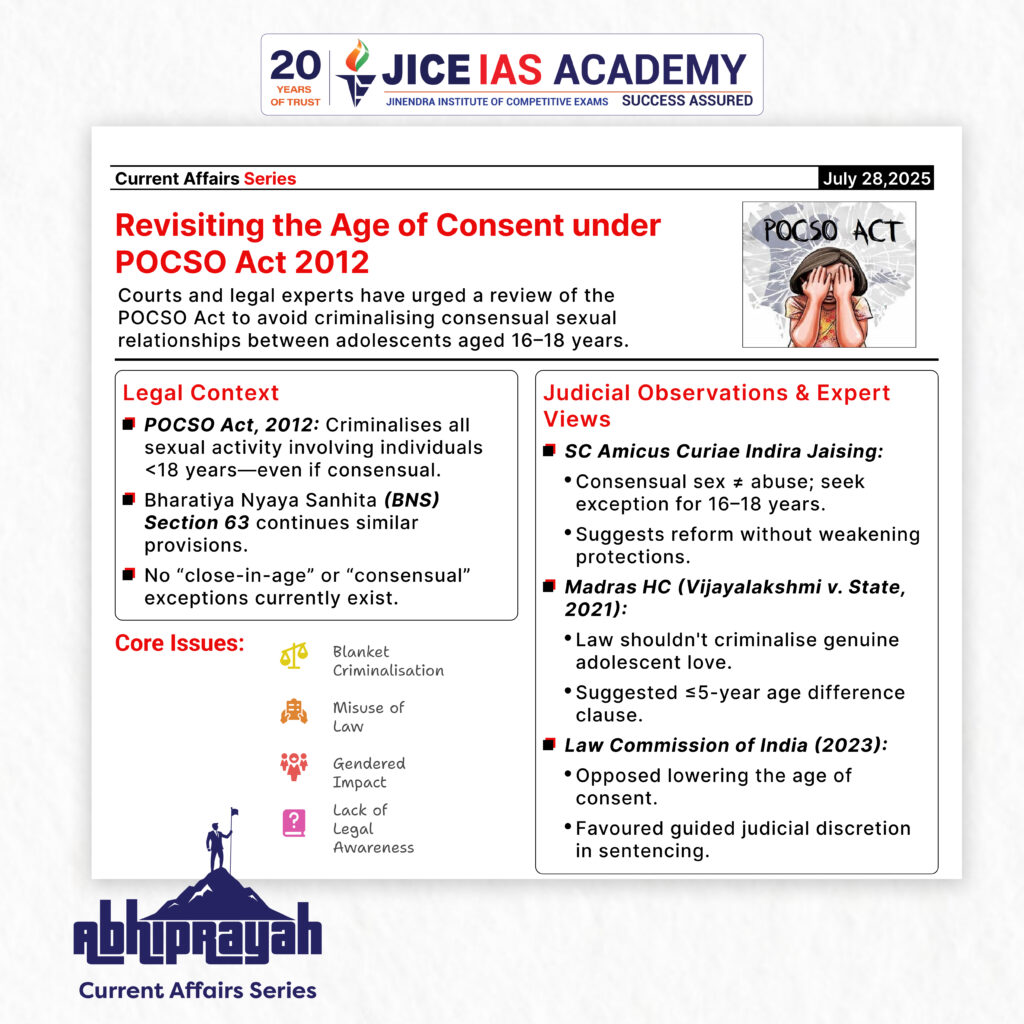
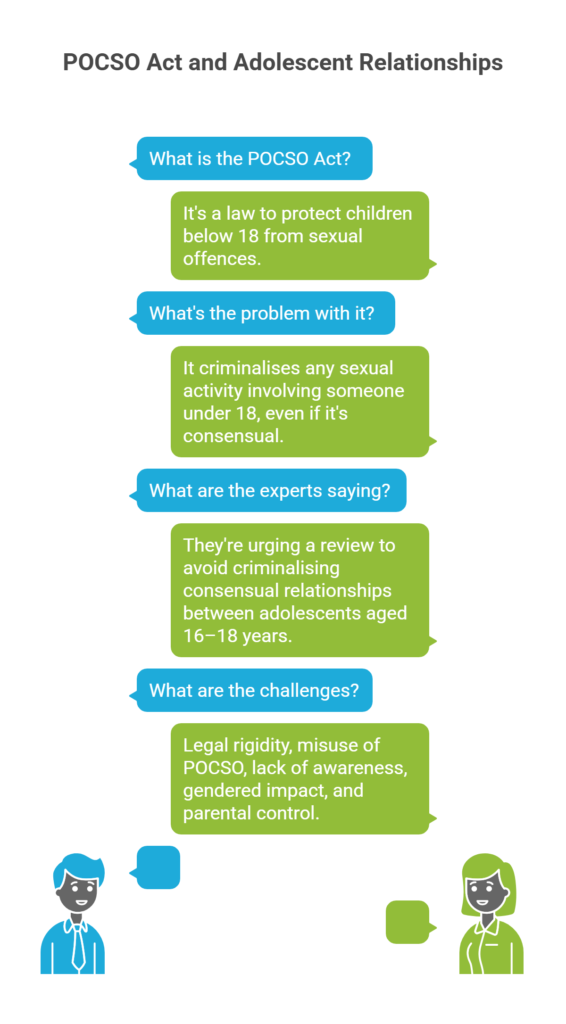
  • Courts and legal experts have urged a review of the POCSO Act to avoid criminalising consensual sexual relationships between adolescents aged 16–18 years.

Introduction

  • The Protection of Children from Sexual Offences (POCSO) Act, 2012 was enacted to protect children below 18 years from sexual offences.
  • However, recent judicial observations and advocacy inputs have flagged its unintended consequences, especially regarding consensual relationships between adolescents aged 16–18 years.

Key Issue

  • Under current law, any sexual activity involving a person below 18 years is criminalised, even if it is consensual and non-exploitative.
  • The POCSO Act, along with the Bharatiya Nyaya Sanhita (BNS) provisions, treats consensual adolescent relationships as criminal, ignoring the complexities of adolescent development and autonomy.

Judicial Developments & Expert Intervention

Indira Jaising, appointed as amicus curiae in a petition filed by Nipun Saxena, submitted to the Supreme Court that:

  • The law must recognize that consensual sex between adolescents aged 16–18 years is not “abuse”.
  • She proposed that an exception be read into the POCSO Act and Section 63 of the BNS.
  • Such an exception would protect adolescents from punitive action in non-exploitative relationships, without diluting the protective spirit of the law.
  • The Madras High Court (2021) in Vijayalakshmi vs State Rep observed:
    • Criminal law should not disrupt consensual adolescent relationships.
    • Recommended a maximum five-year age difference to ensure the younger party is not exploited.
  • The Law Commission of India (2023):
    • Opposed lowering the age of consent.
    • Recommended “guided judicial discretion” while sentencing in consensual cases involving adolescents.

Challenges

  • Legal Rigidity vs Social Reality: The law’s blanket criminalisation does not align with adolescent behaviour patterns and sexual maturity.
  • Misuse of POCSO: Increasing cases where consensual teenage relationships are prosecuted due to parental complaints.
  • Lack of Adolescent Awareness: Many are unaware of the legal consequences of consensual intimacy.
  • Gendered Impact: Adolescent boys are often disproportionately criminalised.
  • Parental and Societal Control: Law is sometimes weaponised to enforce caste, religious, or social boundaries in young relationships.

Way Forward

  • Legislative Amendment or Judicial Interpretation: Introduce a “close-in-age” exception (e.g., 16–18 years with ≤5-year age gap) into the POCSO Act.
  • Use of Judicial Discretion: In line with Law Commission suggestions, allow judges to differentiate exploitative and non-exploitative cases.
  • Comprehensive Sexuality Education: Educate adolescents about bodily autonomy, legal boundaries, and consent.
  • Sensitisation of Police and Judiciary: Train stakeholders to handle such cases with sensitivity and nuance.
  • Safeguard Against Exploitation: Retain strict penalties for genuinely exploitative relationships or abuse of power dynamics.

Conclusion

  • The POCSO Act was enacted with the noble intent of safeguarding children from abuse, but it must evolve with societal realities and developmental science.
  • Recognising consensual adolescent relationships, within a protective framework, is not diluting protection—it is ensuring justice.

Introduction

Economic Implications

For Indian Exporters

  • These reforms reduce transaction costs and compliance hurdles
  • Encourage a more competitive and efficient export environment
  • Promote value addition in key sectors like leather

For Tamil Nadu

  • The reforms particularly benefit the state’s leather industry, a major contributor to employment and exports
  • Boost the marketability of GI-tagged E.I. leather, enhancing rural and traditional industries

For Trade Policy

  • These decisions indicate a shift from regulatory controls to policy facilitation

Reinforce the goals of Make in India, Atmanirbhar Bharat, and India’s ambition to become a leading export power

Recently, BVR Subrahmanyam, CEO of NITI Aayog, claimed that India has overtaken Japan to become the fourth-largest economy in the world, citing data from the International Monetary Fund (IMF). 

India’s rank as the world’s largest economy varies by measure—nominal GDP or purchasing power parity (PPP)—each with key implications for economic analysis.

Significance and Applications

One Response

Leave a Reply to Kisisel Hesap Olusturun Cancel reply

Your email address will not be published. Required fields are marked *

Call Us Now !

Copyright © JICE ACADEMY FOR EXCELLENCE PRIVATE LIMITED