UPSC CURRENT AFFAIRS – 28th July 2025
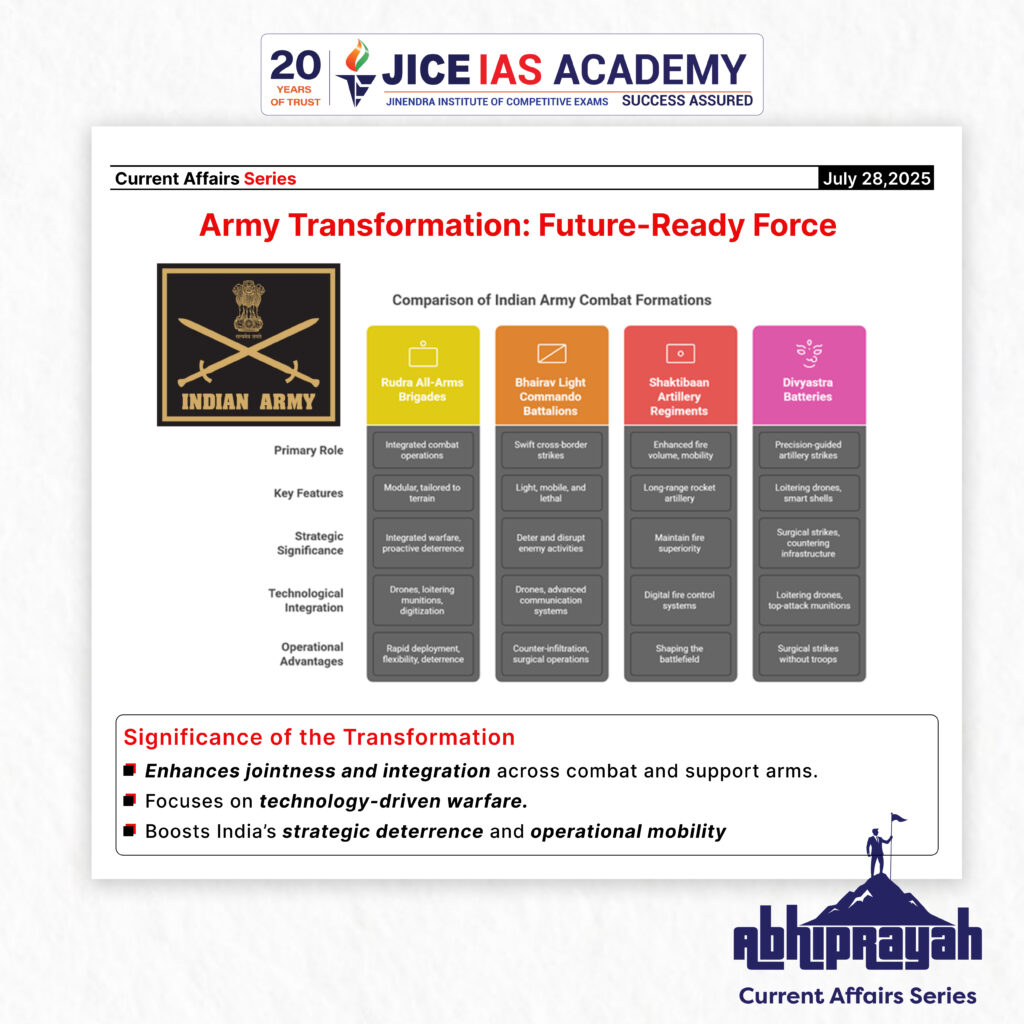
Rudra all-arms brigades will make Army future-ready
Why in News?
Announced by Army Chief Gen. Upendra Dwivedi during Kargil Vijay Diwas, the Rudra Brigades are the cornerstone of a broader Integrated Battle Group (IBG) initiative aimed at modernizing the force structure
Introduction
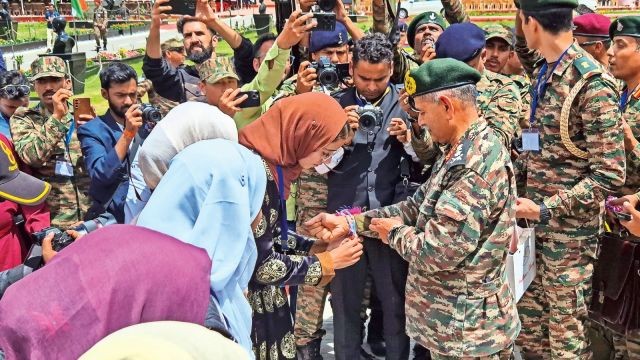
On the occasion of the 26th Vijay Diwas (Kargil Victory Day) on July 26, 2025, Chief of Army Staff (COAS) General Upendra Dwivedi visited Drass, Kargil, to honour the sacrifice of soldiers in the 1999 Kargil War. He used the platform to:
- Outline the Indian Army’s future-ready transformation strategy.
- Highlight the successful cross-border counter-terror operation, Operation Sindoor, launched after the Pahalgam attack.
Transforming the Indian Army: Towards a Future-Ready Force
General Dwivedi announced a major restructuring and modernization drive aimed at creating a highly integrated, technologically advanced, and responsive fighting force.
Key New Units and Capabilities Introduced
New Unit/Initiative | Description |
Rudra All Arms Brigades | Integrated formations combining infantry, mechanised infantry, armour, artillery, special forces, and unmanned aerial units for synergised combat and logistics support. |
Bhairav Light Commando Battalions | Light, agile, quick-response commando units trained for high-altitude, anti-terror, and special operations. |
Shaktibaan Artillery Regiments | Enhanced precision artillery formations, likely equipped with long-range and smart artillery systems. |
Divyastra Batteries | Units focused on drone warfare and counter-drone operations, integrated within infantry battalions. |
Indigenous Air Defence Systems | Deployment of made-in-India air defence platforms, promoting Atmanirbhar Bharat in defence. |
Rudra All Arms Brigades:
- Background and Strategic Need
- The Rudra Brigades are a new combat formation initiative by the Indian Army to address modern battlefield challenges.
- They are being formed as part of the Indian Army’s transformation towards a lean, agile, and technology-driven force.
- The concept evolved from lessons learned in recent operations and reflects India’s growing focus on integrated warfare and proactive deterrence against adversaries on both western and northern borders.
- Organizational Structure
- These brigades integrate multiple combat arms and support elements under a single unified command.
- Composition includes:
- Infantry
- Mechanised Infantry
- Armoured Units
- Artillery
- Special Forces components
- Drone platoons and air defence elements
- Combat engineers and logistics teams
- The structure is modular and tailored to operational terrain:
- Plains: Emphasis on mechanised and armoured elements.
- Mountains: Light infantry, drones, and artillery support.
- LoC: Infantry, Special Forces, and surveillance capabilities.
- Technological Integration
- Each brigade will be equipped with:
- Drone platoons for surveillance and attack roles.
- Loitering munitions and precision-guided artillery.
- Advanced air defence systems and real-time battlefield communication tools.
- The transformation includes digitization, real-time ISR (Intelligence, Surveillance, Reconnaissance), and AI-supported targeting.
- Operational Advantages
- Rapid Deployment: Units can respond within 12–48 hours across multiple fronts.
- Flexibility: Can be reconfigured for various missions and geographies.
- Enhanced Deterrence: Offers credible offensive and defensive capabilities in a compact format.
- Efficient Resource Use: Instead of expanding the force size, existing brigades are being reorganized for higher effectiveness.
Bhairav Light Commando Battalions
Overview
- Newly raised light, mobile, and lethal commando units designed for swift cross-border strikes, surveillance, and special missions.
- Named “Bhairav”, symbolizing destruction of evil and tactical surprise.
Key Features
- Highly agile units, lighter than traditional Special Forces.
- Equipped with drones, loitering munitions, and advanced communication systems.
- Trained for terrain-specific warfare—mountains, deserts, jungles, and urban areas.
- Operate close to the border for quick retaliation and offensive strikes.
- Ideal for counter-infiltration, surgical operations, and shock actions against enemy posts.
Strategic Significance
- Designed to deter and disrupt enemy activities along LoC and LAC.
- Complements Special Forces without overlapping their strategic roles.
- Enables the Army to launch quick-reaction missions without large-scale mobilization.
Shaktibaan Artillery Regiments
Overview
- These are upgraded artillery units with enhanced volume-of-fire capability and mobility.
- “Shaktibaan” (meaning powerful) symbolizes massive firepower in battlefield operations.
Key Features
- Equipped with long-range rocket artillery, 155mm howitzers, and multi-barrel rocket launchers.
- Designed for area saturation, suppression of enemy fire, and support to advancing infantry/mechanised units.
- Improved target acquisition through digital fire control systems and satellite mapping.
Strategic Significance
- Helps maintain fire superiority in both offensive and defensive scenarios.
- Plays a crucial role in shaping the battlefield before ground assault.
- Forms part of the Army’s effort to counter massed Chinese artillery and precision Pakistani strikes.
Divyastra Batteries
Overview
- “Divyastra” (meaning divine weapon) Batteries are specialized precision-guided artillery detachments.
- Focused on deep-strike capabilities using loitering munitions and smart ammunition.
Key Features
- Equipped with loitering drones, top-attack munitions, and smart shells.
- Designed to pinpoint high-value enemy targets like command posts, air defences, and logistics hubs.
- Can operate independently or in support of Rudra Brigades and Bhairav units.
Strategic Significance
- Enhances India’s capability to conduct surgical strikes without deploying troops.
- Key to countering entrenched enemy infrastructure in forward positions.
- Reduces collateral damage while increasing battlefield effectiveness.
Significance of the Transformation
- Enhances jointness and integration across combat and support arms.
- Focuses on technology-driven warfare, including use of UAVs, drones, and real-time intelligence.
- Boosts India’s strategic deterrence and operational mobility, especially along sensitive borders.

3rd UN conference on landlocked countries
UPSC CURRENT AFFAIRS – 08th August 2025 Home / 3rd UN conference on landlocked countries Why in News? At the

Issue of soapstone mining in Uttarakhand’s Bageshwar
UPSC CURRENT AFFAIRS – 08th August 2025 Home / Issue of soapstone mining in Uttarakhand’s Bageshwar Why in News? Unregulated

Groundwater Pollution in India – A Silent Public Health Emergency
UPSC CURRENT AFFAIRS – 08th August 2025 Home / Groundwater Pollution in India – A Silent Public Health Emergency Why

Universal banking- need and impact
UPSC CURRENT AFFAIRS – 08th August 2025 Home / Universal banking- need and impact Why in News? The Reserve Bank

India’s “Goldilocks” Economy: A Critical Appraisal
UPSC CURRENT AFFAIRS – 08th August 2025 Home / India’s “Goldilocks” Economy: A Critical Appraisal Why in News? The Finance

U.S.-India Trade Dispute: Trump’s 50% Tariffs and India’s Oil Imports from Russia
UPSC CURRENT AFFAIRS – 07th August 2025 Home / U.S.-India Trade Dispute: Trump’s 50% Tariffs and India’s Oil Imports from
Eco-Friendly Solution to Teak Pest Crisis: KFRI’s HpNPV Technology
UPSC CURRENT AFFAIRS – 07th August 2025 Home / Eco-Friendly Solution to Teak Pest Crisis: KFRI’s HpNPV Technology Why in

New Species of Non-Venomous Rain Snake Discovered in Mizoram
UPSC CURRENT AFFAIRS – 07th August 2025 Home / New Species of Non-Venomous Rain Snake Discovered in Mizoram Why in

Introduction
Economic Implications
For Indian Exporters
- These reforms reduce transaction costs and compliance hurdles
- Encourage a more competitive and efficient export environment
- Promote value addition in key sectors like leather
For Tamil Nadu
- The reforms particularly benefit the state’s leather industry, a major contributor to employment and exports
- Boost the marketability of GI-tagged E.I. leather, enhancing rural and traditional industries
For Trade Policy
- These decisions indicate a shift from regulatory controls to policy facilitation
Reinforce the goals of Make in India, Atmanirbhar Bharat, and India’s ambition to become a leading export power
Recently, BVR Subrahmanyam, CEO of NITI Aayog, claimed that India has overtaken Japan to become the fourth-largest economy in the world, citing data from the International Monetary Fund (IMF).
India’s rank as the world’s largest economy varies by measure—nominal GDP or purchasing power parity (PPP)—each with key implications for economic analysis.