
UPSC CURRENT AFFAIRS – 19th May 2025

Home / UPSC / Current Affairs / Scheme to produce electronic components

Scheme to produce electronic components

electronics manufacturing scheme

Why in News?

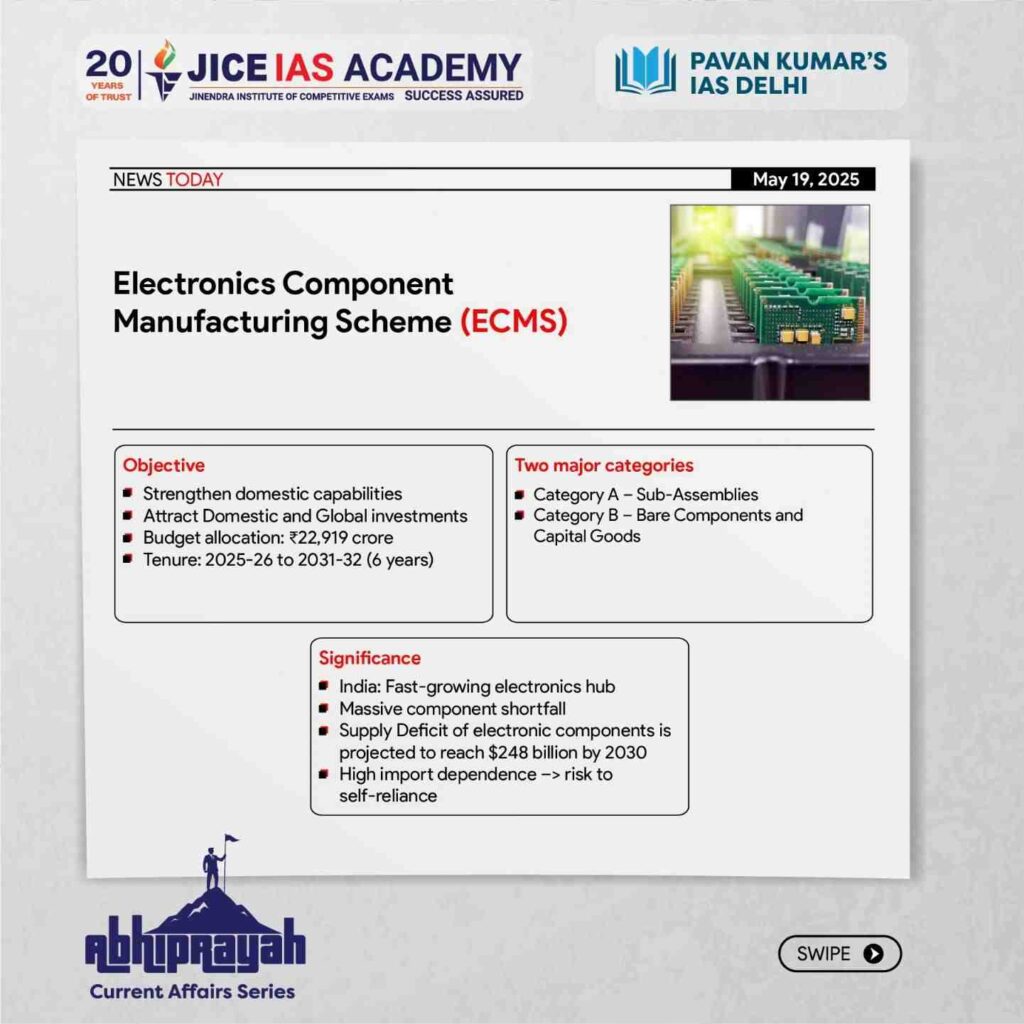
The ₹22,805-crore Electronics Component Manufacturing Scheme (ECMS) aims to reduce import dependence and bridge the demand-supply gap in electronic components by supporting domestic production, especially among SMEs.

Introduction

  • The Government of India launched the Electronics Component Manufacturing Scheme (ECMS) on May 1, 2025, with a financial outlay of ₹22,805 crore
  • The scheme is designed to strengthen India’s domestic capabilities in the manufacturing of electronic components and sub-assemblies, thereby reducing reliance on imports and supporting the goal of self-reliance under the Atmanirbhar Bharat initiative.

Purpose of the Scheme

  • India is rapidly growing as a global electronics manufacturing hub. However, there is a significant demand-supply deficit in the production of key electronic inputs.
  • According to the Electronic Industries Association of India (Elcina):
  • By the year 2030, the deficit in the supply of electronic components is projected to reach $248 billion (approximately ₹21 lakh crore).
  • This shortfall is in the context of an anticipated $500 billion electronics production market in India.
  • Without intervention, most of the required components would need to be imported, undermining the government’s efforts to promote domestic manufacturing.
  • The ECMS aims to bridge this gap by encouraging the establishment and expansion of component and sub-assembly manufacturing facilities within India.

Structure and Funding of the Scheme

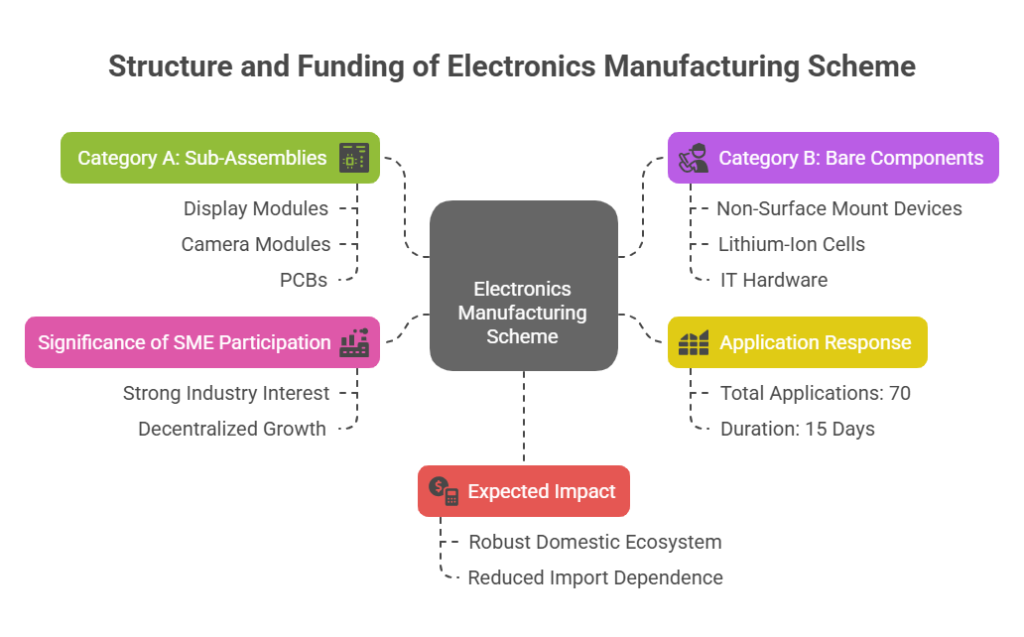
The total financial outlay of ₹22,805 crore is divided into two major categories:

  1. Category A – Sub-Assemblies
    • Fund Allocation: ₹21,093 crore
    • Focus: To support the manufacturing of high-value electronic sub-assemblies that go directly into final products.
    • Eligible Products Include:
    • Display modules (used in televisions, smartphones, and monitors)
    • Camera modules (used in mobile phones, surveillance equipment)
    • Multi-layered printed circuit boards (PCBs)
    • Flexible PCBs
    • Passive components (such as resistors and capacitors that are machine-mounted on PCBs)
  1. Category B – Bare Components and Capital Goods
    • Fund Allocation: ₹1,712 crore
    • Focus: To encourage the production of core components and machinery essential for electronics manufacturing.
    • Eligible Products Include:
      • Non-surface mount devices
      • Bare multi-layered PCBs
      • Lithium-ion cells (used in digital devices)
      • IT hardware components and devices
      • Capital goods and machinery used in the electronics manufacturing process
  • Application Response
    • Since applications opened on May 1, 2025, the scheme has received a strong response:
    • Total Applications Received: 70
    • Duration: Within just 15 days
  • Key Observation: According to Union Minister Ashwini Vaishnaw, 80 percent of the applications have come from small and medium enterprises (SMEs).
  • While the minister did not disclose specific names, sources have indicated that large companies such as Tata Electronics, Dixon Technologies, and Foxconn have shown interest in the scheme.
structure and funding of electronics manufacturing scheme

Significance of SME Participation

  • The large share of applications from small and medium enterprises is particularly significant. It reflects:
  • Strong interest in electronics manufacturing across the broader industry, beyond just large corporations.
  • The potential for decentralized industrial growth, with opportunities in tier-2 and tier-3 cities.
  • Increased scope for innovation, employment generation, and skill development.

Expected Impact

  • Development of a robust domestic ecosystem for electronics manufacturing.
  • Reduction in import dependence, improving the country’s trade balance.
  • Support for the Make in India and Digital India initiatives by ensuring the availability of locally manufactured, high-quality components.
  • Decreased oxygen-carrying capacity of RBCs.
  • Increased fragility and cell stiffness.
  • Vascular blockage, causing pain and organ injury.
  • Increased susceptibility to infections, anemia, and stroke.

Past Illegal Allotments Invalid

Leave a Reply

Your email address will not be published. Required fields are marked *

Call Us Now !

Copyright © JICE ACADEMY FOR EXCELLENCE PRIVATE LIMITED