
UPSC CURRENT AFFAIRS – 23th May 2025

Home / UPSC / Current Affairs / Why India needs stable urban forests

Why India needs stable urban forests

urban forests case study of kancha gachibowli

Why in News?

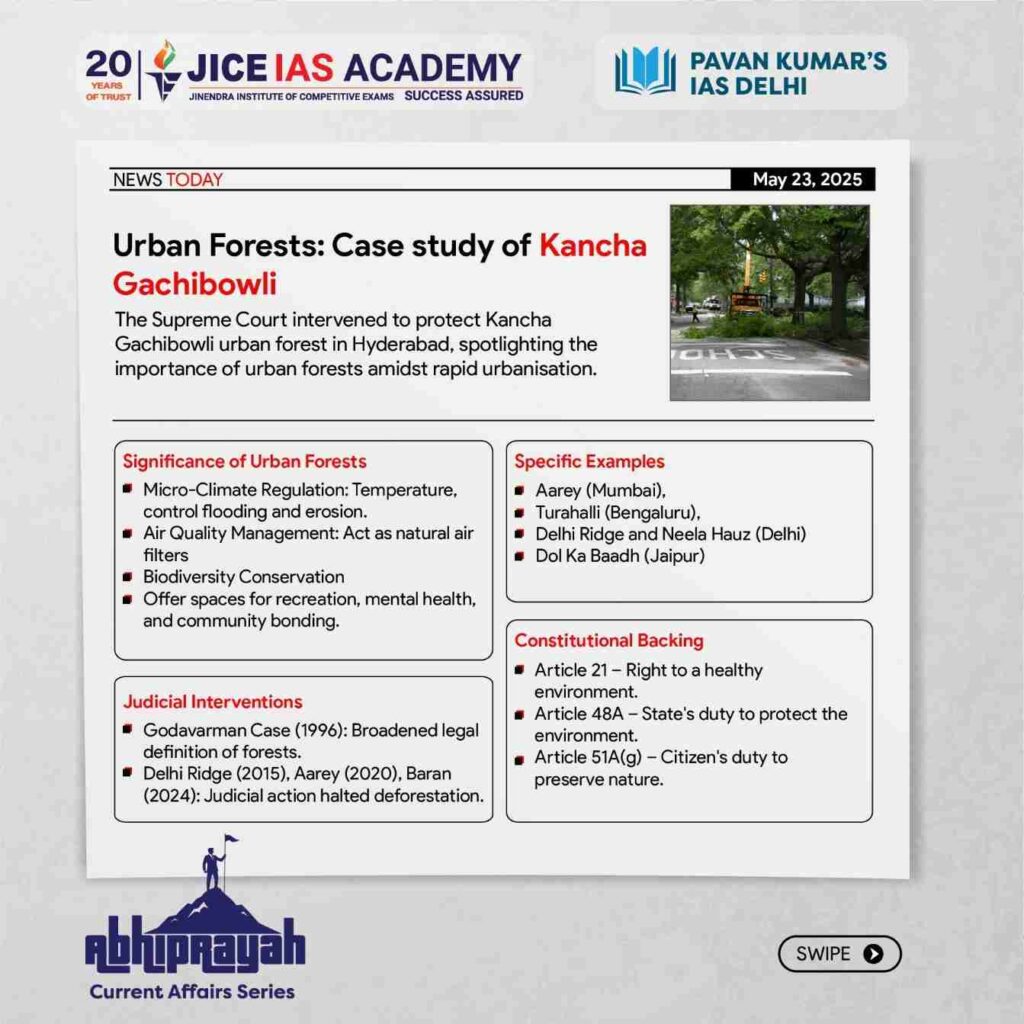
  • The Supreme Court intervened to protect Hyderabad’s Kancha Gachibowli urban forest, highlighting the critical role of urban forests in sustainable city development and environmental governance.
india needs stable urban forests

Introduction

  • Urban forests, often the last bastions of green cover in rapidly growing Indian cities, are facing an existential crisis. 
  • The recent case of Kancha Gachibowli in Hyderabad, where 400 acres were earmarked for industrial development, exemplifies the growing conflict between environmental conservation and urban expansion.
  • The Supreme Court’s intervention, following the felling of 100 acres of trees, brought national attention to the importance of preserving urban forests amidst development pressures.

Significance of Urban Forests

Urban forests — such as Aarey in Mumbai, Turahalli in Bengaluru, Neela Hauz and the Delhi Ridge, and Dol Ka Baadh in Jaipur — play a pivotal role in sustaining urban ecosystems and enhancing the quality of urban life. They serve multiple environmental, health, and social functions:

  • Environmental Protection: They reduce the urban heat island effect, mitigate climate change, absorb pollutants, and control stormwater runoff, erosion, and flooding.
  • Air Quality Management: With urban AQI levels soaring — Delhi reported an AQI of 494 in November 2024 — green spaces act as natural air filters. As per a 2006 USDA study, one hectare of trees can remove up to one ton of air pollutants annually.
  • Biodiversity Conservation: Urban forests provide crucial habitats for endangered flora and fauna, ensuring ecological balance within city limits.
  • Cultural and Social Value: These forests offer spaces for recreation, relaxation, and community engagement, fostering a nature-sensitive urban culture.
urban forest conservation

The Role of Judicial Interventions

India’s judicial system has played a vital role in safeguarding urban forests:

  • Godavarman Case (1996): Expanded the legal definition of forests, enabling protection of urban green spaces.
  • Supreme Court Orders (2004): Directed all States to identify and map forested areas.
  • Delhi Ridge Protection (2015): The Delhi High Court ordered notification and protection of the ecologically sensitive Aravalli wildlife corridor.
  • Save Aarey Movement (2020): The apex court stayed tree felling in Mumbai following public outcry.
  • Baran, Rajasthan (2024): The Rajasthan High Court took suo motu cognisance of illegal tree felling in biodiversity-rich areas.

These rulings reinforce the constitutional provisions:

  • Article 21: Right to life includes the right to a healthy environment.
  • Article 48A: Mandates the State to protect and improve the environment.
  • Article 51A(g): Places a fundamental duty on citizens to protect the natural environment.

The Way Forward

India’s urbanisation must not come at the cost of environmental degradation. The threat to urban forests signifies a larger crisis affecting our biomedical, social, and cultural well-being. Citizens, civil society, judiciary, and the State must work collaboratively to:

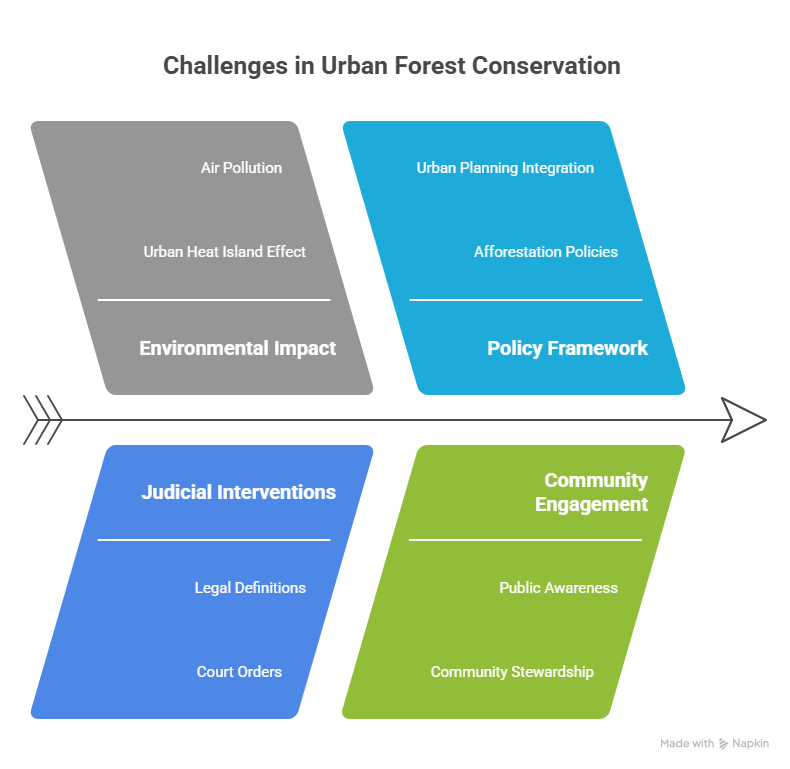
  • Ensure legal protection of all identified urban forests.
  • Integrate green cover targets in urban development plans.
  • Promote public awareness and community stewardship.
  • Strengthen implementation of environmental laws and urban forestry programmes.

Leave a Reply

Your email address will not be published. Required fields are marked *

Call Us Now !

Copyright © JICE ACADEMY FOR EXCELLENCE PRIVATE LIMITED