UPSC CURRENT AFFAIRS – 26th July 2025

Home / UPSC / Current Affairs / Startup20: Giving Startups a Seat at the G20 Policy Table

Startup20: Giving Startups a Seat at the G20 Policy Table

Why in News?

  • With South Africa’s G20 Presidency in 2025, Startup20 has entered its third year, continuing to evolve as the world’s highest policy forum for start-up and SME ecosystems.

Introduction

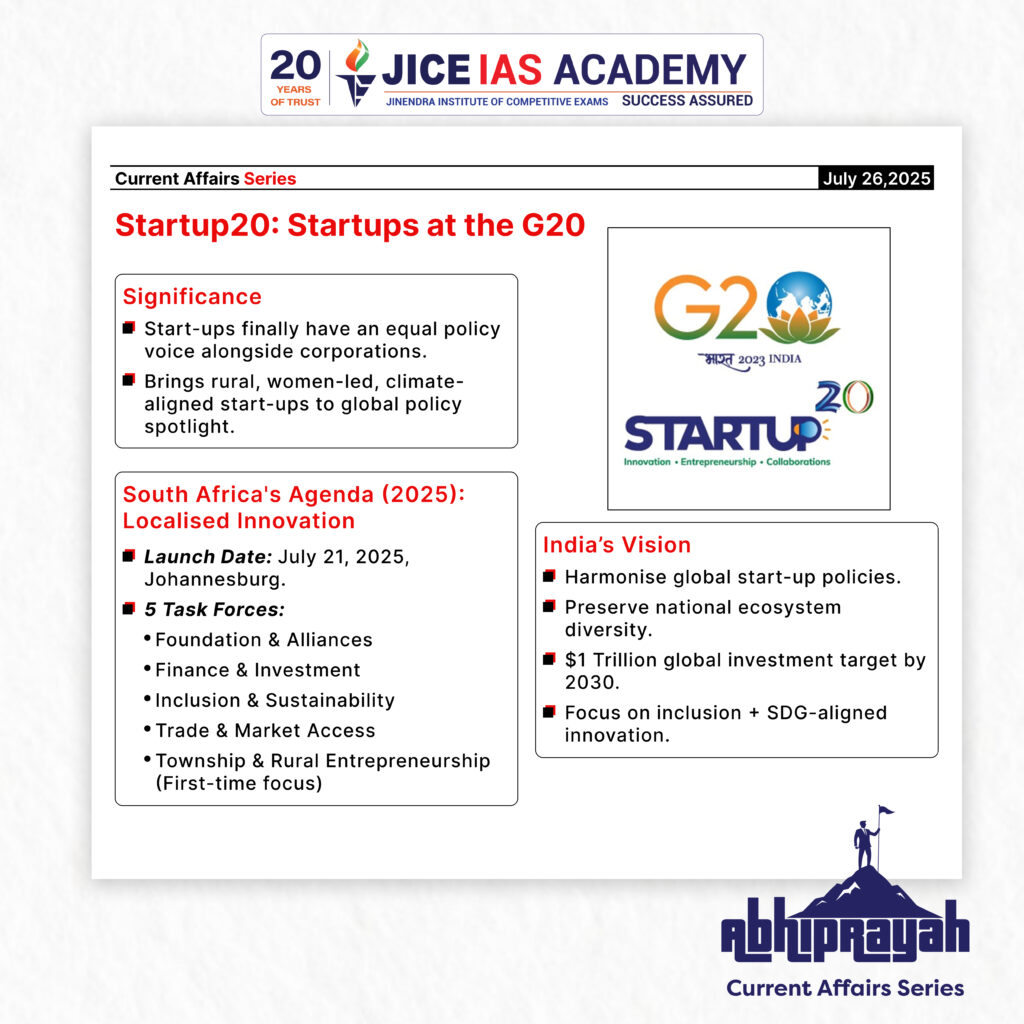
  • A landmark development under India’s G20 Presidency in 2023 was the formal recognition of Startup20 as an official G20 Engagement Group. For the first time, emerging start-ups and SMEs gained a dedicated platform to shape global policy — complementing the traditional Business20 (B20) platform for large enterprises.

Background and Evolution of Startup20

  • 2021 (Italy): First G20 Start-up competition – G20 Innovation League.
  • 2022 (Indonesia): G20 Digital Innovation Network established.
  • 2023 (India): Formal institutionalisation of Startup20 as a G20 Engagement Group.

This journey reflected a growing consensus: start-ups and SMEs are critical engines of inclusive, sustainable, and innovation-driven global growth.

India’s Vision and Contributions

India, with its rapidly expanding start-up ecosystem, spearheaded the creation of Startup20 with two primary objectives:

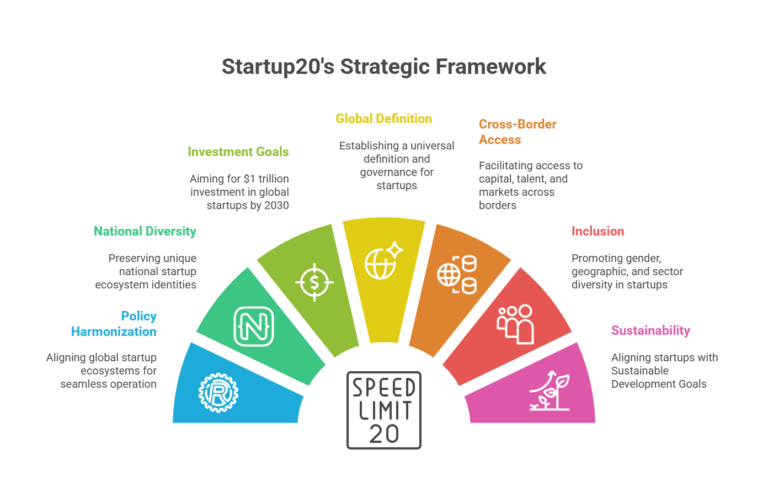
  1. Policy harmonisation of global start-up ecosystems.
  2. Preservation of national ecosystem diversity and autonomy.

India’s inaugural policy communiqué under Startup20 proposed:

  • A collective investment goal of $1 trillion by 2030 into global start-up ecosystems.
  • Development of a global start-up definition and governance framework.
  • Enabling cross-border access to capital, talent, and markets.
  • Promoting inclusion (gender, geography, sectors).
  • Scaling start-ups aligned with Sustainable Development Goals (SDGs).


South Africa’s Presidency and the 2025 Startup20 Agenda

Launched on July 21, 2025, in Johannesburg, South Africa’s Startup20 focuses on:

Five Key Task Forces

  1. Foundation and Alliances
  2. Finance and Investment
  3. Inclusion and Sustainability
  4. Trade and Market Access
  5. Township and Rural Entrepreneurship

Notable Firsts under South Africa

  • First-time focus on rural and township entrepreneurship.
  • Private-sector leaders representing national start-up interests.

A deliberate push to develop an implementation mechanism for policy recommendations.

Critical Challenges Identified

While Startup20 has created a structured process for policy formulation, two major gaps remain:

  1. Lack of a mechanism to translate recommendations into national policies.
  2. No continuity mechanism between presidencies.

Proposed Solution

Establishment of an international Startup20 Secretariat to provide long-term coordination — mirroring the entrepreneurial agility it promotes.

Significance of Startup20

  1. A Dual Business Platform
  • B20: Represents large corporations.
  • Startup20: Represents early-stage ventures and SMEs.
  1. Global Policy Voice for Start-ups
  • A platform where global start-up ecosystems can collectively articulate shared needs.
  • Elevates entrepreneurial agility to the highest level of policy dialogue.
  1. Promotes Inclusive and Sustainable Growth
  • Supports underrepresented geographies and communities.
  • Aligns innovation with climate goals, SDGs, and social development.
  1. A Model of Complementarity
  • As demonstrated during the COVID-19 pandemic, collaboration between small innovators (e.g., Moderna, Bharat Biotech) and large firms (e.g., Pfizer, AstraZeneca) is crucial.
  • Startup20 institutionalises such complementary innovation within global governance structures.

Introduction

Economic Implications

For Indian Exporters

  • These reforms reduce transaction costs and compliance hurdles
  • Encourage a more competitive and efficient export environment
  • Promote value addition in key sectors like leather

For Tamil Nadu

  • The reforms particularly benefit the state’s leather industry, a major contributor to employment and exports
  • Boost the marketability of GI-tagged E.I. leather, enhancing rural and traditional industries

For Trade Policy

  • These decisions indicate a shift from regulatory controls to policy facilitation

Reinforce the goals of Make in India, Atmanirbhar Bharat, and India’s ambition to become a leading export power

Recently, BVR Subrahmanyam, CEO of NITI Aayog, claimed that India has overtaken Japan to become the fourth-largest economy in the world, citing data from the International Monetary Fund (IMF). 

India’s rank as the world’s largest economy varies by measure—nominal GDP or purchasing power parity (PPP)—each with key implications for economic analysis.

Significance and Applications

Leave a Reply

Your email address will not be published. Required fields are marked *

Call Us Now !

Copyright © JICE ACADEMY FOR EXCELLENCE PRIVATE LIMITED