UPSC CURRENT AFFAIRS – 28th May 2025

Home / UPSC / Current Affairs / States’ Demand for a Greater Share in Central Taxes

States’ Demand for a Greater Share in Central Taxes

states demand for greater share in central taxes

Why in News?

The 10th Governing Council Meeting of NITI Aayog exposed the gap between the Centre’s rhetoric of “Team India” and the actual imbalance in Centre-State relations, particularly in fiscal and cooperative federalism.

Introduction

  • Prime Minister Narendra Modi’s recent appeal at the 10th Governing Council Meeting of NITI Aayog in New Delhi, urging States and the Centre to function together as “Team India,” underlines the importance of cooperative federalism. 
  • However, the current ground realities indicate a growing gap between this vision and the actual nature of Centre-State relations.

What is the NITI Aayog Governing Council?

The Governing Council is the highest policy-making body under NITI Aayog, comprising:

  • The Prime Minister (Chairperson)
  • Chief Ministers of all States and Union Territories with legislatures
  • Lt. Governors of other UTs

Primary Objective:

  • To foster cooperative federalism and evolve a shared vision of national development priorities.
  • However, it meets only once a year, which is insufficient to address the dynamic and often urgent challenges faced by States.

Current Nature of Centre-State Relations: A One-Way Street

While the “Team India” slogan promotes unity, in practice:

  • The Centre increasingly uses top-down approaches.
  • States are expected to comply with centrally designed schemes and mandates, often without adequate consultation.
  • Federal forums like the NITI Aayog Governing Council and GST Council meet infrequently, limiting meaningful dialogue.
  • Example: The GST Council, which is mandated to meet at least once every quarter, has not met for over five months.
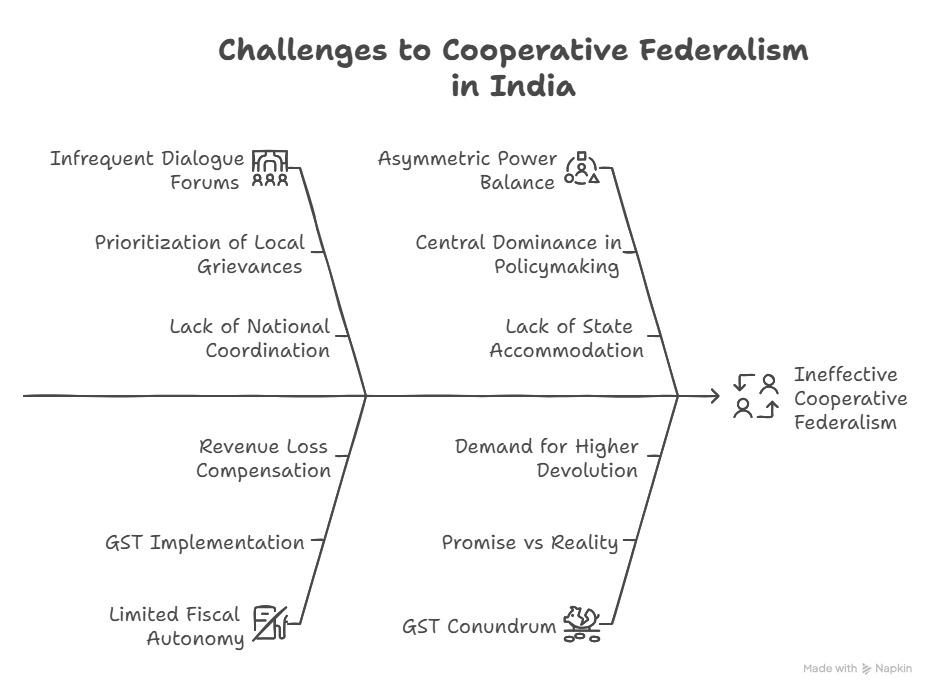
challenges to cooperative federalism in india

Challenges Faced by States

  1. Infrequent Forums for Dialogue:
    • When opportunities arise, States often prioritize voicing local grievances or showcasing achievements rather than broader national coordination.
  2. Limited Fiscal Autonomy:
    • After the implementation of GST, many State-level taxes were subsumed, reducing the States’ capacity to raise their own revenues.
    • Compensation for GST revenue loss was only for five years, post which States are expected to manage on their own.
  3. Asymmetric Power Balance:
    • There’s a perception that the Centre dominates policymaking, with little genuine accommodation for State concerns.

Constructive Suggestions from States: Towards True Cooperative Federalism

Despite limitations, some Chief Ministers proposed collaborative ideas:

1. Andhra Pradesh CM N. Chandrababu Naidu:

Proposed formation of three sub-groups of States to work on:

  • GDP growth & investments
  • Demographic dividend
  • Tech-enabled governance

Why this matters: Smaller working groups can facilitate more focused and frequent cooperation than larger national bodies.

The GST Conundrum: A Case for Fiscal Rebalancing

  • Promise vs Reality: GST was envisioned as a “good and simple tax” that would improve compliance and boost revenue. However, it has only recently managed to surpass the pre-GST indirect tax levels.
  • States Lost Autonomy: Many taxes like octroi, entry tax, entertainment tax, VAT on certain goods, etc., were removed.
  • Demand for Higher Devolution: Since States surrendered part of their taxation power, they are rightfully asking for a greater share of the central pool.

Way Forward:

  • Institutionalising Regular Consultations: Make NITI Aayog and GST Council meetings quarterly or bi-annual events.
  • Revisiting the Fiscal Federalism Framework: Consider higher devolution of taxes and review of Finance Commission recommendations in light of GST performance.
  • Strengthen Bottom-Up Planning: Empower States to initiate policy innovations, and give them the freedom to adapt centrally sponsored schemes to local needs.
  • Encourage Sub-Group Models: Form thematic working groups among States to share best practices and co-develop solutions with Centre’s support.

Leave a Reply

Your email address will not be published. Required fields are marked *

Call Us Now !

Copyright © JICE ACADEMY FOR EXCELLENCE PRIVATE LIMITED