

UPSC CURRENT AFFAIRS – 09th April 2025
Strengthening enforcement of judicial orders
Why in News?
Despite an NGT order limiting air horn usage in Jaipur, lack of enforcement highlights the systemic failures in judicial implementation, emphasizing the need for practical, accountable, and tech-driven compliance mechanisms.
Introduction
- In spite of repeated judicial interventions, including the National Green Tribunal’s (NGT) directive restricting air horn use in central Jaipur at night, poor enforcement by concerned agencies has made such directives ineffective.
- This is a symptom of a deeper problem of systemic enforcement failures that erode the intent and authority of judicial pronouncements in India.
The Problem of Enforcement Gaps
India’s judicial system is strong in giving judgments, but enforcement is usually lacking. The NGT ruling on Jaipur’s air horns is still unenforced after over two years, revealing the enforcement agencies’ lack of interest and institutional failings.
Some of the critical issues are
- Inadequate coordination among enforcement agencies like traffic police, pollution control boards, and transport departments.
- Neglect of “minor” offenses, resulting in gradual cumulative harm.
- Lack of accountability systems in administrative departments to implement court orders.
- This judicial-executive gap erodes public trust in the judiciary as well as in governance.
Judicial Foresight Required
- Judicial rulings must anticipate enforcement hurdles to remain impactful.
- The State of Tamil Nadu v. K. Balu (2017) case, which prohibited liquor sales within 500 metres of highways to prevent drunk driving, is illustrative.
- While well-intentioned, the lack of foresight led to circumvention strategies like reclassification of roads and relocation of outlets, diluting the order’s effectiveness.
Learning from Successful Enforcement
A number of path-breaking judgments reflect that judicial clarification, administrative integration, and surveillance mechanisms are vital to effective implementation:
Common Cause v. Union of India (2018):
- The Supreme Court legalized passive euthanasia but also established practical operational guidelines, such as mandates for medical boards, documentation guidelines, and institutional monitoring.
Taj Trapezium Zone case:
- According to expert suggestions, the Court instructed the establishment of a green belt around Mathura refinery, in addition to continuous air quality monitoring and inter-agency compliance reporting. This is an example of integrated environmental governance by judicial initiative.
Current Legal Framework: CPC Provisions
- Section 38, Code of Civil Procedure (CPC): Gives the court that granted the decree or to which it is transferred the power to enforce it.
- Order 21, CPC: Prescribes the process of execution of decrees but remains underutilized or delayed because of bureaucratic delays or lack of will.
Even with these provisions, decree execution is usually tainted with uncertainty, particularly when there are several agencies involved or when there are jurisdictional overlaps.
Global Example: Kathmandu's Noise Control Success
- Kathmandu’s success in noise pollution reduction was gained through the synergy of strict enforcement and public awareness campaigns.
- This highlights that the enforcement process is not just a mechanical but a participatory process with community involvement, education, and collaborative governance.
Way Forward
In order to overcome systemic enforcement issues, the following reforms are necessary:
- Appointment of Dedicated Compliance Officers: Each government ministry must appoint a nodal officer to carry out court orders, audit, and report non-compliance.
- Technology-Driven Monitoring: AI-powered dashboards and GIS mapping software can assist courts in monitoring compliance by connecting judicial orders with the jurisdiction of certain government departments.
- Positive Reinforcement Mechanisms: Alongside punishments for non-execution, reward systems for timely and clear execution can encourage bureaucratic responsiveness.
- Transparency and Citizen Engagement: Public dashboards showing order status, grievance redressal systems, and awareness campaigns can fill the gap between judiciary and citizens.
- Inter-Agency Coordination Platforms: Multi-stakeholder task forces, led by a judicial monitoring cell, can avoid turf wars and provide synchronised action.
Conclusion
- The transformative role of the judiciary in India cannot be achieved without strong enforcement mechanisms. Issuance of orders, no matter how well-intentioned, does not ensure justice.
- As evident in cases from noise pollution to environmental degradation and right to health, the true test of judicial power is in putting it into action on the ground.
- A well-rounded framework of accountable officers, intelligent technology, inter-agency coordination, and public engagement is essential to ensuring that judicial verdicts become sustained social impacts.

3rd UN conference on landlocked countries
UPSC CURRENT AFFAIRS – 08th August 2025 Home / 3rd UN conference on landlocked countries Why in News? At the

Issue of soapstone mining in Uttarakhand’s Bageshwar
UPSC CURRENT AFFAIRS – 08th August 2025 Home / Issue of soapstone mining in Uttarakhand’s Bageshwar Why in News? Unregulated
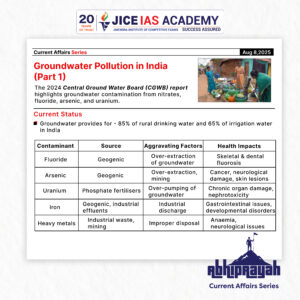
Groundwater Pollution in India – A Silent Public Health Emergency
UPSC CURRENT AFFAIRS – 08th August 2025 Home / Groundwater Pollution in India – A Silent Public Health Emergency Why

Universal banking- need and impact
UPSC CURRENT AFFAIRS – 08th August 2025 Home / Universal banking- need and impact Why in News? The Reserve Bank

India’s “Goldilocks” Economy: A Critical Appraisal
UPSC CURRENT AFFAIRS – 08th August 2025 Home / India’s “Goldilocks” Economy: A Critical Appraisal Why in News? The Finance

U.S.-India Trade Dispute: Trump’s 50% Tariffs and India’s Oil Imports from Russia
UPSC CURRENT AFFAIRS – 07th August 2025 Home / U.S.-India Trade Dispute: Trump’s 50% Tariffs and India’s Oil Imports from
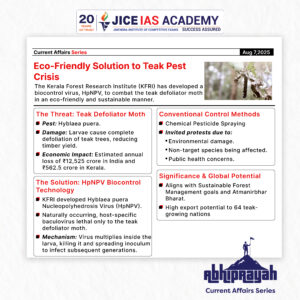
Eco-Friendly Solution to Teak Pest Crisis: KFRI’s HpNPV Technology
UPSC CURRENT AFFAIRS – 07th August 2025 Home / Eco-Friendly Solution to Teak Pest Crisis: KFRI’s HpNPV Technology Why in

New Species of Non-Venomous Rain Snake Discovered in Mizoram
UPSC CURRENT AFFAIRS – 07th August 2025 Home / New Species of Non-Venomous Rain Snake Discovered in Mizoram Why in