UPSC CURRENT AFFAIRS – 23th May 2025

Home / UPSC / Current Affairs / Tamil Nadu sues Centre in Supreme Court over non-disbursal of ₹2,000-crore education funds

Tamil Nadu sues Centre in Supreme Court over non-disbursal of ₹2,000-crore education funds

tamil nadu sues centre in supreme court over education funds delay

Why in News?

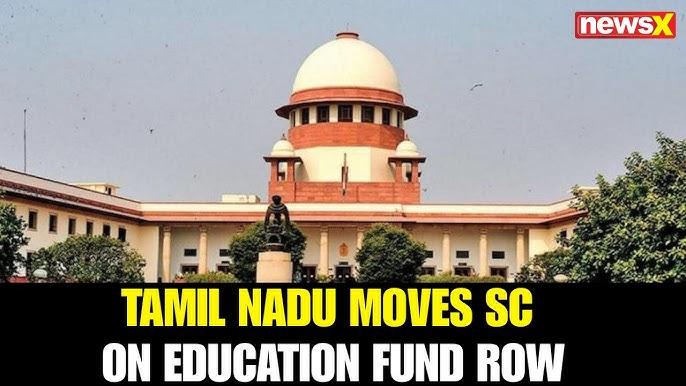
  • The State of Tamil Nadu has filed an original suit in the Supreme Court of India against the Union Government, accusing it of withholding over ₹2,000 crore in education funds under the Samagra Shiksha Scheme. Tamil Nadu alleges that this is being done to coerce the State into implementing the National Education Policy (NEP) 2020, which it has consistently opposed.
tamil nadu moves sc on education funds row

Background of the Dispute

Samagra Shiksha Scheme

The Samagra Shiksha Scheme is a centrally sponsored programme aimed at improving school education from pre-primary to senior secondary levels (Class 12). It merges earlier schemes such as Sarva Shiksha Abhiyan (SSA), Rashtriya Madhyamik Shiksha Abhiyan (RMSA), and Teacher Education (TE).

  • It follows a funding pattern, usually 60:40 between the Centre and the States.
  • For 2025-26, the Project Approval Board allocated ₹3,585.99 crore for Tamil Nadu, of which the Centre was to provide ₹2,151.59 crore as its share.

Tamil Nadu claims that the Centre has withheld this amount despite its approval, severely impacting the scheme’s implementation and affecting students, teachers, and staff.

Tamil Nadu's Allegations

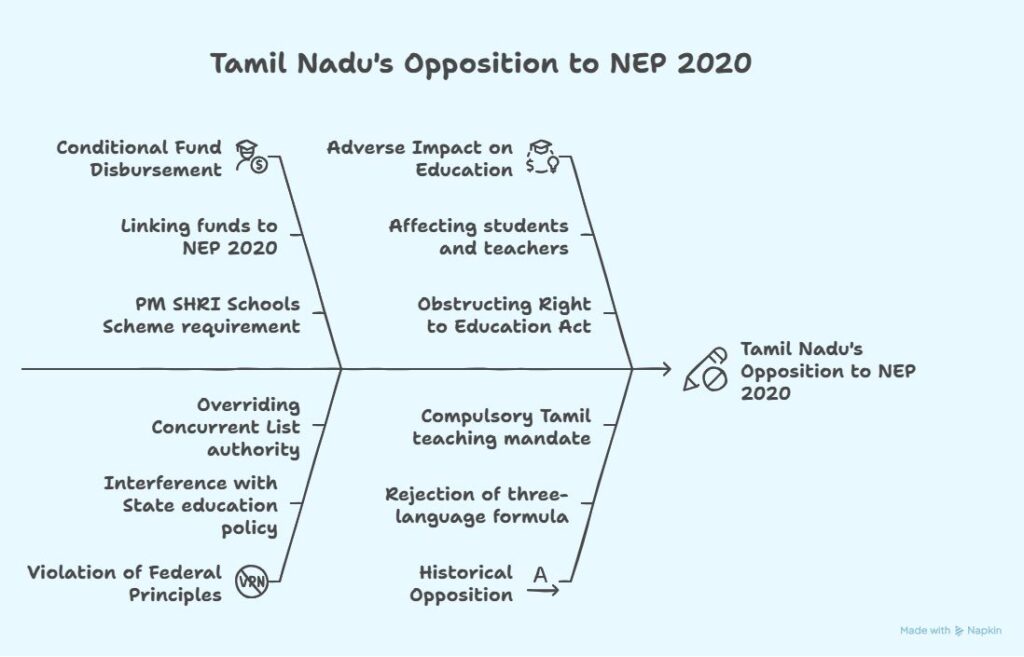
1. Conditional Fund Disbursement Linked to NEP 2020

Tamil Nadu argues that the Central Government has made the disbursal of funds contingent upon the State’s acceptance of NEP 2020 and the implementation of the PM SHRI Schools Scheme. The State asserts that the Samagra Shiksha Scheme is independent of NEP 2020 and should not be linked to it in any manner.

2. Violation of Federal Principles

The State contends that withholding the funds violates the principle of cooperative federalism. It alleges that the Centre is attempting to interfere with the State’s constitutional right to frame its own education policy, which falls under Entry 25 of the Concurrent List in the Seventh Schedule of the Constitution.

3. Adverse Impact on Education

The lack of funds has significantly affected:

  • Over 43.94 lakh students
  • Around 2.21 lakh teachers
  • Over 32,000 staff members

The State also claims that this has obstructed its ability to implement provisions of the Right to Education Act, 2009, thereby affecting the fundamental right to education.

Tamil Nadu's Opposition to NEP 2020

Historical Background

  • Tamil Nadu has a long history of opposing the three-language formula proposed by the Union Government. 
  • In 1968, the Tamil Nadu Legislative Assembly passed a resolution rejecting the Official Languages (Amendment) Act, 1967, and reaffirming its two-language policy of Tamil and English. 
  • Under the Official Languages Rules, 1976, Tamil Nadu was exempted from the implementation of the Official Languages Act, 1963.

The Tamil Nadu Tamil Learning Act, 2006

  • This Act mandates the compulsory teaching of Tamil in all schools in the State from Class 1 to Class 10. 
  • The third language is optional and left to students whose mother tongue is neither Tamil nor English.
  • Tamil Nadu views the NEP’s promotion of the three-language formula as a veiled imposition of Hindi, which is politically and culturally sensitive in the State.
tamil nadu opposition to nep 2020

Legal Relief Sought by Tamil Nadu

In its suit, Tamil Nadu has requested the Supreme Court to:

  1. Declare that NEP 2020 and the PM SHRI Schools Scheme are not binding on the State.
  2. Hold that linking Samagra Shiksha funds to the implementation of NEP 2020 is unconstitutional, illegal, arbitrary, and unreasonable.
  3. Direct the Union Government to release ₹2,291 crore (₹2,151 crore plus interest) with 6 percent annual interest from May 1, 2025, until the amount is paid.

Constitutional and Legal Implications

  • Cooperative Federalism: Tamil Nadu argues that the Centre’s actions violate the spirit of cooperative federalism, which requires collaboration rather than coercion between the Union and State governments.
  • Concurrent List Authority: Education falls under the Concurrent List, where both the Centre and the States can legislate. However, the State claims its authority is being overridden unconstitutionally.
  • Right to Education: The financial block is seen as undermining the State’s efforts to fulfill obligations under the Right to Education Act, which provides free and compulsory education to all children aged 6 to 14.

Conclusion

The case highlights a broader issue of Centre-State relations in India, particularly in areas where States have strong cultural and political positions, such as education. Tamil Nadu’s challenge to the Centre’s policies raises significant constitutional questions about federalism, the role of centrally-sponsored schemes, and the limits of Central influence over State policymaking. The Supreme Court’s decision in this matter could have far-reaching implications for the balance of power in India’s federal structure.

Leave a Reply

Your email address will not be published. Required fields are marked *

Call Us Now !

Copyright © JICE ACADEMY FOR EXCELLENCE PRIVATE LIMITED