
UPSC CURRENT AFFAIRS – 24th July 2025
U.N.'s top court delivers landmark decision on tackling climate change
Why in News?
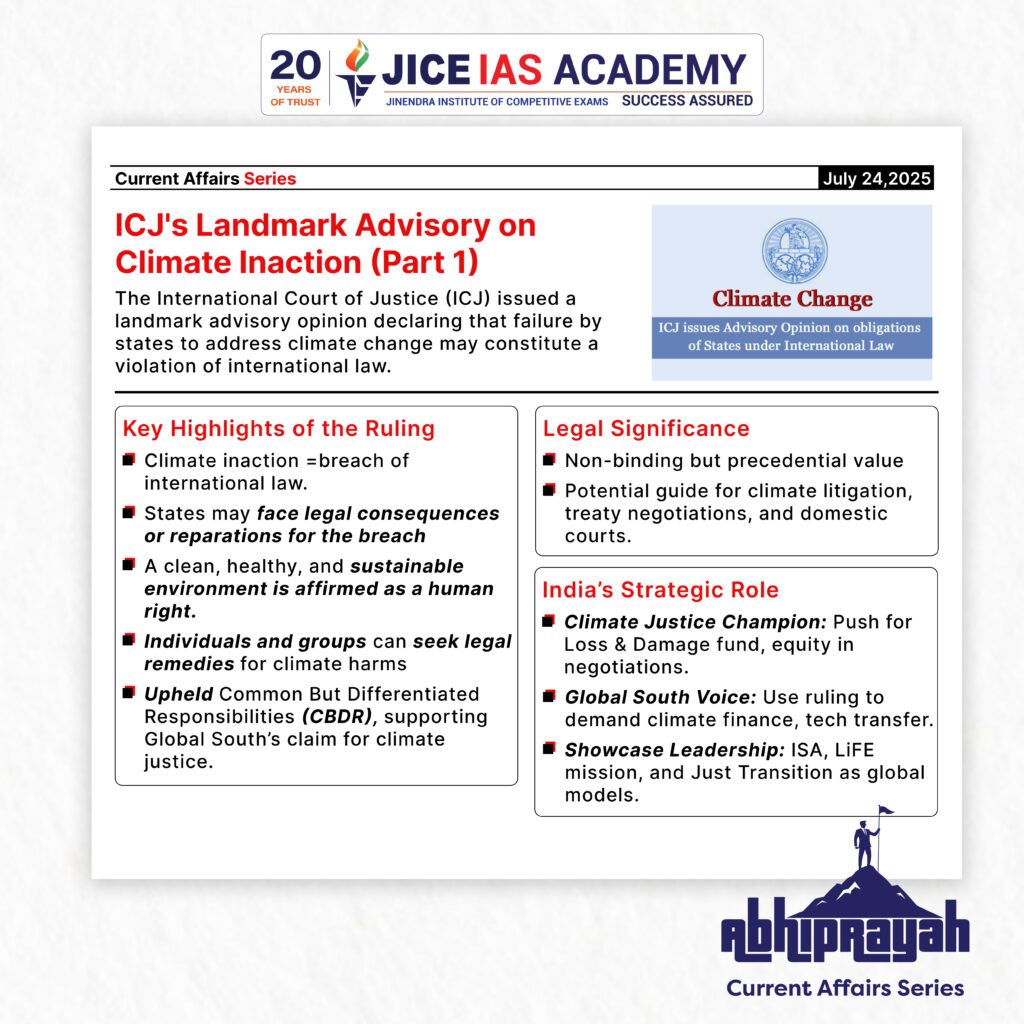
- In July 2025, the International Court of Justice (ICJ) issued a landmark advisory opinion declaring that failure by states to address climate change may constitute a violation of international law.
Introduction
- In a landmark advisory opinion delivered in July 2025, the International Court of Justice (ICJ) declared that countries could be in violation of international law if they fail to take sufficient action to protect the climate system.
- This ruling follows a request by the UN General Assembly (2023) led by the Pacific Island nation of Vanuatu and supported by over 130 countries, many of which are among the world’s most climate-vulnerable.
- This non-binding yet historic decision marks a critical milestone in international climate law, with far-reaching implications for state accountability, human rights, reparations, and future climate litigation.
Key Highlights of the ICJ Ruling
1. Climate Inaction as a Violation of International Law
- The ICJ held that the failure of a state to take “appropriate action to protect the climate system” may constitute an internationally wrongful act.
- Countries may thus face legal consequences, including reparations, for their contribution to climate change or failure to mitigate its effects.
2. Clean and Healthy Environment Recognized as a Human Right
- The court reaffirmed that access to a clean, healthy, and sustainable environment is a human right, aligning with recent rulings by other international courts.
- This opens the door for individuals and groups to seek legal redress for climate harms through human rights frameworks.
3. Historical Responsibility Acknowledged
- The opinion emphasized that past, present, and future emissions must all be considered when determining responsibility.
- It underscores the principle of Common But Differentiated Responsibilities (CBDR), reinforcing claims of the Global South for climate justice.
Legal Significance
Nature of the Advisory Opinion
- The ICJ’s advisory opinion is non-binding, but it carries significant moral and legal weight.
- It can be used by countries and courts as a legal precedent in:
- Domestic lawsuits against governments.
- International climate negotiations and treaties.
- Bilateral investment and trade agreements.
Impact on International Law
- Strengthens the role of customary international law and environmental obligations under existing treaties (e.g., UNFCCC, Paris Agreement).
- Encourages the evolution of climate change as a justiciable issue under international law.
South-South Cooperation and India’s Role
1. Championing Climate Justice
India, a key voice in the Global South, can use this legal milestone to:
- Strengthen calls for climate finance and technology transfers.
- Demand accountability from historical emitters.
- Promote equity in global climate negotiations.
2. Leadership in Renewable Energy and Adaptation
- India’s initiatives such as the International Solar Alliance (ISA), LiFE mission, and National Adaptation Fund for Climate Change can be shared as best practices in:
- Renewable energy deployment.
- Community-based climate resilience.
- Just transition frameworks.
- Platform for Vulnerable Nations
- India can act as a bridge between climate-vulnerable nations (e.g., Pacific and African island states) and developed countries by:
- Advocating for operationalization of the Loss and Damage Fund.
- Supporting capacity building and litigation support mechanisms.
Broader Global Developments in Climate Law
Court/Forum | Ruling/Outcome | Year |
Inter-American Court of Human Rights | Duty of states to protect and restore ecosystems | 2025 |
European Court of Human Rights | States must protect citizens from climate impacts | 2024 |
Netherlands Supreme Court (Urgenda case) | Climate protection is a human right | 2019 |
These rulings, together with the ICJ opinion, form a growing body of international jurisprudence recognizing environmental protection as a legal obligation.
Challenges Ahead
- Provisions of the World Anti-Doping Code, especially Article 2 on Anti-Doping Rule Violations, are formally added to the Schedule of the Act.
- These provisions will now have statutory recognition and legal enforceability in India.
Conclusion
- The ICJ’s advisory opinion is a turning point for international climate law.
- While non-binding, it marks a moral and legal shift, recognizing that climate action is no longer just a policy choice but a legal obligation.
- For countries like India, it is both a strategic opportunity and ethical imperative to champion climate justice and build resilient futures, especially for the world’s most vulnerable.

3rd UN conference on landlocked countries
UPSC CURRENT AFFAIRS – 08th August 2025 Home / 3rd UN conference on landlocked countries Why in News? At the

Issue of soapstone mining in Uttarakhand’s Bageshwar
UPSC CURRENT AFFAIRS – 08th August 2025 Home / Issue of soapstone mining in Uttarakhand’s Bageshwar Why in News? Unregulated
Groundwater Pollution in India – A Silent Public Health Emergency
UPSC CURRENT AFFAIRS – 08th August 2025 Home / Groundwater Pollution in India – A Silent Public Health Emergency Why
Universal banking- need and impact
UPSC CURRENT AFFAIRS – 08th August 2025 Home / Universal banking- need and impact Why in News? The Reserve Bank

India’s “Goldilocks” Economy: A Critical Appraisal
UPSC CURRENT AFFAIRS – 08th August 2025 Home / India’s “Goldilocks” Economy: A Critical Appraisal Why in News? The Finance

U.S.-India Trade Dispute: Trump’s 50% Tariffs and India’s Oil Imports from Russia
UPSC CURRENT AFFAIRS – 07th August 2025 Home / U.S.-India Trade Dispute: Trump’s 50% Tariffs and India’s Oil Imports from
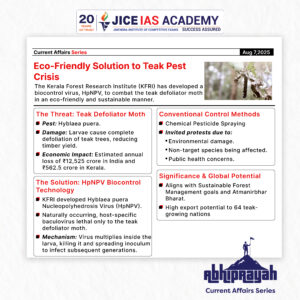
Eco-Friendly Solution to Teak Pest Crisis: KFRI’s HpNPV Technology
UPSC CURRENT AFFAIRS – 07th August 2025 Home / Eco-Friendly Solution to Teak Pest Crisis: KFRI’s HpNPV Technology Why in

New Species of Non-Venomous Rain Snake Discovered in Mizoram
UPSC CURRENT AFFAIRS – 07th August 2025 Home / New Species of Non-Venomous Rain Snake Discovered in Mizoram Why in

Economic Implications
For Indian Exporters
- These reforms reduce transaction costs and compliance hurdles
- Encourage a more competitive and efficient export environment
- Promote value addition in key sectors like leather
For Tamil Nadu
- The reforms particularly benefit the state’s leather industry, a major contributor to employment and exports
- Boost the marketability of GI-tagged E.I. leather, enhancing rural and traditional industries
For Trade Policy
- These decisions indicate a shift from regulatory controls to policy facilitation
Reinforce the goals of Make in India, Atmanirbhar Bharat, and India’s ambition to become a leading export power
Recently, BVR Subrahmanyam, CEO of NITI Aayog, claimed that India has overtaken Japan to become the fourth-largest economy in the world, citing data from the International Monetary Fund (IMF).
India’s rank as the world’s largest economy varies by measure—nominal GDP or purchasing power parity (PPP)—each with key implications for economic analysis.