UPSC CURRENT AFFAIRS – 14th July 2025
Understanding and Reimagining Deserts
Why in News?
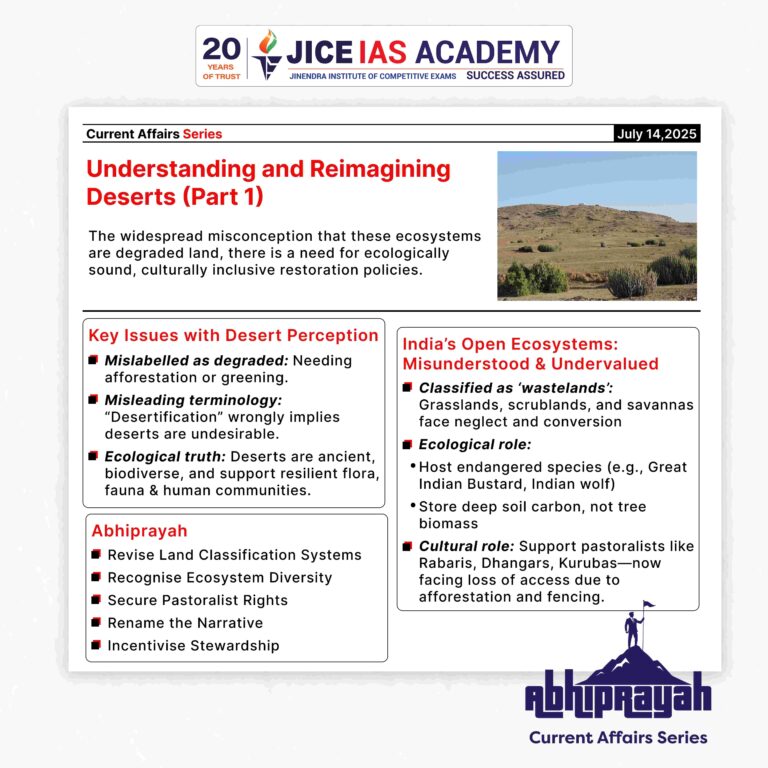
The widespread misconception of deserts as degraded land and advocates for ecologically sound, culturally inclusive restoration of open ecosystems like deserts, grasslands, and savannas.
Introduction
- Deserts are commonly viewed as failed landscapes—lifeless, barren, and in need of redemption through afforestation, irrigation, or climate engineering.
- This perception underpins global and national initiatives aimed at “greening” the deserts.
- However, such approaches often ignore the ecological significance, cultural heritage, and resilience of desert and other open ecosystems.
- Re-examining these landscapes with ecological sensitivity and social inclusivity is crucial for sustainable environmental governance.
Are Deserts Really Wastelands?
- Contrary to popular belief, deserts are ancient, biodiverse, and resilient biomes that have adapted to extreme climatic conditions over millennia.
- They comprise nearly one-third of the Earth’s terrestrial surface, supporting not just uniquely adapted flora and fauna, but also indigenous human cultures that have thrived in these conditions.
- Historically, deserts were the cradle of early civilizations—such as Mesopotamia, Ancient Egypt, and the Indus Valley.
- The harsh climate pushed human societies to innovate in agriculture, irrigation, and governance, giving rise to complex technological and social systems.
- Despite this rich legacy, modern environmental policies and public perception continue to equate deserts with degradation, a notion reinforced by the term “desertification”, which misleadingly implies that desert-like landscapes are undesirable or broken.
- This misrepresentation fuels the drive to “correct” deserts by converting them into forests or agricultural land—efforts that often backfire ecologically.
India’s Open Natural Ecosystems - Misunderstood & Mishandled
India’s attitude towards open natural ecosystems—including deserts, grasslands, savannas, scrublands, and open woodlands—is marked by neglect and contradiction.
- While urban elites idealise open spaces in gated communities through manicured lawns and exotic names like “Savana,” the country’s own naturally open ecosystems are systematically undervalued or misclassified.
- On official records, vast areas of grasslands and scrublands are labelled “wastelands”, a term inherited from colonial land-use practices.
- This policy misclassification results in misguided developmental actions—such as afforestation, agricultural conversion, or industrialisation—on ecologically sensitive lands.
These ecosystems are home to endemic and endangered species, including:
- The Great Indian Bustard
- The caracal
- The Indian wolf
Moreover, their carbon sequestration capacity lies underground—in deep soil carbon—unlike forests that store carbon in tree biomass. Hence, erasing these ecosystems undermines both biodiversity and climate goals.
Pastoral Communities:
India’s open landscapes are not just ecological spaces but also livelihood ecosystems. Pastoralist communities like the Dhangar, Rabari, and Kuruba depend on these regions for grazing, seasonal migration, and cultural practices.
However, these communities face growing marginalisation:
- Fencing off grazing lands
- Planting non-native trees as part of afforestation drives
- Denial of access to traditional migratory routes
These interventions disrupt socio-ecological systems, erode traditional knowledge, and threaten sustainable pastoralism that has coexisted with nature for centuries. Ironically, pastoralists have often served as custodians of biodiversity, maintaining healthy rangelands through rotational grazing and land stewardship.
Rethinking Restoration: From Greenwashing to Grounded Solutions
While land degradation is real, the solution is not to afforest every open space, but to restore landscapes intelligently and contextually. Key strategies include:
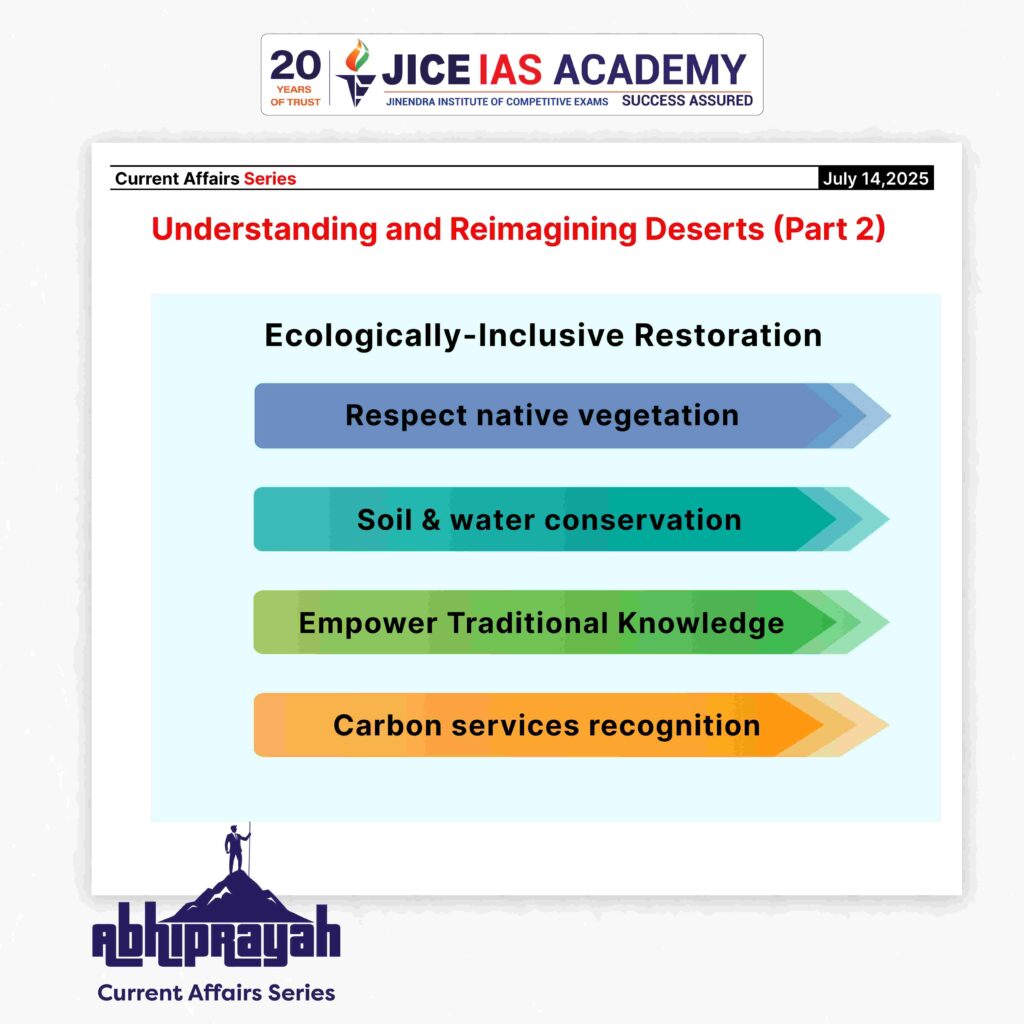
- Respect Native Vegetation: Restoration efforts must prioritise the native species that are best suited to arid and semi-arid climates.
- Soil and Water Conservation: Techniques such as water harvesting, mulching, and check dams are more effective than large-scale tree plantations.
- Support Indigenous Knowledge: Traditional methods of land management and pastoralism are time-tested and ecologically attuned.
- Avoid Monocultures: Mass tree-planting, especially of alien species, can damage soil health, reduce water availability, and displace native flora and fauna.
- Promote Soil Carbon Storage: Ecosystem services like underground carbon sequestration in deserts and grasslands should be monetised and protected through carbon credits and ecosystem service payments.
Policy Recommendations and Way Forward
- Revise Land Classification Systems Reassess land-use categories to correctly identify grasslands, deserts, and scrublands as ecologically valuable ecosystems—not as wastelands.
- Recognise Ecosystem Diversity Policies should account for the diversity and specificity of ecosystems. A “one-size-fits-all” green model of afforestation is ecologically counterproductive.
- Secure Pastoralist Rights Provide legal recognition and protection to pastoralist communities for access, mobility, and participation in land governance.
- Rename the Narrative Replace the term “combat desertification” with “combat land degradation” to remove the negative connotation attached to deserts and highlight restoration rather than replacement.
- Incentivise Stewardship Promote ecological services through payments to communities who conserve these ecosystems. Encourage community-led conservation initiatives.
Conclusion
- Deserts and open ecosystems like grasslands are not ecological failures—they are vibrant, complex, and functioning biomes.
- The current model of “greening” these regions risks ecological harm, cultural erasure, and the loss of biodiversity.

3rd UN conference on landlocked countries
UPSC CURRENT AFFAIRS – 08th August 2025 Home / 3rd UN conference on landlocked countries Why in News? At the
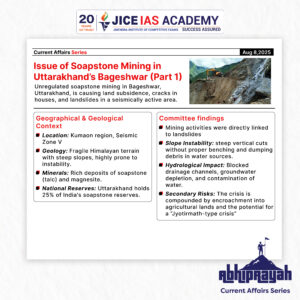
Issue of soapstone mining in Uttarakhand’s Bageshwar
UPSC CURRENT AFFAIRS – 08th August 2025 Home / Issue of soapstone mining in Uttarakhand’s Bageshwar Why in News? Unregulated
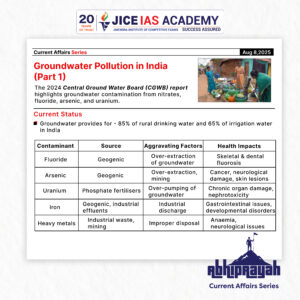
Groundwater Pollution in India – A Silent Public Health Emergency
UPSC CURRENT AFFAIRS – 08th August 2025 Home / Groundwater Pollution in India – A Silent Public Health Emergency Why

Universal banking- need and impact
UPSC CURRENT AFFAIRS – 08th August 2025 Home / Universal banking- need and impact Why in News? The Reserve Bank
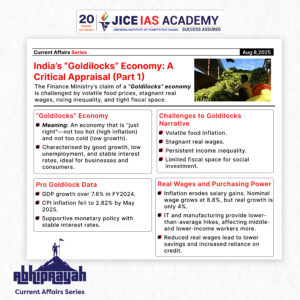
India’s “Goldilocks” Economy: A Critical Appraisal
UPSC CURRENT AFFAIRS – 08th August 2025 Home / India’s “Goldilocks” Economy: A Critical Appraisal Why in News? The Finance

U.S.-India Trade Dispute: Trump’s 50% Tariffs and India’s Oil Imports from Russia
UPSC CURRENT AFFAIRS – 07th August 2025 Home / U.S.-India Trade Dispute: Trump’s 50% Tariffs and India’s Oil Imports from
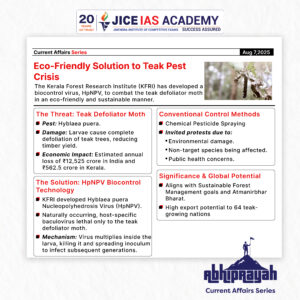
Eco-Friendly Solution to Teak Pest Crisis: KFRI’s HpNPV Technology
UPSC CURRENT AFFAIRS – 07th August 2025 Home / Eco-Friendly Solution to Teak Pest Crisis: KFRI’s HpNPV Technology Why in

New Species of Non-Venomous Rain Snake Discovered in Mizoram
UPSC CURRENT AFFAIRS – 07th August 2025 Home / New Species of Non-Venomous Rain Snake Discovered in Mizoram Why in

Economic Implications
For Indian Exporters
- These reforms reduce transaction costs and compliance hurdles
- Encourage a more competitive and efficient export environment
- Promote value addition in key sectors like leather
For Tamil Nadu
- The reforms particularly benefit the state’s leather industry, a major contributor to employment and exports
- Boost the marketability of GI-tagged E.I. leather, enhancing rural and traditional industries
For Trade Policy
- These decisions indicate a shift from regulatory controls to policy facilitation
Reinforce the goals of Make in India, Atmanirbhar Bharat, and India’s ambition to become a leading export power
Recently, BVR Subrahmanyam, CEO of NITI Aayog, claimed that India has overtaken Japan to become the fourth-largest economy in the world, citing data from the International Monetary Fund (IMF).
India’s rank as the world’s largest economy varies by measure—nominal GDP or purchasing power parity (PPP)—each with key implications for economic analysis.