
UPSC CURRENT AFFAIRS – 28th July 2025
ZSI scientists discover a wolf spider, and four wasp species from West Bengal
Why in News?
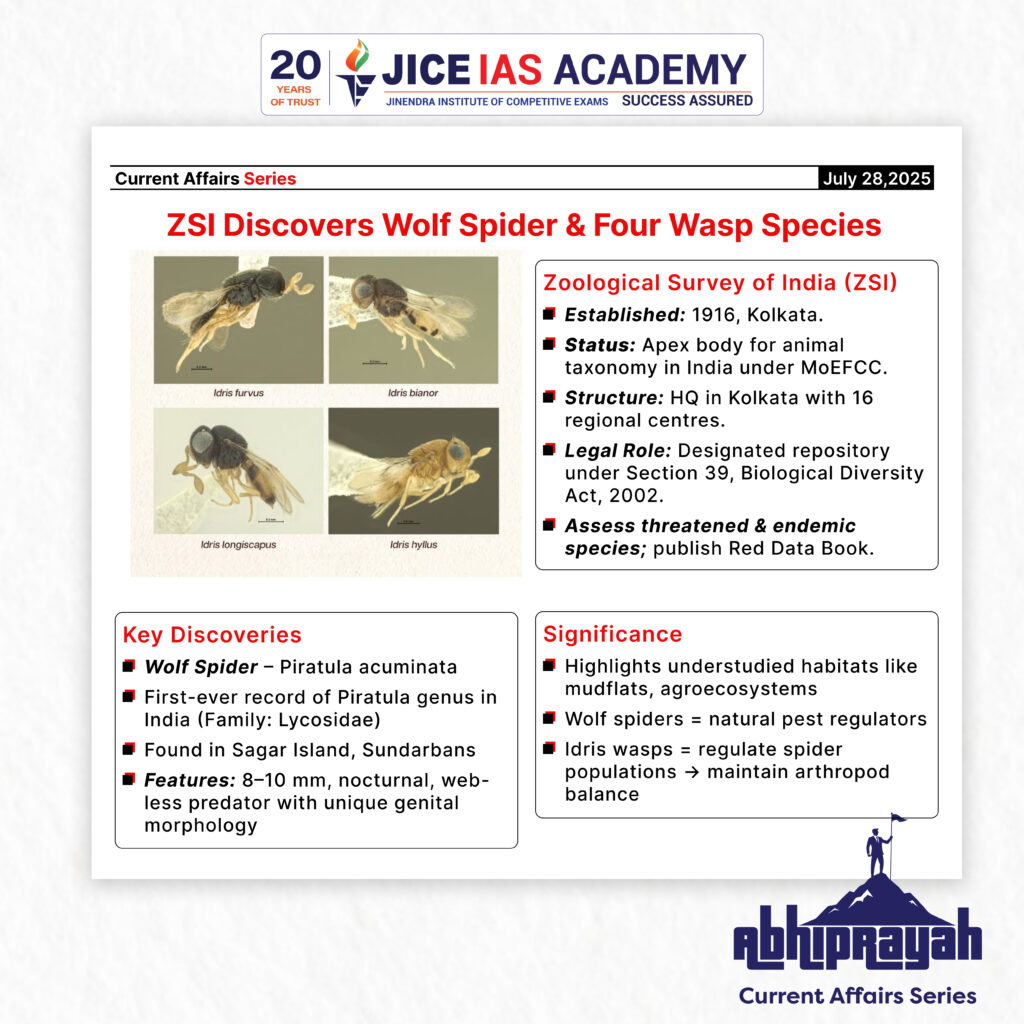
- Zoological Survey of India (ZSI) scientists discovered a new species of wolf spider (Piratula acuminata) from Sagar Island and four new parasitoid wasp species (Idris genus) from West Bengal.
Introduction
- In July 2025, scientists from the Zoological Survey of India (ZSI) made significant contributions to India’s biodiversity documentation by announcing the discovery of:
- One new species of wolf spider, and
- Four new species of parasitoid wasps.
- These discoveries, made in West Bengal, not only expand India’s faunal records but also underscore the need for focused biodiversity surveys in ecologically sensitive zones and agroecosystems.
Zoological Survey of India (ZSI)
- The Zoological Survey of India (ZSI) is the premier Indian organization responsible for the survey, exploration, and research on animal biodiversity in the country.
- It operates under the Ministry of Environment, Forest and Climate Change (MoEFCC).
- Established: 1916 at Calcutta (now Kolkata)
Discovery of Piratula acuminata: A New Wolf Spider Species
- First Record of Genus Piratula in India
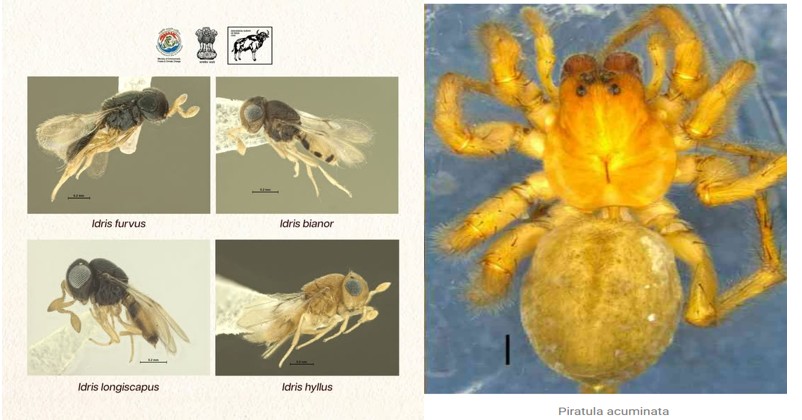
- The newly described species, Piratula acuminata, is the first-ever record of the genus Piratula (Family: Lycosidae) from India.
- It was discovered in Sagar Island, situated in the Sundarbans delta, an ecologically fragile and biodiversity-rich region shaped by the Ganga’s alluvial deposits.
Key Features of Piratula acuminata
- Medium-sized, measuring 8–10 mm.
- Characterised by a creamy-white body with brown and chalk-white spots.
- Exhibits distinct genital morphology, which helped researchers confirm it as a new species.
- Nocturnal and ground-dwelling; does not weave webs but ambushes prey — a typical behaviour of wolf spiders.
- Ecological Significance
- The spider’s presence in the estuarine mudflats highlights the Sundarbans as a unique habitat with underexplored faunal diversity.
- Its discovery emphasizes the role of systematic morphological analysis in identifying cryptic species.
Discovery of Four New Idris Wasp Species
- The Genus Idris (Family: Scelionidae, Order: Hymenoptera)
- Tiny wasps that are parasitoids of spider eggs, specifically those of jumping spiders (Family: Salticidae).
- Newly discovered species:
- Idris bianor
- Idris furvus
- Idris hyllus
- Idris longiscapus
- Unique Behaviour: Gregarious Parasitism
- These wasps exhibit gregarious parasitism, where multiple individuals emerge from a single spider egg sac.
- This is a rare reproductive strategy among parasitoid insects.
Broader Significance of the Discoveries
Biodiversity Conservation
- These findings underscore that even in well-inhabited regions like West Bengal, new and undocumented species exist.
- Sheds light on understudied habitats such as estuarine mudflats and semi-natural agricultural zones.
Ecological Roles
- Wolf spiders like acuminata act as natural pest controllers.
- Parasitoid wasps of genus Idris play a role in regulating spider populations, thus maintaining ecological balance in arthropod communities.
Strengthening Biodiversity Missions
- Aligns with India’s broader national mission to document biodiversity, especially in the face of climate change and habitat loss.
- Emphasizes the role of institutions like ZSI in advancing systematic taxonomy, species conservation, and ecological monitoring.

3rd UN conference on landlocked countries
UPSC CURRENT AFFAIRS – 08th August 2025 Home / 3rd UN conference on landlocked countries Why in News? At the

Issue of soapstone mining in Uttarakhand’s Bageshwar
UPSC CURRENT AFFAIRS – 08th August 2025 Home / Issue of soapstone mining in Uttarakhand’s Bageshwar Why in News? Unregulated

Groundwater Pollution in India – A Silent Public Health Emergency
UPSC CURRENT AFFAIRS – 08th August 2025 Home / Groundwater Pollution in India – A Silent Public Health Emergency Why

Universal banking- need and impact
UPSC CURRENT AFFAIRS – 08th August 2025 Home / Universal banking- need and impact Why in News? The Reserve Bank

India’s “Goldilocks” Economy: A Critical Appraisal
UPSC CURRENT AFFAIRS – 08th August 2025 Home / India’s “Goldilocks” Economy: A Critical Appraisal Why in News? The Finance

U.S.-India Trade Dispute: Trump’s 50% Tariffs and India’s Oil Imports from Russia
UPSC CURRENT AFFAIRS – 07th August 2025 Home / U.S.-India Trade Dispute: Trump’s 50% Tariffs and India’s Oil Imports from

Eco-Friendly Solution to Teak Pest Crisis: KFRI’s HpNPV Technology
UPSC CURRENT AFFAIRS – 07th August 2025 Home / Eco-Friendly Solution to Teak Pest Crisis: KFRI’s HpNPV Technology Why in

New Species of Non-Venomous Rain Snake Discovered in Mizoram
UPSC CURRENT AFFAIRS – 07th August 2025 Home / New Species of Non-Venomous Rain Snake Discovered in Mizoram Why in
Introduction
Economic Implications
For Indian Exporters
- These reforms reduce transaction costs and compliance hurdles
- Encourage a more competitive and efficient export environment
- Promote value addition in key sectors like leather
For Tamil Nadu
- The reforms particularly benefit the state’s leather industry, a major contributor to employment and exports
- Boost the marketability of GI-tagged E.I. leather, enhancing rural and traditional industries
For Trade Policy
- These decisions indicate a shift from regulatory controls to policy facilitation
Reinforce the goals of Make in India, Atmanirbhar Bharat, and India’s ambition to become a leading export power
Recently, BVR Subrahmanyam, CEO of NITI Aayog, claimed that India has overtaken Japan to become the fourth-largest economy in the world, citing data from the International Monetary Fund (IMF).
India’s rank as the world’s largest economy varies by measure—nominal GDP or purchasing power parity (PPP)—each with key implications for economic analysis.