PwC suggests IDEA framework for Indian companies to navigate U.S. tariff uncertainties

UPSC CURRENT AFFAIRS – 03rd April 2025 Home / PwC suggests IDEA framework for Indian companies to navigate U.S. tariff uncertainties Why in News? PwC’s IDEA (Invest, Diversify, Express, Stay Aware) Framework provides a strategic approach for Indian businesses to navigate trade uncertainties amid the U.S. administration’s reciprocal tariffs on Indian exports. Introduction The global trade landscape has witnessed significant shifts following the U.S. presidential elections in November 2024. The Donald Trump administration has implemented reciprocal tariffs, impacting major economies, including India. In response to these developments, PwC (PricewaterhouseCoopers) has introduced the IDEA (Invest, Diversify, Express, Stay Aware) Framework to help Indian businesses build resilience against trade uncertainties and leverage emerging opportunities. Understanding the IDEA Framework Invest Indian businesses should invest in technology upgradation and AI-driven supply chain solutions to enhance operational efficiency. Strengthening domestic manufacturing and automation can help reduce reliance on imports and enhance global competitiveness. Diversify To minimize risks from trade restrictions, businesses should explore new export markets and reduce dependence on a single source of raw materials or suppliers. Identifying alternative procurement sources from multiple countries ensures resilience against geopolitical disruptions. Express The industry must actively communicate its concerns to the government and seek necessary policy interventions. Possible measures include tariff relief, trade agreements, and sector-specific incentives to safeguard domestic industries. Stay Aware Businesses should continuously monitor global trade developments and adapt dynamically to evolving policies. Proactive engagement with stakeholders and leveraging trade intelligence can help minimize risks and seize new opportunities. Significance of the IDEA Framework Helps Indian businesses navigate trade uncertainties caused by tariff realignments. Encourages self-reliance and strategic expansion in global markets. Strengthens India’s position in the global supply chain through technological advancements and diversified trade partnerships. Conclusion The PwC IDEA Framework serves as a strategic roadmap for Indian businesses to mitigate the impact of U.S. trade policies and capitalize on new opportunities. By investing in technology, diversifying markets, expressing concerns, and staying aware, Indian industries can build long-term resilience in an increasingly complex global trade environment.
Manufacturing PMI climbs to eight month high of 58.1 in March
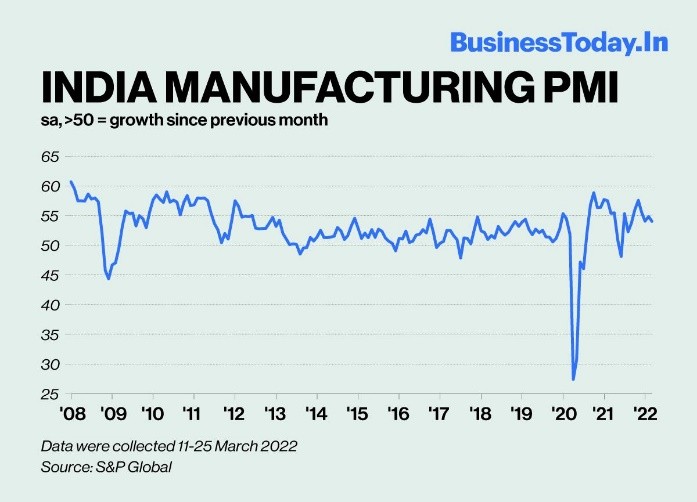
UPSC CURRENT AFFAIRS – 03rd April 2025 Home / Manufacturing PMI climbs to eight month high of 58.1 in March Why in News? India’s Manufacturing PMI rose to 58.1 in March 2025, an eight-month high, driven by strong domestic demand, increased new orders, and robust production growth. Introduction India’s Manufacturing Purchasing Managers’ Index (PMI), a key indicator of industrial activity, rose to an eight-month high of 58.1 in March 2025, according to a report by S&P Global. This marks a significant increase from 56.3 in February 2025. The index has now remained above the expansion threshold of 50 for 45 consecutive months, highlighting sustained growth in the sector. Key Highlights of the PMI Report Strong Growth in New Orders The increase in PMI was primarily attributed to higher new orders, which reached an eight-month high of 61.5. Domestic demand remained robust, even though international orders experienced a slight slowdown. Firms responded to strong demand by utilizing existing inventories, leading to the sharpest decline in finished goods stocks in over three years. Sales and Production Expansion Manufacturing sales expanded at a robust pace, driven by positive customer interest, strong market conditions, and effective marketing strategies. Production volumes also increased toward the end of the financial year 2024-25, indicating a positive outlook for the sector. Export orders continued to grow, but the growth rate was the slowest in three months. Price Trends and Cost Pressures Input prices recorded a three-month high but remained below their long-term average, suggesting manageable cost pressures. Despite rising input costs, the increase in prices charged for goods remained moderate, helping to sustain demand. Business Sentiment and Future Outlook Business confidence remained optimistic, with 30% of firms expecting higher output in the next 12 months, compared to less than 2% anticipating a contraction. HSBC noted that pending projects and stable customer relations contributed to positive expectations for future output levels. Purchasing Managers’ Index (PMI) The Purchasing Managers’ Index (PMI) is a widely used economic indicator that measures the performance of the manufacturing and services sectors in an economy. It is based on a survey of purchasing managers in businesses and provides insights into economic trends such as growth, contraction, and business sentiment. How is PMI Measured? PMI is calculated based on five key indicators: New Orders – Measures the level of demand for goods and services. Production Output – Reflects the level of manufacturing activity. Employment Levels – Indicates hiring trends in the industry. Supplier Deliveries – Assesses supply chain efficiency. Stock of Purchases – Tracks inventory levels of raw materials. PMI Scale and Interpretation PMI above 50 → Indicates economic expansion and industry growth. PMI below 50 → Suggests contraction in business activity. PMI at 50 → Signals no change in business conditions. Types of PMI Manufacturing PMI – Measures the performance of the manufacturing sector. Services PMI – Assesses the health of the services industry. Composite PMI – A combined measure of manufacturing and services PMI. Importance of PMI Leading Economic Indicator – PMI provides early signals of economic trends before official GDP data. Business and Investment Decisions – Helps companies plan production, hiring, and investments. Central Bank Policy – Used by policymakers to assess inflationary pressures and adjust monetary policies accordingly. Stock Market Reactions – PMI influences investor sentiment and stock market movements. Conclusion The latest PMI data signals continued strength in India’s manufacturing sector, supported by strong domestic demand, steady production growth, and favorable business sentiment. Despite global uncertainties and a slight slowdown in export orders, the manufacturing industry remains resilient, contributing to the overall economic momentum.
Lok Sabha passes the Waqf (Amendment) Bill, 2025
UPSC CURRENT AFFAIRS – 03rd April 2025 Home / Lok Sabha passes the Waqf (Amendment) Bill, 2025 Why in News? The Waqf (Amendment) Bill, 2024, passed in the Lok Sabha, aims to revise the legal framework governing waqf properties. Introduction The Lok Sabha passed the Waqf (Amendment) Bill, 2024, after a heated 12-hour debate, with the government strongly defending its stance against opposition allegations of encroachment on constitutional rights, federalism, and minority rights. The Bill was adopted with 288 votes in favor and 232 against. The Bill, which seeks to amend laws governing Islamic endowments (waqf properties), is expected to pass smoothly in the Rajya Sabha as well. Background of the Bill The Waqf Act, 1995, provides for the administration, supervision, and management of waqf properties—endowments made for religious or charitable purposes in Islam. The government’s amendments in 2013 gave the Waqf Act an overriding effect over other property laws, which the government seeks to reverse through the Waqf (Amendment) Bill, 2024. Key Provisions of the Bill Reversal of 2013 Amendments: The Bill seeks to remove provisions that granted waqf laws precedence over other property laws, ensuring a more balanced legal framework. Inclusion of Non-Muslim Members: It allows for the appointment of non-Muslims in waqf boards and councils, which has been a contentious issue. Emphasis on Property Regulation: The Bill claims to deal solely with properties and administration, without interfering in religious matters. Repeal of Mussalman Waqf Act, 1923: Alongside the amendment bill, the Mussalman Waqf (Repeal) Bill, 2024 was also passed, repealing an outdated law concerning waqf properties. Broader Implications Legal and Constitutional Impact The amendment redefines the status of waqf properties in legal disputes, ensuring they do not override other land laws. The inclusion of non-Muslims in waqf boards could be challenged in court as a violation of the right of religious communities to manage their own affairs under Article 26 of the Indian Constitution. Political Significance This is the fourth major legislative action by the government related to Muslim personal laws, following: Criminalization of Triple Talaq Citizenship (Amendment) Act, 2019 (CAA) Implementation of the Uniform Civil Code (UCC) in Uttarakhand Impact on Minority Rights The opposition argues that this amendment weakens autonomy in waqf administration, potentially leading to disputes over religious property rights. It is a necessary reform to curb mismanagement and favoritism within waqf boards. Right to Property The Right to Property was initially a Fundamental Right under Article 19(1)(f) and Article 31 of the Indian Constitution. However, it was later removed as a Fundamental Right and given the status of a legal/constitutional right under Article 300A by the 44th Constitutional Amendment Act, 1978. Historical Evolution Original Position (1950) Article 19(1)(f): Guaranteed citizens the right to acquire, hold, and dispose of property. Article 31: Stated that no person shall be deprived of their property except by the authority of law, and provided for compensation in case of acquisition by the State. Amendments and Changes 1st Amendment (1951): Added Article 31A and 31B, enabling the government to acquire land for land reforms and placed certain laws under the Ninth Schedule to protect them from judicial review. 4th Amendment (1955): Limited the power of courts to question compensation given by the government for land acquisition. 25th Amendment (1971): Replaced “compensation” with “amount”, reducing the obligation to provide market-value compensation. 44th Amendment (1978): Deleted Article 19(1)(f) and Article 31, thereby removing the Right to Property from the list of Fundamental Rights. Introduced Article 300A, making the Right to Property a legal/constitutional right, stating that no person shall be deprived of their property except by authority of law. Current Status (Article 300A) The Right to Property is now a constitutional/legal right and not a Fundamental Right. The government can acquire private property for public purposes, but it must be done lawfully. Citizens cannot challenge property deprivation under Fundamental Rights (Part III) but can seek remedy under legal provisions. Judicial Interpretations Kesavananda Bharati Case (1973) Upheld the power of Parliament to amend the Constitution but ruled that the basic structure of the Constitution cannot be altered. Waman Rao Case (1981) Reaffirmed that laws placed under the Ninth Schedule after April 24, 1973, are open to judicial review. Tukaram Kana Joshi v. Maharashtra (2013) Supreme Court ruled that state cannot take private property without following due legal procedure. Conclusion The Waqf (Amendment) Bill, 2024, represents a significant shift in the governance of Islamic endowments in India. While the government asserts it is a reform measure aimed at legal parity and property management, the opposition views it as an attack on minority rights. With the Bill set for clearance in Rajya Sabha, its long-term implications on legal, political, and religious affairs remain to be seen.
Green Credit Programme

UPSC CURRENT AFFAIRS – 03rd April 2025 Home / Green Credit Programme Why in News? The Green Credit Programme (GCP), launched in December 2023, aims to incentivize voluntary environmental actions by awarding tradable green credits. Introduction The Green Credit Programme (GCP) was officially launched by Prime Minister Narendra Modi and UAE President Sheikh Mohammed bin Zayed Al Nahyan on December 1, 2023, during the United Nations Climate Conference (COP28) in Dubai. It aims to incentivize “pro-planet” actions under the Centre’s Mission LiFE (Lifestyle for Sustainable Environment). The Union Environment Ministry notified the Green Credit Rules in October 2023, outlining its objectives and implementation framework. Objectives of the Green Credit Programme Encourage voluntary participation of individuals, companies, industries, and other entities in environmental activities. Generate tradable “green credits” through participation in activities such as: Tree plantation and afforestation Waste management Water conservation Sustainable agriculture Air pollution reduction Mangrove conservation Ecosystem restoration Establish a domestic market platform where green credits can be traded for meeting sustainability goals or legal obligations. Allow listed companies to use green credits as part of their Environmental, Social, and Governance (ESG) disclosures under SEBI’s Business Responsibility and Sustainability Reporting (BRSR) framework. Implementation and Calculation of Green Credits The pilot phase focuses on tree plantation and eco-restoration of degraded lands. Nodal Agency: Indian Council of Forestry Research and Education (ICFRE), Dehradun Target Areas: Degraded lands, open forests, scrublands, wastelands, and catchment areas of 5 hectares or more. Process: State forest departments identify degraded lands. Interested parties register with ICFRE and pay a fee for land allotment. Forest departments carry out and maintain the plantations. Completion timeframe: Within two years after payment. Green Credit Calculation: One tree planted = One Green Credit Minimum density requirement: 1,100 trees per hectare Certification of completion provided by the forest department. Current Status (as of March 2024): 2,364 land parcels registered (total area: 54,669.46 hectares) 384 entities registered, including 41 public-sector undertakings (PSUs) Concerns and Criticism Potential Incentive for Forest Diversion: The scheme allows tradable credits to meet compensatory afforestation obligations, possibly encouraging forest land diversion for industrial projects. Ecological Concerns: Plantations on degraded lands, open forests, and scrublands could impact existing ecosystems that offer valuable ecological services. Survival of Plantation Trees: The Supreme Court has sought the Environment Ministry’s views on the survival rate of plantations under GCP. Conflict with Forest Conservation Act (Van Adhiniyam, 2023): The Forest Conservation Act mandates compensatory afforestation on non-forest land equivalent to diverted forest land. GCP allows compensatory afforestation on degraded forest land, contradicting the land-for-land principle. Monetization of Forest Conservation: Critics argue that arbitrary tree plantations cannot replace old-growth forests. Public Opposition: In April 2024, over 100 environmental organizations and 400 citizens petitioned for the rollback of GCP citing environmental concerns. Conclusion The Green Credit Programme is an ambitious initiative aimed at promoting environmental sustainability. However, concerns over forest diversion, ecological impact, and legal contradictions raise serious questions about its effectiveness. While it provides financial incentives for environmental actions, stronger safeguards are needed to prevent misuse and ensure genuine ecological benefits. Future success of the programme will depend on transparent implementation, scientific monitoring, and balancing conservation with economic interests.
Powering Infrastructure Through Make in India

UPSC CURRENT AFFAIRS – 02nd April 2025 Home / Powering Infrastructure Through Make in India Why in News? India’s infrastructure landscape is undergoing a monumental shift, driven by the Make in India initiative as a catalyst for growth and development. Introduction India’s infrastructure landscape is undergoing a monumental shift, driven by the Make in India initiative as a catalyst for growth and development. Recognising that world-class infrastructure is the backbone of economic progress, the government has launched several transformative projects to strengthen transportation, logistics, and urban facilities: Bharatmala Pariyojana – Enhancing road connectivity through expressways and economic corridors. Sagarmala Programme – Revolutionising port-led development. Smart Cities Mission – Modernising urban centres with digital integration. PM Gati Shakti – Streamlining multimodal connectivity for seamless movement of goods and people. These initiatives are laying the foundation for a more efficient, interconnected, and sustainable India. Engineering Feats and Achievements India’s ambitious infrastructure drive is marked by remarkable projects that showcase engineering excellence: Atal Tunnel – The world’s longest highway tunnel. Chenab Bridge – The world’s highest railway bridge. Statue of Unity – The world’s tallest statue. Zojila Tunnel – Asia’s longest tunnel. Dedicated Freight Corridors, modern airports, and renewable energy grids – Strengthening India’s economic foundation. By aligning infrastructure growth with industrial expansion, Make in India is unlocking new opportunities for investment, employment, and innovation. Economic Acceleration Through Infrastructure National Industrial Corridor Development Programme (NICDP) NICDP is a transformative initiative aimed at developing world-class industrial infrastructure and promoting planned urbanisation. Integrates smart technologies and multimodal connectivity. Develops globally competitive manufacturing hubs. Ensures economic growth and employment generation. Key Developments (August 2024) Cabinet approved 12 new industrial areas across 10 states under NICDP. Investment of ₹28,602 crore. Strengthening India’s manufacturing ecosystem along six major corridors. PM Gati Shakti – National Master Plan for Multimodal Connectivity Launched in 2021, this initiative strengthens Make in India by ensuring: Seamless infrastructure development through coordination across 16 ministries. Geospatial mapping and data-driven planning to reduce delays. Efficient supply chains and investment attraction. Network Planning Group (NPG) assesses projects above ₹500 crore. Key Achievements (March 2025) 115 National Highway and road projects covering 13,500 km assessed. Total investment: ₹6.38 lakh crore. Road and Maritime Connectivity Bharatmala Pariyojana Bharatmala is advancing India’s transportation sector by: Developing economic corridors, expressways, and connectivity roads. Improving logistics efficiency and industrial growth. Supporting indigenous manufacturing and self-reliance. Key Achievements (February 2025) 26,425 km awarded out of 34,800 km planned. 19,826 km already constructed. Total expenditure: ₹4,92,562 crore. 6,669 km of high-speed greenfield corridors awarded (4,610 km completed). National Highway Network Expanded from 91,287 km in 2014 to 1,46,145 km in 2024 (60% increase). Enhanced connectivity, reduced travel time, and boosted economic activities. Sagarmala Programme Launched in 2015, the Sagarmala Programme aligns with Make in India by promoting port-led development: Enhancing manufacturing and export capabilities. Reducing logistics costs for domestic and international trade. Improving port infrastructure and coastal economic zones. Key Achievements (March 2025) 839 projects worth ₹5.79 lakh crore identified. 272 projects completed with an investment of ₹1.41 lakh crore. Strengthened maritime trade efficiency. Rail Infrastructure Vande Bharat Trains First indigenously designed and manufactured semi-high-speed trains. Modern features: automatic plug doors, ergonomic seats, mobile charging sockets. Fast connectivity across medium and short-distance routes. Key Achievements (March 2025) 136 Vande Bharat trains in operation. Operational schedules: 122 services (six days a week). 2 services (four days a week). 8 services (tri-weekly). 4 services (weekly). Amrit Bharat Station Scheme A long-term initiative for modernising railway stations. Focuses on enhancing passenger amenities and multimodal connectivity. 1,337 stations identified for upgradation (March 2025). Metro Rail Expansion Major urban transformation with expanded metro networks. Fast, eco-friendly, and reliable public transportation. Key Achievements (March 2025) Metro network expanded from 248 km (2014) to 1,011 km (2025) across 20+ cities. Namo Bharat trains operational on the Delhi-Meerut RRTS corridor. BEML Limited supplied 2,000+ metro coaches across India. Civil Aviation Growth India’s aviation sector has witnessed unprecedented growth with: Increased regional connectivity. Higher demand and government support. Expansion of infrastructure and training facilities. Key Achievements Operational airports increased from 74 (2014) to 159 (2025). Domestic air passenger traffic exceeded 5 lakh per day (November 2024). Flying Training Organisations (FTOs) expanded from 29 (2016) to 38 (2024).
Government to set up second national Gene Bank to ensure future food security

UPSC CURRENT AFFAIRS – 02nd April 2025 Home / Government to set up second national Gene Bank to ensure future food security Why in News? The second National Gene Bank aims to enhance India’s capacity for conserving agricultural biodiversity and ensuring long-term food security. Introduction The central government has announced the establishment of the second National Gene Bank (NGB) as part of its commitment to ensuring long-term food and nutritional security. This initiative falls under the “Investing in Innovations” theme of the Union Budget 2025-26 and aims to conserve 10 lakh crop germplasm for future generations. Background and Significance The first National Gene Bank, located at the ICAR-National Bureau of Plant Genetic Resources (NBPGR) in New Delhi, holds the distinction of being the second-largest gene bank in the world. It currently houses 4,71,561 accessions from 2,157 species. These plant genetic resources play a crucial role in the improvement of crops and the management of genetic diversity, aiding both public and private sector agencies engaged in agricultural development and research. The establishment of the second NGB is a significant step towards enhancing India’s capacity to conserve a diverse range of plant genetic resources. The initiative underscores the government’s commitment to biodiversity conservation, agricultural sustainability, and long-term food security. Objectives of the Second National Gene Bank Expansion of Genetic Resource Conservation: The new facility will enable the storage and preservation of a larger variety of crop germplasm, ensuring the availability of diverse genetic material for future agricultural advancements. Strengthening India’s Role in Global Biodiversity Conservation: With state-of-the-art infrastructure, the second NGB will position India as a leader in global efforts to safeguard genetic resources. Enhancing Crop Improvement and Research: The preserved germplasm will be accessible to research institutions and private sector agencies, facilitating innovations in crop breeding, resilience, and productivity. Ensuring Sustainable Agricultural Practices: By conserving a wider variety of genetic material, the gene bank will contribute to the development of climate-resilient and high-yield crops, essential for sustainable agriculture. Government’s Vision and Future Prospects The establishment of the second NGB aligns with India’s broader vision of agricultural innovation and sustainability. This move is expected to bolster national food security efforts, mitigate the risks posed by climate change, and support the growing demand for diverse and nutritious crops. As India takes proactive steps in preserving its rich agricultural heritage, the second National Gene Bank will serve as a cornerstone for future agricultural resilience, ensuring that genetic resources remain safeguarded for the benefit of future generations.
Why are tensions high in the Arctic?
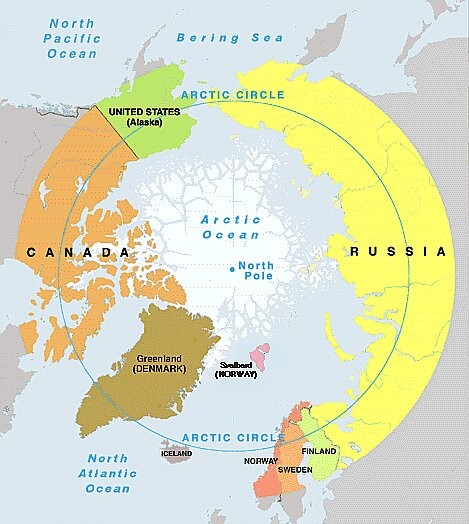
UPSC CURRENT AFFAIRS – 02nd April 2025 Home / Why are tensions high in the Arctic? Why in News? The Arctic is becoming a geopolitical hotspot due to climate change-driven accessibility, resource competition, and rising military tensions among global powers. Introduction The Arctic region, once largely isolated, has gained strategic importance due to climate change-induced ice melt, unlocking new trade routes and access to vast untapped natural resources. However, overlapping territorial claims, military posturing, and geopolitical rivalries have escalated tensions among Arctic nations and global powers. Geopolitical Significance of the Arctic Natural Resources – The Arctic is estimated to hold 13% of the world’s undiscovered oil and 30% of its untapped natural gas reserves. Additionally, it has rare earth elements, phosphates, and lucrative fishing grounds. Strategic Trade Routes – The melting ice has made shipping routes like the Northeast Passage (along Russia’s coast) and the Northwest Passage (through Canada’s Arctic Archipelago) more accessible, reducing maritime distance between Europe and Asia. Military and Security Interests – The Arctic is witnessing increased military activity, particularly by Russia, the U.S., and NATO members, raising concerns about potential conflicts. Governance of the Arctic The Arctic Council consists of eight member countries: Canada, Denmark (Greenland), Finland, Iceland, Norway, Russia, Sweden, and the U.S. It focuses on environmental protection, scientific research, and indigenous rights. Unlike Antarctica, which is protected under an international treaty, the Arctic is primarily governed by the UN Convention on the Law of the Sea (UNCLOS), allowing nations to claim the seabed beyond their Exclusive Economic Zones (EEZs). Russia, Canada, and Denmark have submitted overlapping claims over the Arctic seabed, leading to disputes. Key Geopolitical Tensions Russia vs. NATO – Russia has the most extensive Arctic infrastructure, including nuclear-powered icebreakers and military bases. Since Sweden and Finland joined NATO post-Ukraine war, NATO has strengthened its Arctic presence, raising tensions. U.S. vs. Canada (Northwest Passage Dispute) – The U.S. considers the Northwest Passage an international waterway, whereas Canada claims it as internal waters, leading to legal and diplomatic disagreements. U.S. vs. Denmark (Greenland Issue) – The U.S. has shown interest in acquiring Greenland due to its strategic location and rare earth deposits. Denmark has resisted these efforts and bolstered its security presence. Russia’s Territorial Claims – Russian officials have suggested claims over Norway’s Svalbard Islands and have conducted military drills with China, adding to Arctic security concerns. China’s Arctic Ambitions – Though not an Arctic nation, China has declared itself a “Near-Arctic State” and is pushing for the Polar Silk Road, aiming to use Arctic trade routes for economic expansion. Implications of Arctic Tensions Geopolitical Rivalries – The Arctic could become a zone of great-power competition, particularly between the U.S., Russia, NATO, and China. Environmental Concerns – Increased human activity threatens the fragile Arctic ecosystem, accelerating climate change. Resource Exploitation – Nations are eager to exploit the Arctic’s vast natural resources, which could lead to conflicts over extraction rights. Maritime Security – Disputes over Arctic shipping routes could disrupt global trade, affecting economic stability. Arctic Council The Arctic Council is a high-level intergovernmental forum established to promote cooperation, coordination, and interaction among Arctic states, indigenous communities, and other stakeholders on Arctic issues. It was founded by the Ottawa Declaration (1996) and focuses on sustainable development and environmental protection in the Arctic region. Key Features of the Arctic Council Feature Details Established 1996 (Ottawa Declaration) Type Intergovernmental forum (Not treaty-based) Headquarters Tromsø, Norway Members 8 Arctic states Observers 38 (including India, China, and Japan) Focus Areas Sustainable development, environmental protection, indigenous rights, scientific cooperation Members of the Arctic Council The eight Arctic states that form the core members of the Arctic Council are: Canada Denmark (including Greenland & Faroe Islands) Finland Iceland Norway Russia Sweden United States Each of these states has sovereignty over parts of the Arctic region and plays a crucial role in governance and policy formulation. Observers of the Arctic Council The Arctic Council grants observer status to non-Arctic states, intergovernmental organizations, and NGOs. Observers participate in discussions but do not have decision-making rights. Some key observer states include: India (Observer since 2013) China Japan South Korea United Kingdom Germany France India’s involvement focuses on scientific research, climate studies, and sustainable development. Structure of the Arctic Council Senior Arctic Officials (SAOs): Lead representatives from member states managing the council’s work. Working Groups: Specialized bodies conducting research and projects on issues like climate change, biodiversity, and pollution. Indigenous Permanent Participants: Six indigenous groups (e.g., Inuit Circumpolar Council, Saami Council) that actively contribute to decision-making. Way Forward Strengthening Arctic Governance – Establishing an Arctic treaty similar to the Antarctic Treaty System could help in resource-sharing and conflict prevention. Diplomatic Dialogue – Arctic Council members should engage in multilateral negotiations to resolve overlapping territorial claims. Environmental Protection – Sustainable development initiatives must be prioritized to balance economic interests with ecological preservation. Military De-escalation – Confidence-building measures between NATO and Russia are essential to avoid an Arctic arms race. Conclusion The Arctic is emerging as a key theatre of strategic, economic, and military competition among global powers. While climate change presents new opportunities, it also raises risks of territorial conflicts and environmental degradation. Effective diplomacy, multilateral cooperation, and sustainable policies are crucial for ensuring peace and stability in the region.
Yunus: Bangladesh is China’s Gateway to India’s Landlocked Northeast

UPSC CURRENT AFFAIRS – 02nd April 2025 Home / Yunus: Bangladesh is China’s Gateway to India’s Landlocked Northeast Why in News? Bangladesh’s interim government chief advisor, Professor Muhammad Yunus, highlighted Bangladesh’s strategic role in India’s Northeast connectivity while advocating for closer economic ties with China Introduction Bangladesh’s interim government chief advisor, Professor Muhammad Yunus, emphasized Dhaka’s strategic importance for India’s Northeast while advocating for stronger economic ties with China. During his four-day visit to China (March 26-29, 2025), Yunus stated that Bangladesh is the “only guardian of the ocean” for Northeast India and suggested that the region could serve as an “extension of the Chinese economy.” His remarks have raised concerns in New Delhi, as India’s engagement with Bangladesh has been crucial for the economic and security dynamics of the Northeast. Shift in Bangladesh’s Foreign Policy? Yunus’s statement on Northeast India: Described the region as “landlocked” and reliant on Bangladesh for access to the ocean. Indicated that the economic future of Northeast India could be linked to China through Bangladesh. Economic Outreach to China: During his meeting with Chinese President Xi Jinping, Yunus sought greater Chinese investments to revive Bangladesh’s economy. Termed China a “good friend” and projected it as a balancing factor against India. Upcoming BIMSTEC Summit (April 3-4, 2025): Yunus has requested a meeting with Prime Minister Narendra Modi in Thailand. India’s response is awaited, as the Northeast is a key focus area in India’s BIMSTEC engagement. India’s Strategic Concerns Bangladesh’s Leverage on Northeast India India’s Northeast has historically depended on the ‘Chicken’s Neck’ corridor in North Bengal, making transit through Bangladesh a key geopolitical factor. Over the past decade-and-a-half, India has worked with former PM Sheikh Hasina’s government to facilitate connectivity, including: Inland waterway agreements Rail and road transit projects Energy cooperation Yunus’s remarks suggest a potential shift in Dhaka’s policy, leveraging its position as a transit hub for economic and strategic gains. Deepening Bangladesh-China Ties China is a major investor in Bangladesh’s infrastructure projects, including: The Padma Bridge Rail Link Project Development of Chittagong Port Several energy and special economic zone projects Bangladesh’s increasing economic dependence on China could reshape regional power dynamics, affecting India’s ‘Neighbourhood First’ policy. China’s influence in South Asia through its Belt and Road Initiative (BRI) could limit India’s strategic access and economic influence. Implications for India’s Northeast and Act East Policy India’s Act East Policy focuses on linking the Northeast with Southeast Asia through connectivity projects like: Kaladan Multi-Modal Transit Transport Project (via Myanmar) India-Bangladesh cross-border rail links A Bangladesh tilt towards China could impact these projects, potentially increasing costs and logistical challenges for India. China’s economic influence in Bangladesh could also lead to security concerns, including greater Chinese military presence in the Bay of Bengal. Way Forward for India Strengthening Diplomatic Engagement with Bangladesh India should engage with Bangladesh’s interim government to reaffirm past agreements and maintain cooperation in connectivity projects. Expanding initiatives such as the India-Bangladesh joint economic corridor can reduce Chinese influence. Enhancing Regional Connectivity Beyond Bangladesh Diversifying connectivity routes via: Trilateral Highway (India-Myanmar-Thailand) Deep-sea port collaborations in Myanmar (Sittwe) and Sri Lanka Expediting BIMSTEC projects to establish alternative trade corridors. Economic and Security Partnerships Strengthening India’s economic presence in Bangladesh through targeted investments in: Manufacturing and supply chains Renewable energy cooperation Digital infrastructure Expanding defense ties with Bangladesh to counter China’s growing military influence in South Asia.
Tackling the disinformation threat in India

UPSC CURRENT AFFAIRS – 02nd April 2025 Home / Tackling the disinformation threat in India Why in News? The World Economic Forum’s (WEF) Global Risks Report 2025 highlights misinformation and disinformation as the most significant short-term global threat. Introduction The World Economic Forum’s (WEF) Global Risks Report 2025 has highlighted misinformation and disinformation as the most significant short-term global threat. The report defines a global risk as an event that can adversely affect a substantial portion of the population, global GDP, and natural resources. The rapid proliferation of AI-generated content, algorithmic biases, and deep societal divides has made it increasingly difficult to distinguish facts from fabricated narratives. The Crisis of Information Disorder India, with an expanding digital population of over 900 million Internet users, is particularly vulnerable to disinformation and manipulated narratives. The country’s diverse political and social landscape creates a fertile ground for the spread of falsehoods, influencing voters and economic decisions. This is not just a political challenge but also an economic and social one, leading to consumer boycotts, economic disruptions, and international tensions. Adding to this crisis, trust in legacy media has significantly declined, with social media emerging as the primary news source. As a result, many users unknowingly forward unverified information, assuming it to be credible because it originates from familiar sources. Political entities and non-state actors exploit this trust deficit to spread propaganda, further fueling polarization and social unrest. India’s Battle Against Disinformation As a rising global power, India has faced foreign disinformation threats, particularly from China. The 2017 Doklam standoff prompted India to ban over 300 Chinese apps, including TikTok, to curb external interference. According to a study by the Indian School of Business and the CyberPeace Foundation, 46% of disinformation in India is political, followed by 33.6% on general issues and 16.8% on religious topics. Platforms such as Weibo, controlled by China, have been instrumental in distorting India’s global image. Additionally, concerns have arisen over Meta’s potential decision to end fact-checking partnerships, similar to what was observed in the United States. With almost 400 million Facebook and 500 million WhatsApp users, India represents one of the largest digital markets, making it crucial to implement effective regulatory mechanisms. Recommended Measures The Global Risks Report 2025 outlines several key strategies to mitigate the risks posed by disinformation: Regulation of AI-Generated Content – Establishing supervisory boards and AI councils to monitor Generative AI practices and algorithmic biases. Strengthening Digital Literacy – Public awareness campaigns, such as the Reserve Bank of India’s Financial Literacy Campaign, to enhance critical thinking skills. Platform Accountability – Implementing risk assessments for very large online platforms (VLOPs), similar to the EU’s Digital Services Act. Cybersecurity Research – Increasing investment in cybersecurity innovations to counteract deepfakes and AI-driven misinformation. Content Moderation Policies – Enforcing strict non-discrimination rules and ensuring funding transparency for online advertisements to prevent manipulated narratives. Cross-Border Collaboration – Establishing global coalitions to combat foreign information manipulation and interference (FIMI). Concerns Over Surveillance and Censorship While stringent regulations are necessary to combat misinformation, the WEF report also warns against excessive censorship and surveillance. Misuse of regulatory policies could lead to restrictions on free speech and potential authoritarian control over digital spaces. Thus, any intervention must balance security concerns with democratic safeguards. Conclusion Misinformation and disinformation are not just technological challenges but tests of global democratic values. As the world’s largest democracy, India must take a leading role in promoting digital resilience by implementing comprehensive policies that counteract disinformation while upholding freedom of expression. The real challenge is not just fighting falsehoods but ensuring that India’s unity in diversity remains intact in the face of rising digital polarization.
Forest areas encroached in 25 States, Union Territories: MP, Assam worst affected

UPSC CURRENT AFFAIRS – 02nd April 2025 Home / Forest areas encroached in 25 States, Union Territories: MP, Assam worst affected Why in News? Over 13,000 sq km of forest land across 25 Indian states and UTs is under encroachment, with Madhya Pradesh and Assam being the most affected, according to the Environment Ministry’s report to the NGT. Introduction A significant portion of India’s forest land, totaling over 13,000 square kilometers, is currently under encroachment across 25 States and Union Territories, according to data submitted by the Union Environment Ministry to the National Green Tribunal (NGT). This encroached area is larger than the combined geographical area of Delhi, Sikkim, and Goa. The NGT had previously taken suo motu cognizance of a report last year that indicated over 7,506 sq km of forest area was under encroachment. Following this, the NGT directed the Environment Ministry to compile comprehensive data on forest encroachment from all states and UTs. The latest report, submitted to the NGT last week, reveals that as of March 2024, 13,056 sq km of forest area has been encroached upon by 25 states and UTs that have provided data. Understanding Forest Area (RFA) The report clarifies that “Recorded Forest Area” includes land officially designated as forest by the government, regardless of whether it has tree cover. This area is further categorized into reserved forests, protected forests, and unclassed forests with varying levels of protection and permitted activities. Efforts to Remove Encroachment The ministry’s report also indicates that encroachment has been removed from 77 sq km of forest land so far. However, it remains unclear if this area has been excluded from the total figure of encroached land as of March 2024. Government Action The Union Environment Ministry has been actively pursuing data collection from states and UTs, sending multiple letters and reminders, and holding meetings to obtain the required information in a standardized format. Key Findings Total Encroached Forest Area: As of March 2024, 13,056 sq km of forest land is under encroachment across 25 States and UTs. This is larger than the combined area of Delhi, Sikkim, and Goa. Majorly Affected States: Madhya Pradesh: 5,460.9 sq km (Highest encroachment) Assam: 3,620.9 sq km Karnataka: 863.08 sq km Maharashtra: 575.54 sq km Arunachal Pradesh: 534.9 sq km Odisha, UP, Mizoram, Jharkhand, and Chhattisgarh also have significant encroachments. States Yet to Submit Data: Bihar, Haryana, HP, Rajasthan, Telangana, WB, Nagaland, Delhi, J&K, Ladakh are yet to provide their figures. Forest Classification & Protection: Forest areas in India fall under Reserved Forests, Protected Forests, and Unclassed Forests. Reserved forests enjoy the highest protection, while unclassed forests have the least restrictions. Government Action: 409.77 sq km of encroached land has been cleared. The Environment Ministry has issued multiple reminders to states for data submission. Implications Deforestation & Ecological Impact: Encroachment leads to habitat destruction, loss of biodiversity, and climate change effects. Legal & Policy Challenges: Stricter enforcement and rehabilitation plans are needed to prevent encroachment. Need for Comprehensive Data: With several states yet to report, the real extent of encroachment could be even higher.