Lok Sabha passes Aircraft Objects and Coastal Shipping Bills
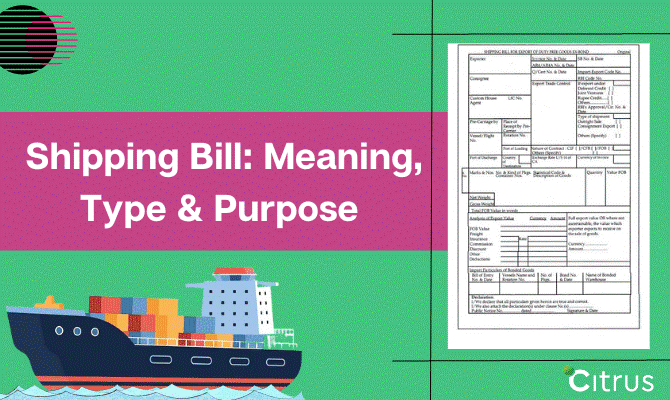
UPSC CURRENT AFFAIRS – 04th April 2025 Home / Lok Sabha passes Aircraft Objects and Coastal Shipping Bills Why in News? The Protection of Interests in Aircraft Objects Bill, 2024, ensures faster repossession of leased aircraft by international lessors, while the Coastal Shipping Bill, 2024. Introduction The Lok Sabha recently passed two key legislations—the Protection of Interests in Aircraft Objects Bill, 2024, and the Coastal Shipping Bill, 2024—through a voice vote. These bills aim to strengthen India’s aviation and maritime sectors by enhancing investor confidence in aircraft leasing and promoting coastal shipping as an efficient mode of freight transport. Protection of Interests in Aircraft Objects Bill, 2024 Objective: To protect the interests of international lessors and financiers by ensuring quick repossession of aircraft in case of airline defaults. To align Indian aviation regulations with the Cape Town Convention and improve India’s compliance score, which affects leasing costs. Background and Need: The bill was introduced in response to challenges faced by international aircraft lessors in retrieving their aircraft when Indian airlines defaulted on lease payments. Case Studies: SpiceJet (2015): Lessors were unable to repossess aircraft due to a lack of legal provisions. Jet Airways (2019): Lessors retrieved aircraft before insolvency proceedings began. Go Air (2023): Aircraft were not returned to lessors, leading to India’s compliance score drop in the Cape Town Convention index. Key Provisions: Empowers lessors to take back aircraft swiftly in case of payment defaults. Ensures DGCA (Directorate General of Civil Aviation) has the legal authority to deregister aircraft upon default. Prevents aircraft from being stuck in insolvency proceedings, thereby reducing risks for international lessors. Expected Impact: Lower leasing costs for Indian airlines, leading to reduced airfares. Boosts investor confidence, encouraging more aircraft leasing deals. Supports India’s growing aviation sector, with airlines ordering 1,700 new aircraft to meet rising demand. Coastal Shipping Bill, 2024 Objective: To regulate and promote coastal shipping within India’s territorial waters. To increase the share of coastal shipping in freight movement, reducing dependence on road and rail transport. Background and Need: Despite India’s 11,098 km long coastline, coastal shipping accounts for only 5% of total freight movement. Comparatively, the European Union (EU) uses coastal shipping for 40% of freight, highlighting India’s underutilization of this mode. Currently, 66% of freight moves via roadways, 31% via rail, and only 5% via coastal shipping, leading to high transportation costs, pollution, and congestion. Key Provisions: Simplifies regulatory processes for vessels engaged in coastal trade. Encourages investment in coastal shipping infrastructure. Promotes coastal shipping as a cost-effective and environment-friendly alternative to road and rail transport. Expected Impact: Lower transportation costs for industries dependent on freight movement. Reduced congestion on road and rail networks. Job creation in the maritime sector, boosting economic growth. Lower carbon emissions, contributing to environmental sustainability. Conclusion The passage of these two bills marks a significant step toward enhancing India’s civil aviation and maritime sectors. While the Aircraft Objects Bill will improve India’s standing in global aviation leasing, the Coastal Shipping Bill is expected to boost trade efficiency and reduce logistics costs. Successful implementation of these legislations will contribute to India’s broader goals of economic growth, investment attraction, and sustainable transport development.
Instant injustice
UPSC CURRENT AFFAIRS – 04th April 2025 Home / Instant injustice Why in News? The Supreme Court of India has strongly criticized the illegal demolition of properties by state authorities without due process, reaffirming the fundamental principles of the rule of law and the right to shelter under Article 21 of the Constitution. Introduction The rule of law is a fundamental pillar of a democratic society, ensuring justice, fairness, and protection of fundamental rights. Arbitrary and biased law enforcement has undermined the rule of law in India for decades, leading to concerns over human rights violations. Instances of custodial torture, extrajudicial killings, and illegal demolitions highlight the growing trend of state high-handedness. Judicial Intervention and Supreme Court’s Observations The Supreme Court of India recently criticized the illegal demolition of properties in Prayagraj, Uttar Pradesh, stating that it “shocked the conscience” of the Court. A Bench led by Justice A.S. Oka observed that the demolitions were conducted without serving show-cause notices to the owners. The Court reaffirmed that: There can be no punishment without trial. Collective punishment is unlawful. Every individual is presumed innocent until proven guilty. The right to shelter is an integral part of Article 21 of the Indian Constitution. The Court ordered ₹10 lakh as compensation for each affected house owner. Growing Trend of Extra-Legal Punishments Despite judicial disapproval, the practice of bulldozing properties without due process continues in various states. Originally observed in Bharatiya Janata Party (BJP)-ruled states, the trend has now spread beyond partisan lines. In Punjab, the Aam Aadmi Party (AAP) government used property demolition as a tool in its campaign against the drug mafia. The widespread social approval of such actions reflects a decline in governance standards and the normalization of state high-handedness. Concerns Over State-Sanctioned Mob Justice The state has a constitutional duty to curb mob lynching and ensure law and order. When the state itself resorts to tactics resembling mob justice, it erodes public trust in institutions. Bypassing legal procedures sets a dangerous precedent and threatens civil liberties. Way Forward: Ensuring Rule of Law Judicial Oversight: The Supreme Court must ensure strict implementation of its rulings across all states. Accountability of Authorities: Officials responsible for extra-legal demolitions should be held accountable. Public Awareness: Citizens must be made aware of their rights to challenge unlawful state actions. Strengthening Due Process: All legal procedures, including proper investigation and trials, must be strictly followed before any punitive action. Article 21 of the Indian Constitution “No person shall be deprived of his life or personal liberty except according to the procedure established by law.” Key Features of Article 21: Fundamental Right: It is a fundamental right under Part III of the Indian Constitution. Available to Citizens and Non-Citizens: It applies to both Indian citizens and foreigners within the territory of India. Protection Against State Actions: The state cannot take away a person’s life or personal liberty except through a fair and just legal procedure. Interpretation and Expansion by the Supreme Court Over the years, the Supreme Court has expanded the scope of Article 21 to include various rights essential for a dignified life. Some important interpretations include: Right to Live with Human Dignity In Francis Coralie Mullin v. Union Territory of Delhi (1981), the Supreme Court held that life under Article 21 means more than mere animal existence. It includes dignity, education, health, and livelihood. Right to Shelter In Olga Tellis v. Bombay Municipal Corporation (1985), the Court ruled that the right to shelter is part of the right to life, as a home is essential for a dignified existence. The recent Supreme Court order on illegal demolitions in Prayagraj reaffirmed that demolishing homes without following due process violates Article 21. Right to Privacy In K.S. Puttaswamy v. Union of India (2017), the Supreme Court declared that the right to privacy is a fundamental right under Article 21. Right Against Arbitrary Arrest and Torture In D.K. Basu v. State of West Bengal (1997), the Court issued guidelines against custodial torture and emphasized that no person can be deprived of life or liberty through illegal arrests. Right to a Pollution-Free Environment In M.C. Mehta v. Union of India (1987), the Supreme Court ruled that the right to a clean environment is part of Article 21. Conclusion The rule of law is the bedrock of democracy and must be upheld at all costs. The state must not act as a mob but rather as a guardian of justice, ensuring that every citizen receives fair treatment under the law. Judicial interventions must translate into effective policy implementation to prevent further erosion of constitutional values.
XV-Finance Commission Grants to Boost Rural Development
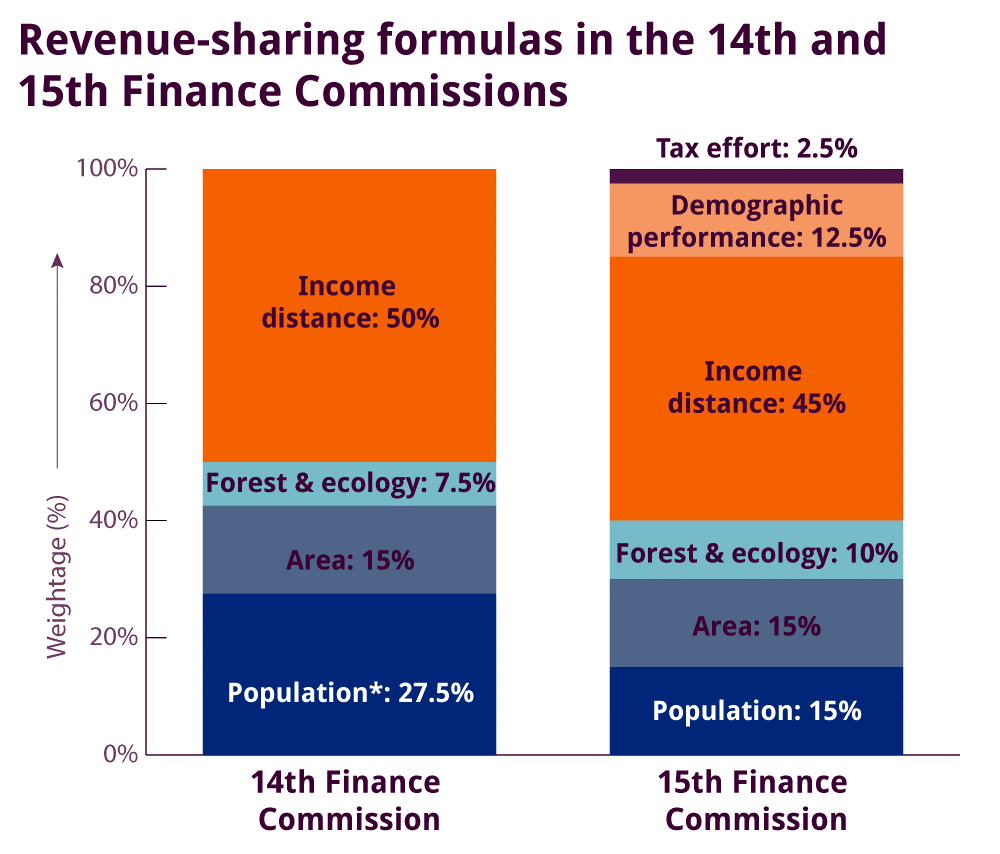
UPSC CURRENT AFFAIRS – 04th April 2025 Home / XV-Finance Commission Grants to Boost Rural Development Why in News? The Union Government has disbursed XV-FC grants to RLBs/PRIs in five states (Arunachal Pradesh, Gujarat, Madhya Pradesh, Nagaland, and Punjab) to strengthen local governance and improve rural service delivery through untied and tied grants. Introduction The Union Government has released the Fifteenth Finance Commission (XV-FC) grants to Rural Local Bodies (RLBs)/Panchayati Raj Institutions (PRIs) in five states—Arunachal Pradesh, Gujarat, Madhya Pradesh, Nagaland, and Punjab—during the financial year 2024–25. These grants, provided in two installments per financial year, are allocated based on recommendations from the Ministry of Panchayati Raj and the Ministry of Jal Shakti (Department of Drinking Water and Sanitation). State-Wise Allocation of XV-FC Grants (FY 2024–25) The recent disbursement of XV-FC grants includes both the first and second installments for different states, as follows: Madhya Pradesh Amount: ₹651.7794 crore (1st Installment, Untied Grants) Beneficiaries: 52 eligible District Panchayats, 309 eligible Block Panchayats, and 22,995 eligible Gram Panchayats. Gujarat Amount: ₹508.6011 crore (1st Installment, Untied Grants) Beneficiaries: 27 eligible District Panchayats, 242 eligible Block Panchayats, and 14,469 eligible Gram Panchayats. Punjab Amount: ₹225.975 crore (2nd Installment, Untied Grants) Beneficiaries: 22 eligible Zila Parishads, 149 eligible Block Panchayats, and 13,152 eligible Gram Panchayats. Arunachal Pradesh Amount: ₹35.40 crore (1st Installment, Untied Grants, FY 2022–23) Beneficiaries: All eligible RLBs in the state. Nagaland Amount: ₹19.20 crore (1st Installment, Untied Grants, FY 2022–23) Beneficiaries: All eligible RLBs in the state. Utilization of XV-FC Grants The XV-FC grants are categorized into Untied Grants and Tied Grants, ensuring flexibility and specific service delivery in rural areas. Untied Grants Untied grants provide autonomy to RLBs/PRIs to address location-specific development needs under the 29 Subjects listed in the Eleventh Schedule of the Constitution. These funds cannot be used for salaries and establishment costs, ensuring direct developmental impact. Tied Grants Tied grants are designated for critical rural infrastructure and service delivery, particularly in the following sectors: Sanitation and Maintenance of Open Defecation Free (ODF) Status Household waste management. Human excreta and fecal sludge treatment. Drinking Water Supply and Water Conservation Ensuring sustainable drinking water access. Promotion of rainwater harvesting and water recycling. Significance of XV-FC Grants in Strengthening Local Governance The timely disbursement of XV-FC grants underscores the Union Government’s commitment to strengthening grassroots governance and enhancing rural service delivery. These grants empower PRIs to implement development projects aligned with the needs of local communities, fostering inclusive growth and rural sustainability. Conclusion The XV-FC grants play a crucial role in decentralizing financial resources, enabling PRIs to function effectively in providing essential public services. The government’s emphasis on timely fund allocation and targeted utilization reinforces its vision for empowering rural local bodies, improving infrastructure, and ensuring sustainable development at the grassroots level.
India, Nepal ink 10 MoUs worth Nepalese Rs.625 million for community development projects
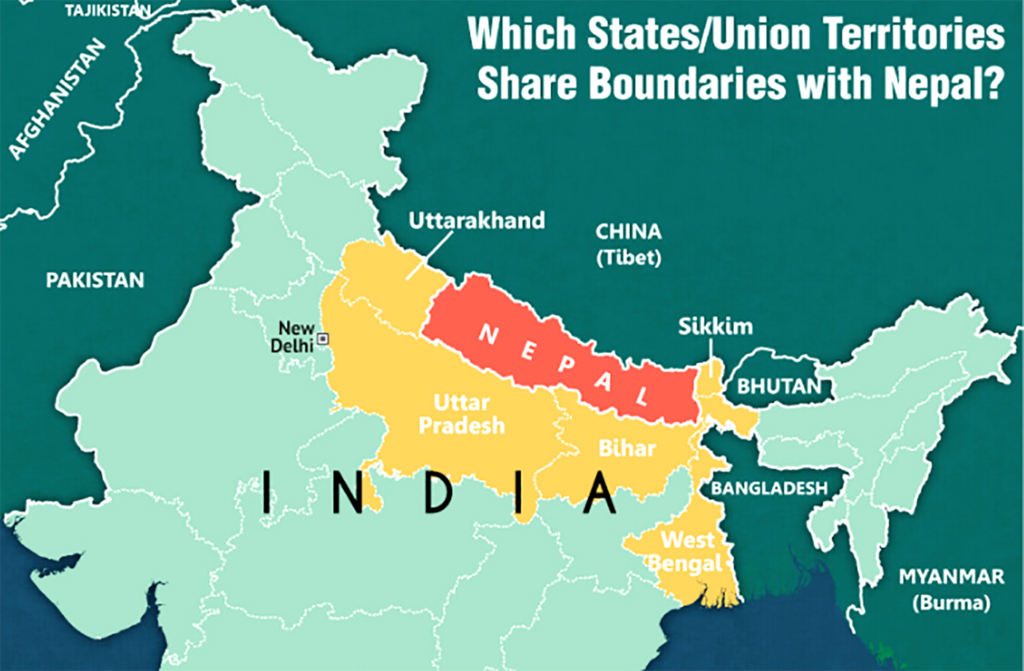
UPSC CURRENT AFFAIRS – 03rd April 2025 Home / India, Nepal ink 10 MoUs worth Nepalese Rs.625 million for community development projects Why in News? India and Nepal signed 10 MoUs under the High Impact Community Development Projects (HICDPs). Introduction India and Nepal have signed 10 Memorandums of Understanding (MoUs) on April 1, 2025, for the development of education, health, and cultural sectors in Nepal. These projects, funded by Indian assistance amounting to Nepalese Rs. 625 million, are part of the High Impact Community Development Projects (HICDPs) under the Nepal-India Development Cooperation initiative. Key Highlights of the Agreement Total Projects Signed: 10 Total Indian Assistance: Nepalese Rs. 625 million Sectors Covered: Education, Health, and Culture Major Projects: Construction of three schools Establishment of one monastery Development of one e-library at a school Construction of two health post buildings Significance of HICDPs Strengthens India-Nepal bilateral relations through developmental cooperation. Enhances education, healthcare, and cultural infrastructure for Nepalese citizens. Reflects India’s continued commitment to Nepal’s socio-economic growth. Builds on the 573 HICDPs undertaken by India in Nepal since 2003, of which 495 projects have been completed. India-Nepal Relations India and Nepal share deep-rooted historical, cultural, economic, and strategic ties. Their relationship is guided by geographical proximity, open borders, and strong people-to-people connections. Both countries collaborate across multiple sectors, including trade, security, energy, infrastructure, and development assistance. Key Aspects of India-Nepal Relations Historical and Cultural Ties Nepal and India share centuries-old civilizational and cultural linkages, including Hinduism and Buddhism. Ramayana and Mahabharata linkages: Janakpur (Sita’s birthplace) and Pashupatinath Temple in Nepal are revered by Indians. Strong people-to-people ties due to intermarriages and social exchanges, especially in the Terai region. Political and Diplomatic Relations India was among the first countries to recognize Nepal’s sovereignty. The 1950 Treaty of Peace and Friendship allows for free movement of people and economic cooperation. High-level visits strengthen ties, such as PM Modi’s multiple visits to Nepal and Nepalese leaders’ visits to India. Economic and Trade Relations India is Nepal’s largest trade partner, accounting for over 60% of Nepal’s total trade. Major Exports from Nepal to India: Agriculture products, jute goods, textiles. Major Imports from India to Nepal: Petroleum products, machinery, food items. India provides development assistance under schemes like High Impact Community Development Projects (HICDPs). Infrastructure and Connectivity India supports road, rail, and air connectivity projects in Nepal. Notable projects: Raxaul-Kathmandu Railway (proposed). Integrated Check Posts (ICPs) for smoother border trade. Motihari-Amlekhgunj Petroleum Pipeline – Nepal’s first cross-border pipeline. Hydroelectric Projects for energy security. Water and Energy Cooperation India and Nepal share transboundary rivers like the Ganga, Kosi, Gandak, and Mahakali. Hydropower agreements: Upper Karnali Hydroelectric Project. Arun III Hydropower Project (900 MW) developed by India’s SJVN. Cross-border electricity trade under the India-Nepal Energy Agreement. Security and Defense Cooperation Nepal and India share an open border, and security cooperation is crucial. Indian and Nepalese Armies have close ties – India recruits Gorkha soldiers into the Indian Army. Regular bilateral military exercises, such as SURYA KIRAN. India supports Nepal’s disaster management and defense infrastructure development. Development Assistance India has undertaken over 573 High Impact Community Development Projects (HICDPs) in Nepal. Sectors covered: education, health, infrastructure, culture. Example: Construction of schools, hospitals, and monasteries in Nepal. Conclusion The signing of these MoUs reinforces India’s development partnership with Nepal, focusing on grassroots-level impact. By augmenting Nepal’s infrastructure in key sectors, these projects contribute to the long-term well-being of the Nepalese people and further
T.N. Assembly unanimously adopts resolution on Katchatheevu retrieval from Sri Lanka
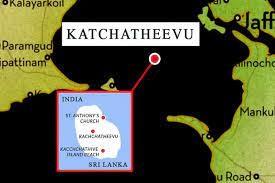
UPSC CURRENT AFFAIRS – 03rd April 2025 Home / T.N. Assembly unanimously adopts resolution on Katchatheevu retrieval from Sri Lanka Why in News? The Tamil Nadu Legislative Assembly passed a resolution urging the Union government to retrieve Katchatheevu Island from Sri Lanka. Introduction Recently, the Tamil Nadu Legislative Assembly unanimously adopted a resolution urging the Union government to take steps to retrieve Katchatheevu island from Sri Lanka. The resolution, moved by Chief Minister M.K. Stalin, emphasized that reclaiming Katchatheevu is the only permanent solution to protect the traditional fishing rights of Tamil Nadu fishermen and mitigate their hardships due to the Sri Lankan Navy’s actions. Background Katchatheevu, a small uninhabited island in the Palk Bay, was ceded to Sri Lanka under the Indo-Sri Lankan agreement of 1974. Tamil Nadu fishermen have traditionally used this region for fishing, but Sri Lanka considers Indian fishing activities near the island as a violation of its maritime boundaries. Key Highlights of the Resolution Demand for Reviewing the 1974 Indo-Sri Lankan Agreement: The resolution calls upon the Union government to review and renegotiate the agreement to reclaim Katchatheevu. Protection of Tamil Nadu Fishermen’s Rights: Tamil Nadu fishermen have faced frequent arrests and boat seizures by the Sri Lankan Navy. In 2024 alone, 530 Indian fishermen were arrested. The resolution stresses the need to ensure their safety and livelihood. Request for the Release of Imprisoned Fishermen: The resolution urged the Prime Minister to negotiate with Sri Lanka for the release of detained fishermen and their seized boats as a goodwill gesture. Historical Opposition to the Agreement: The resolution highlighted that former Tamil Nadu Chief Ministers, including M. Karunanidhi, J. Jayalalithaa, and O. Panneerselvam, had previously opposed the ceding of Katchatheevu and passed multiple resolutions demanding its retrieval. Katchatheevu Island: India-Sri Lanka Conflict Katchatheevu is a small, uninhabited island located in the Palk Bay between India and Sri Lanka. The island has been a long-standing point of contention between the two nations, primarily due to historical claims, fishing rights, and strategic significance. Geographical Significance Location: Situated in the Palk Strait, between Tamil Nadu (India) and the Northern Province of Sri Lanka. Size: Around 1.6 km², with limited vegetation and no permanent human habitation. Fishing Zone: Rich in marine resources, making it crucial for Tamil Nadu fishermen. Historical Background Pre-1974: Katchatheevu was historically used by Indian and Sri Lankan fishermen for fishing and drying nets. Indo-Sri Lankan Agreement (1974): India ceded Katchatheevu to Sri Lanka under an agreement signed by Indira Gandhi and Sirimavo Bandaranaike. The agreement permitted Indian fishermen traditional fishing rights around the island. 1976 Maritime Boundary Agreement: India and Sri Lanka delimited their maritime boundaries, further restricting Indian fishermen from accessing the region. Key Issues in the Conflict Fishermen’s Rights Tamil Nadu fishermen continue to enter waters around Katchatheevu, leading to frequent arrests and clashes with the Sri Lankan Navy. Sri Lanka maintains that Indian fishermen violate maritime boundaries, while India argues for traditional rights. Legal and Political Controversy Tamil Nadu’s Stand: Successive state governments, including DMK and AIADMK, have demanded the retrieval of Katchatheevu. Indian Government’s Stand: The Centre has maintained that the agreement is legally binding, but discussions on fishermen’s rights continue. Supreme Court Case: Various petitions have been filed in the Supreme Court of India, challenging the 1974 agreement. Diplomatic and Strategic Concerns China’s Influence: Growing Chinese investments in Sri Lanka raise security concerns for India. Maritime Security: Katchatheevu is strategically located near vital sea routes, making it significant for India’s maritime defense. Conclusion The unanimous passage of the resolution in the Tamil Nadu Legislative Assembly reflects a unified demand for reclaiming Katchatheevu. The issue remains a major point of contention in India-Sri Lanka relations, with significant diplomatic, legal, and livelihood implications for Tamil Nadu fishermen. The final course of action will depend on India’s foreign policy decisions and negotiations with Sri Lanka.
PwC suggests IDEA framework for Indian companies to navigate U.S. tariff uncertainties

UPSC CURRENT AFFAIRS – 03rd April 2025 Home / PwC suggests IDEA framework for Indian companies to navigate U.S. tariff uncertainties Why in News? PwC’s IDEA (Invest, Diversify, Express, Stay Aware) Framework provides a strategic approach for Indian businesses to navigate trade uncertainties amid the U.S. administration’s reciprocal tariffs on Indian exports. Introduction The global trade landscape has witnessed significant shifts following the U.S. presidential elections in November 2024. The Donald Trump administration has implemented reciprocal tariffs, impacting major economies, including India. In response to these developments, PwC (PricewaterhouseCoopers) has introduced the IDEA (Invest, Diversify, Express, Stay Aware) Framework to help Indian businesses build resilience against trade uncertainties and leverage emerging opportunities. Understanding the IDEA Framework Invest Indian businesses should invest in technology upgradation and AI-driven supply chain solutions to enhance operational efficiency. Strengthening domestic manufacturing and automation can help reduce reliance on imports and enhance global competitiveness. Diversify To minimize risks from trade restrictions, businesses should explore new export markets and reduce dependence on a single source of raw materials or suppliers. Identifying alternative procurement sources from multiple countries ensures resilience against geopolitical disruptions. Express The industry must actively communicate its concerns to the government and seek necessary policy interventions. Possible measures include tariff relief, trade agreements, and sector-specific incentives to safeguard domestic industries. Stay Aware Businesses should continuously monitor global trade developments and adapt dynamically to evolving policies. Proactive engagement with stakeholders and leveraging trade intelligence can help minimize risks and seize new opportunities. Significance of the IDEA Framework Helps Indian businesses navigate trade uncertainties caused by tariff realignments. Encourages self-reliance and strategic expansion in global markets. Strengthens India’s position in the global supply chain through technological advancements and diversified trade partnerships. Conclusion The PwC IDEA Framework serves as a strategic roadmap for Indian businesses to mitigate the impact of U.S. trade policies and capitalize on new opportunities. By investing in technology, diversifying markets, expressing concerns, and staying aware, Indian industries can build long-term resilience in an increasingly complex global trade environment.
Manufacturing PMI climbs to eight month high of 58.1 in March
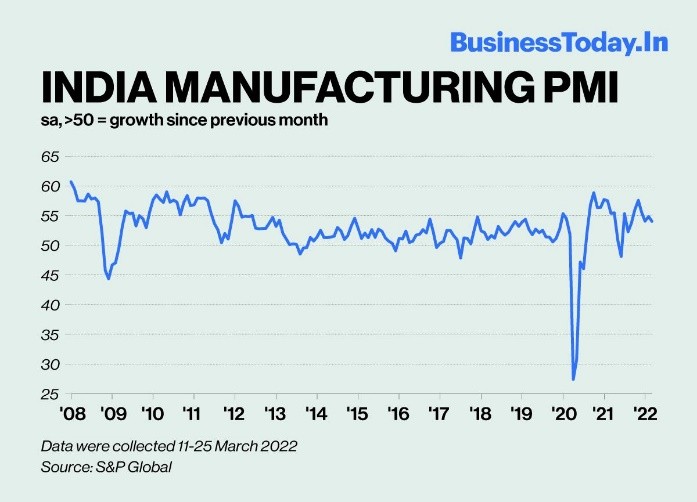
UPSC CURRENT AFFAIRS – 03rd April 2025 Home / Manufacturing PMI climbs to eight month high of 58.1 in March Why in News? India’s Manufacturing PMI rose to 58.1 in March 2025, an eight-month high, driven by strong domestic demand, increased new orders, and robust production growth. Introduction India’s Manufacturing Purchasing Managers’ Index (PMI), a key indicator of industrial activity, rose to an eight-month high of 58.1 in March 2025, according to a report by S&P Global. This marks a significant increase from 56.3 in February 2025. The index has now remained above the expansion threshold of 50 for 45 consecutive months, highlighting sustained growth in the sector. Key Highlights of the PMI Report Strong Growth in New Orders The increase in PMI was primarily attributed to higher new orders, which reached an eight-month high of 61.5. Domestic demand remained robust, even though international orders experienced a slight slowdown. Firms responded to strong demand by utilizing existing inventories, leading to the sharpest decline in finished goods stocks in over three years. Sales and Production Expansion Manufacturing sales expanded at a robust pace, driven by positive customer interest, strong market conditions, and effective marketing strategies. Production volumes also increased toward the end of the financial year 2024-25, indicating a positive outlook for the sector. Export orders continued to grow, but the growth rate was the slowest in three months. Price Trends and Cost Pressures Input prices recorded a three-month high but remained below their long-term average, suggesting manageable cost pressures. Despite rising input costs, the increase in prices charged for goods remained moderate, helping to sustain demand. Business Sentiment and Future Outlook Business confidence remained optimistic, with 30% of firms expecting higher output in the next 12 months, compared to less than 2% anticipating a contraction. HSBC noted that pending projects and stable customer relations contributed to positive expectations for future output levels. Purchasing Managers’ Index (PMI) The Purchasing Managers’ Index (PMI) is a widely used economic indicator that measures the performance of the manufacturing and services sectors in an economy. It is based on a survey of purchasing managers in businesses and provides insights into economic trends such as growth, contraction, and business sentiment. How is PMI Measured? PMI is calculated based on five key indicators: New Orders – Measures the level of demand for goods and services. Production Output – Reflects the level of manufacturing activity. Employment Levels – Indicates hiring trends in the industry. Supplier Deliveries – Assesses supply chain efficiency. Stock of Purchases – Tracks inventory levels of raw materials. PMI Scale and Interpretation PMI above 50 → Indicates economic expansion and industry growth. PMI below 50 → Suggests contraction in business activity. PMI at 50 → Signals no change in business conditions. Types of PMI Manufacturing PMI – Measures the performance of the manufacturing sector. Services PMI – Assesses the health of the services industry. Composite PMI – A combined measure of manufacturing and services PMI. Importance of PMI Leading Economic Indicator – PMI provides early signals of economic trends before official GDP data. Business and Investment Decisions – Helps companies plan production, hiring, and investments. Central Bank Policy – Used by policymakers to assess inflationary pressures and adjust monetary policies accordingly. Stock Market Reactions – PMI influences investor sentiment and stock market movements. Conclusion The latest PMI data signals continued strength in India’s manufacturing sector, supported by strong domestic demand, steady production growth, and favorable business sentiment. Despite global uncertainties and a slight slowdown in export orders, the manufacturing industry remains resilient, contributing to the overall economic momentum.
Lok Sabha passes the Waqf (Amendment) Bill, 2025
UPSC CURRENT AFFAIRS – 03rd April 2025 Home / Lok Sabha passes the Waqf (Amendment) Bill, 2025 Why in News? The Waqf (Amendment) Bill, 2024, passed in the Lok Sabha, aims to revise the legal framework governing waqf properties. Introduction The Lok Sabha passed the Waqf (Amendment) Bill, 2024, after a heated 12-hour debate, with the government strongly defending its stance against opposition allegations of encroachment on constitutional rights, federalism, and minority rights. The Bill was adopted with 288 votes in favor and 232 against. The Bill, which seeks to amend laws governing Islamic endowments (waqf properties), is expected to pass smoothly in the Rajya Sabha as well. Background of the Bill The Waqf Act, 1995, provides for the administration, supervision, and management of waqf properties—endowments made for religious or charitable purposes in Islam. The government’s amendments in 2013 gave the Waqf Act an overriding effect over other property laws, which the government seeks to reverse through the Waqf (Amendment) Bill, 2024. Key Provisions of the Bill Reversal of 2013 Amendments: The Bill seeks to remove provisions that granted waqf laws precedence over other property laws, ensuring a more balanced legal framework. Inclusion of Non-Muslim Members: It allows for the appointment of non-Muslims in waqf boards and councils, which has been a contentious issue. Emphasis on Property Regulation: The Bill claims to deal solely with properties and administration, without interfering in religious matters. Repeal of Mussalman Waqf Act, 1923: Alongside the amendment bill, the Mussalman Waqf (Repeal) Bill, 2024 was also passed, repealing an outdated law concerning waqf properties. Broader Implications Legal and Constitutional Impact The amendment redefines the status of waqf properties in legal disputes, ensuring they do not override other land laws. The inclusion of non-Muslims in waqf boards could be challenged in court as a violation of the right of religious communities to manage their own affairs under Article 26 of the Indian Constitution. Political Significance This is the fourth major legislative action by the government related to Muslim personal laws, following: Criminalization of Triple Talaq Citizenship (Amendment) Act, 2019 (CAA) Implementation of the Uniform Civil Code (UCC) in Uttarakhand Impact on Minority Rights The opposition argues that this amendment weakens autonomy in waqf administration, potentially leading to disputes over religious property rights. It is a necessary reform to curb mismanagement and favoritism within waqf boards. Right to Property The Right to Property was initially a Fundamental Right under Article 19(1)(f) and Article 31 of the Indian Constitution. However, it was later removed as a Fundamental Right and given the status of a legal/constitutional right under Article 300A by the 44th Constitutional Amendment Act, 1978. Historical Evolution Original Position (1950) Article 19(1)(f): Guaranteed citizens the right to acquire, hold, and dispose of property. Article 31: Stated that no person shall be deprived of their property except by the authority of law, and provided for compensation in case of acquisition by the State. Amendments and Changes 1st Amendment (1951): Added Article 31A and 31B, enabling the government to acquire land for land reforms and placed certain laws under the Ninth Schedule to protect them from judicial review. 4th Amendment (1955): Limited the power of courts to question compensation given by the government for land acquisition. 25th Amendment (1971): Replaced “compensation” with “amount”, reducing the obligation to provide market-value compensation. 44th Amendment (1978): Deleted Article 19(1)(f) and Article 31, thereby removing the Right to Property from the list of Fundamental Rights. Introduced Article 300A, making the Right to Property a legal/constitutional right, stating that no person shall be deprived of their property except by authority of law. Current Status (Article 300A) The Right to Property is now a constitutional/legal right and not a Fundamental Right. The government can acquire private property for public purposes, but it must be done lawfully. Citizens cannot challenge property deprivation under Fundamental Rights (Part III) but can seek remedy under legal provisions. Judicial Interpretations Kesavananda Bharati Case (1973) Upheld the power of Parliament to amend the Constitution but ruled that the basic structure of the Constitution cannot be altered. Waman Rao Case (1981) Reaffirmed that laws placed under the Ninth Schedule after April 24, 1973, are open to judicial review. Tukaram Kana Joshi v. Maharashtra (2013) Supreme Court ruled that state cannot take private property without following due legal procedure. Conclusion The Waqf (Amendment) Bill, 2024, represents a significant shift in the governance of Islamic endowments in India. While the government asserts it is a reform measure aimed at legal parity and property management, the opposition views it as an attack on minority rights. With the Bill set for clearance in Rajya Sabha, its long-term implications on legal, political, and religious affairs remain to be seen.
Green Credit Programme

UPSC CURRENT AFFAIRS – 03rd April 2025 Home / Green Credit Programme Why in News? The Green Credit Programme (GCP), launched in December 2023, aims to incentivize voluntary environmental actions by awarding tradable green credits. Introduction The Green Credit Programme (GCP) was officially launched by Prime Minister Narendra Modi and UAE President Sheikh Mohammed bin Zayed Al Nahyan on December 1, 2023, during the United Nations Climate Conference (COP28) in Dubai. It aims to incentivize “pro-planet” actions under the Centre’s Mission LiFE (Lifestyle for Sustainable Environment). The Union Environment Ministry notified the Green Credit Rules in October 2023, outlining its objectives and implementation framework. Objectives of the Green Credit Programme Encourage voluntary participation of individuals, companies, industries, and other entities in environmental activities. Generate tradable “green credits” through participation in activities such as: Tree plantation and afforestation Waste management Water conservation Sustainable agriculture Air pollution reduction Mangrove conservation Ecosystem restoration Establish a domestic market platform where green credits can be traded for meeting sustainability goals or legal obligations. Allow listed companies to use green credits as part of their Environmental, Social, and Governance (ESG) disclosures under SEBI’s Business Responsibility and Sustainability Reporting (BRSR) framework. Implementation and Calculation of Green Credits The pilot phase focuses on tree plantation and eco-restoration of degraded lands. Nodal Agency: Indian Council of Forestry Research and Education (ICFRE), Dehradun Target Areas: Degraded lands, open forests, scrublands, wastelands, and catchment areas of 5 hectares or more. Process: State forest departments identify degraded lands. Interested parties register with ICFRE and pay a fee for land allotment. Forest departments carry out and maintain the plantations. Completion timeframe: Within two years after payment. Green Credit Calculation: One tree planted = One Green Credit Minimum density requirement: 1,100 trees per hectare Certification of completion provided by the forest department. Current Status (as of March 2024): 2,364 land parcels registered (total area: 54,669.46 hectares) 384 entities registered, including 41 public-sector undertakings (PSUs) Concerns and Criticism Potential Incentive for Forest Diversion: The scheme allows tradable credits to meet compensatory afforestation obligations, possibly encouraging forest land diversion for industrial projects. Ecological Concerns: Plantations on degraded lands, open forests, and scrublands could impact existing ecosystems that offer valuable ecological services. Survival of Plantation Trees: The Supreme Court has sought the Environment Ministry’s views on the survival rate of plantations under GCP. Conflict with Forest Conservation Act (Van Adhiniyam, 2023): The Forest Conservation Act mandates compensatory afforestation on non-forest land equivalent to diverted forest land. GCP allows compensatory afforestation on degraded forest land, contradicting the land-for-land principle. Monetization of Forest Conservation: Critics argue that arbitrary tree plantations cannot replace old-growth forests. Public Opposition: In April 2024, over 100 environmental organizations and 400 citizens petitioned for the rollback of GCP citing environmental concerns. Conclusion The Green Credit Programme is an ambitious initiative aimed at promoting environmental sustainability. However, concerns over forest diversion, ecological impact, and legal contradictions raise serious questions about its effectiveness. While it provides financial incentives for environmental actions, stronger safeguards are needed to prevent misuse and ensure genuine ecological benefits. Future success of the programme will depend on transparent implementation, scientific monitoring, and balancing conservation with economic interests.
Powering Infrastructure Through Make in India

UPSC CURRENT AFFAIRS – 02nd April 2025 Home / Powering Infrastructure Through Make in India Why in News? India’s infrastructure landscape is undergoing a monumental shift, driven by the Make in India initiative as a catalyst for growth and development. Introduction India’s infrastructure landscape is undergoing a monumental shift, driven by the Make in India initiative as a catalyst for growth and development. Recognising that world-class infrastructure is the backbone of economic progress, the government has launched several transformative projects to strengthen transportation, logistics, and urban facilities: Bharatmala Pariyojana – Enhancing road connectivity through expressways and economic corridors. Sagarmala Programme – Revolutionising port-led development. Smart Cities Mission – Modernising urban centres with digital integration. PM Gati Shakti – Streamlining multimodal connectivity for seamless movement of goods and people. These initiatives are laying the foundation for a more efficient, interconnected, and sustainable India. Engineering Feats and Achievements India’s ambitious infrastructure drive is marked by remarkable projects that showcase engineering excellence: Atal Tunnel – The world’s longest highway tunnel. Chenab Bridge – The world’s highest railway bridge. Statue of Unity – The world’s tallest statue. Zojila Tunnel – Asia’s longest tunnel. Dedicated Freight Corridors, modern airports, and renewable energy grids – Strengthening India’s economic foundation. By aligning infrastructure growth with industrial expansion, Make in India is unlocking new opportunities for investment, employment, and innovation. Economic Acceleration Through Infrastructure National Industrial Corridor Development Programme (NICDP) NICDP is a transformative initiative aimed at developing world-class industrial infrastructure and promoting planned urbanisation. Integrates smart technologies and multimodal connectivity. Develops globally competitive manufacturing hubs. Ensures economic growth and employment generation. Key Developments (August 2024) Cabinet approved 12 new industrial areas across 10 states under NICDP. Investment of ₹28,602 crore. Strengthening India’s manufacturing ecosystem along six major corridors. PM Gati Shakti – National Master Plan for Multimodal Connectivity Launched in 2021, this initiative strengthens Make in India by ensuring: Seamless infrastructure development through coordination across 16 ministries. Geospatial mapping and data-driven planning to reduce delays. Efficient supply chains and investment attraction. Network Planning Group (NPG) assesses projects above ₹500 crore. Key Achievements (March 2025) 115 National Highway and road projects covering 13,500 km assessed. Total investment: ₹6.38 lakh crore. Road and Maritime Connectivity Bharatmala Pariyojana Bharatmala is advancing India’s transportation sector by: Developing economic corridors, expressways, and connectivity roads. Improving logistics efficiency and industrial growth. Supporting indigenous manufacturing and self-reliance. Key Achievements (February 2025) 26,425 km awarded out of 34,800 km planned. 19,826 km already constructed. Total expenditure: ₹4,92,562 crore. 6,669 km of high-speed greenfield corridors awarded (4,610 km completed). National Highway Network Expanded from 91,287 km in 2014 to 1,46,145 km in 2024 (60% increase). Enhanced connectivity, reduced travel time, and boosted economic activities. Sagarmala Programme Launched in 2015, the Sagarmala Programme aligns with Make in India by promoting port-led development: Enhancing manufacturing and export capabilities. Reducing logistics costs for domestic and international trade. Improving port infrastructure and coastal economic zones. Key Achievements (March 2025) 839 projects worth ₹5.79 lakh crore identified. 272 projects completed with an investment of ₹1.41 lakh crore. Strengthened maritime trade efficiency. Rail Infrastructure Vande Bharat Trains First indigenously designed and manufactured semi-high-speed trains. Modern features: automatic plug doors, ergonomic seats, mobile charging sockets. Fast connectivity across medium and short-distance routes. Key Achievements (March 2025) 136 Vande Bharat trains in operation. Operational schedules: 122 services (six days a week). 2 services (four days a week). 8 services (tri-weekly). 4 services (weekly). Amrit Bharat Station Scheme A long-term initiative for modernising railway stations. Focuses on enhancing passenger amenities and multimodal connectivity. 1,337 stations identified for upgradation (March 2025). Metro Rail Expansion Major urban transformation with expanded metro networks. Fast, eco-friendly, and reliable public transportation. Key Achievements (March 2025) Metro network expanded from 248 km (2014) to 1,011 km (2025) across 20+ cities. Namo Bharat trains operational on the Delhi-Meerut RRTS corridor. BEML Limited supplied 2,000+ metro coaches across India. Civil Aviation Growth India’s aviation sector has witnessed unprecedented growth with: Increased regional connectivity. Higher demand and government support. Expansion of infrastructure and training facilities. Key Achievements Operational airports increased from 74 (2014) to 159 (2025). Domestic air passenger traffic exceeded 5 lakh per day (November 2024). Flying Training Organisations (FTOs) expanded from 29 (2016) to 38 (2024).