After delays, GE Aerospace announces delivery of jet engines for Tejas LCA-Mk1A

UPSC CURRENT AFFAIRS – 27th March 2025 Home / After delays, GE Aerospace announces delivery of jet engines for Tejas LCA-Mk1A Why in News? American defence major GE Aerospace has delivered the first of 99 F404-IN20 aircraft engines to Hindustan Aeronautics Limited (HAL) for India’s Tejas Light Combat Aircraft (LCA) Mk-1A programme. Background: Tejas Mk-1A and Engine Procurement Tejas LCA is an indigenously developed, fourth-generation multirole fighter aircraft designed for the Indian Air Force (IAF). In February 2021, the Defence Ministry signed a ₹48,000 crore contract with HAL for 83 Tejas Mk-1A jets. The F404-IN20 engine, part of GE Aerospace’s F404 family, is tailored for India’s single-engine fighter programme, featuring higher thrust, a high-flow fan, and advanced turbine blades. Reasons for Delay in Tejas Mk-1A Deliveries The first Tejas Mk-1A jets were due in March 2023, but engine supply delays from GE Aerospace affected HAL’s schedule. Production Restart Challenges: The F404-IN20 production line, shut down in 2016, had to be revived amid COVID-19 supply chain disruptions. Supply Chain Bottlenecks: GE had to rebuild its global network, optimize manufacturing, and address delays. Strategic Importance of Tejas for India’s Defence Future of IAF’s Combat Fleet: With 97 more Tejas jets approved for procurement in November 2024, Tejas is set to become a cornerstone of the IAF’s fleet in the coming years. Multi-role Capabilities: The Tejas is designed for air combat, offensive support, reconnaissance, and anti-ship operations. Indigenous Defence Boost: Strengthening India’s self-reliance in defence manufacturing aligns with the Aatmanirbhar Bharat initiative. GE Aerospace’s Commitment and Future Outlook The delivery of the first F404-IN20 engine marks the revival of its production line after five years. GE Aerospace is ramping up production with suppliers to ensure timely deliveries of the remaining 98 engines. The company emphasizes safety, quality, and efficiency, working closely with HAL to enhance India’s fighter jet capabilities. India’s Fighter Jet Fleet Rafale Jets: India has inducted 36 Dassault Rafale fighters for air superiority missions. Sukhoi Su-30MKI: Backbone of IAF’s fleet, with over 270 jets in service. Indigenous Fighter Roadmap: Focus on reducing dependency on foreign aircraft and strengthening Make in India. Conclusion As India moves toward fifth-generation fighter jet development with projects like AMCA (Advanced Medium Combat Aircraft), the success of Tejas and global collaborations will play a crucial role in shaping India’s defence future.
Parliamentary panel flags issues faced by MSMEs, exporters under GST
UPSC CURRENT AFFAIRS – 27th March 2025 Home / Parliamentary panel flags issues faced by MSMEs, exporters under GST Why in News? The Parliamentary Public Accounts Committee (PAC) has recommended simplified GST compliance for MSMEs and exporters, fast-track refund processing, AI-driven revenue projections, and enhanced GST portal functionality to address administrative challenges. Also Read: Govt notifies revisions to investment, turnover criteria for MSMEs Background The Parliamentary Public Accounts Committee (PAC) has highlighted various challenges faced by Micro, Small, and Medium Enterprises (MSMEs) and exporters under the Goods and Services Tax (GST) regime. In its report presented to Parliament, the Committee urged the Ministry of Finance to introduce a simplified compliance framework for smaller businesses. Key Recommendations by the Committee Simplified Compliance Framework for MSMEs The PAC has emphasized the need to reduce the compliance burden on MSMEs by: Fast-tracking return filing and refund processing Reducing the frequency of return filings Implementing a more straightforward online reporting process Fast-Track Refund Processing for Exporters The Committee has underlined the importance of ensuring that Input Tax Credit (ITC) claims related to exports are processed efficiently. It has recommended the creation of a dedicated refund processing system with: Prioritization of ITC claims for exports Strict timelines for refund disbursal Regular updates to taxpayers on refund status AI-Based Data Analytics for Revenue Projections The report notes a decline in the share of indirect taxes in total revenue receipts, from 38.76% in FY18 to 36.92% in FY20. The Ministry of Finance attributed this decline to macroeconomic factors, including: Fluctuations in import volumes Global economic conditions Tax policy changes under Free Trade Agreements (FTAs) The Committee, however, criticized the Ministry for not formulating a comprehensive strategy to mitigate these influences. It recommended the use of AI tools and data analytics for: More accurate revenue projections Timely assessment of macroeconomic impacts on tax collection Developing a proactive tax revenue growth strategy Addressing Issues Related to Multiple Registrations Businesses operating across multiple states currently face administrative burdens due to multiple GST registrations. The Committee noted that the existing procedural validations are inadequate, leading to: Instances of non-compliance Complexity in tax administration To resolve this, the Committee suggested: Enhancing GST portal functionalities to allow businesses to easily manage multiple registrations Creating a Unique Business ID to track all registrations of a business entity across states Conducting regular consultations with industry stakeholders to address challenges Conclusion The Parliamentary Public Accounts Committee has urged the Ministry of Finance to adopt a business-friendly GST regime, ensuring ease of compliance for MSMEs and exporters. It stressed the need for technology-driven solutions, including AI-based revenue forecasting and simplified tax administration, to improve the overall effectiveness of the GST framework in India.
International Commission of Jurists report recommendations on Collegium system
UPSC CURRENT AFFAIRS – 27th March 2025 Home / International Commission of Jurists report recommendations on Collegium system Why in News? The International Commission of Jurists (ICJ) has recommended establishing a Judicial Council to oversee judicial appointments and transfers with transparency, amid renewed debates over the Collegium system’s lack of accountability. Background The Collegium system of judicial appointments and transfers has once again come under scrutiny, with both the government and the Opposition highlighting concerns over its lack of transparency. The issue gained momentum following allegations related to a High Court judge, prompting calls for reforms in the judicial appointment process. ICJ’s Call for a Judicial Council A report by the Geneva-based International Commission of Jurists (ICJ) has urged the Indian government and Parliament to enact a law constituting a ‘Judicial Council’ to oversee judicial appointments and transfers. The Judicial Council, according to the report, should: Be composed of a majority of judges, in line with international standards of judicial independence. Function based on transparent, predetermined, and objective criteria for judicial appointments and transfers. The report, titled ‘Judicial Independence in India: Tipping the Scale’, was prepared with inputs from former Delhi High Court Chief Justice A.P. Shah, advocate Vrinda Grover, and advocate Ratna Appnender. Criticism of the Collegium System and Judicial Independence The ICJ report highlighted several structural weaknesses in the Indian judicial system: The judiciary, though constitutionally independent, remains vulnerable to executive influence. The lack of a proper self-governance mechanism within the judiciary affects its accountability. The in-house inquiry procedure for complaints against sitting judges is not backed by statute and lacks clear rules for determining judicial misconduct. The NJAC Debate and Supreme Court’s Stance The current debate comes nearly a decade after the Supreme Court struck down the National Judicial Appointments Commission (NJAC) Act and the 99th Constitutional Amendment in October 2015. The Supreme Court had ruled that the NJAC could lead to executive interference, potentially compromising judicial independence. However, the ICJ report suggests that judicial accountability in India is insular and ineffective, making meaningful oversight nearly impossible. Concerns Over Judicial Transfers The ICJ also raised concerns over judicial transfers, arguing that they: Often take place on vague grounds such as ‘public interest’ and ‘better administration of justice’. Lack transparency, making it unclear whether transfers serve a disciplinary or punitive purpose. The report recommended the establishment of a statutory mechanism for handling complaints against judges of the Supreme Court and High Courts. It further stated that redress mechanisms and their outcomes must be subject to judicial review. Conclusion The renewed debate over the Collegium system and judicial independence signals a potential shift in India’s judicial appointment process. With the government, Opposition, and international jurists calling for reforms, discussions on whether to modify or replace the Collegium system are likely to intensify in the coming months. The establishment of a Judicial Council with a transparent selection process could be a step toward addressing longstanding concerns about judicial accountability and independence in India.
Russia–Ukraine Agree to Black Sea Ceasefire – Strategic Breakthrough

UPSC CURRENT AFFAIRS – 26th March 2025 Home / Russia–Ukraine Agree to Black Sea Ceasefire – Strategic Breakthrough Why in News? On March 25, 2025, the White House confirmed that Russia and Ukraine have agreed to a ceasefire in the Black Sea, halting military action along key shipping lanes and energy infrastructure. The agreement was brokered after negotiations hosted in Saudi Arabia, with US facilitation including involvement from President Donald Trump. Background The Russia–Ukraine war, ongoing since February 2022, has significantly disrupted global energy and food supply chains. The Black Sea has been a flashpoint due to its role in: Grain exports from Ukraine. Oil and energy routes. Strategic military positioning for both countries. Earlier initiatives like the UN–Turkey grain corridor deal were fragile and failed to bring lasting stability. Key Highlights of the Ceasefire Agreement Ceasefire at Sea: Halts naval hostilities and guarantees safe passage for civilian cargo ships in the Black Sea. Designed to protect trade routes and humanitarian shipments, particularly food and energy. Energy Infrastructure Protection: Both sides agreed to stop attacks on power grids, oil refineries, and civilian energy installations. Aims to prevent humanitarian crises during winter and reduce collateral damage. Reopening Diplomatic Channels: The deal lays the foundation for future peace talks. Marks the re-entry of the US and Saudi Arabia as key mediators in the conflict, signaling a shift from previous UN/Turkey-led initiatives. Global and Strategic Relevance For India: India imports grain and fertilizers from both Ukraine and Russia via Black Sea routes. Stability in the region may: Lower food and fertilizer prices, reducing inflationary pressure. Ease import bills, especially for oil and food products. Enhance India’s diplomatic options due to its non-aligned stance, potentially allowing a role in reconstruction or peace efforts. For Global Economy: Black Sea is a crucial corridor for grain, oil, and fertilizer exports. Ceasefire may: Reduce shipping insurance premiums. Stabilize commodity prices. Restore supply chains disrupted by the conflict. For Global Geopolitics: Signals a fragile but significant de-escalation in hostilities. US and Saudi Arabia’s mediation underscores a shift toward multipolar diplomacy, with emerging regional powers playing key roles. Could shape future norms around conflict resolution and maritime security. Conclusion The Russia–Ukraine Black Sea ceasefire represents a rare breakthrough in a prolonged and destructive conflict. While fragile, it offers a window of opportunity for diplomatic engagement, humanitarian relief, and economic stabilization. For India and the global community, the agreement could mark the beginning of rebuilding trust, restoring supply chains, and reimagining multilateral peace efforts in a shifting world order.
IMF Asks Indian Banks to Adopt Global Norms for Credit Risk Management
UPSC CURRENT AFFAIRS – 26th March 2025 Home / IMF Asks Indian Banks to Adopt Global Norms for Credit Risk Management Why in News? In March 2025, the International Monetary Fund (IMF) released its Financial System Stability Assessment (FSSA) report for India as part of the Financial Sector Assessment Program (FSAP). The report, released by the Reserve Bank of India (RBI), highlights India’s financial sector progress since 2017 while recommending adoption of global risk norms like IFRS 9, and enhanced oversight in credit risk, insurance, and cybersecurity. Key Highlights of the IMF’s FSSA Report Credit Risk Management: Indian banks are advised to adopt International Financial Reporting Standards (IFRS 9) to improve credit provisioning and risk classification. IMF recommends tighter supervision of: Individual loans Collateral valuation Connected borrower groups Resilience of the Financial Sector: Since 2017, India’s financial system has become more diverse and resilient. Banks and NBFCs have sufficient capital buffers to withstand moderate financial shocks. The sector has recovered from past NPAs, IL&FS crisis, and the COVID-19 pandemic. Inclusion and Digital Infrastructure: Public Digital Infrastructure (PDI) like UPI, Aadhaar, and Jan Dhan has deepened retail financial inclusion. Financial Inclusion Index improved from 43.4 in 2017 to 64.2 in 2024. Over 548 million Jan Dhan accounts have been opened with a collective balance of ₹2.45 trillion. NBFC and Insurance Sector Evolution: The NBFC sector is now more interconnected with the banking sector. The insurance sector has remained stable due to better regulation and digital innovation. The IMF urges adoption of risk-based solvency frameworks and stronger group supervision in insurance. Credit Access to Underserved Sectors: IMF calls for legal, tax, and information infrastructure reforms to promote digital and asset-based lending for underserved sectors, including MSMEs. Emerging Risks Identified by IMF Cybersecurity: RBI has improved cybersecurity oversight, but the IMF recommends: Expanded crisis simulations Market-wide stress testing Cross-sectoral resilience analysis Climate Change Risks: Climate-related financial risks are manageable for now, but: Granular data and climate risk mapping are needed. Scenario-based stress testing should be introduced. Systemic Contagion: Interconnectedness of financial entities could pose systemic risks. Requires continuous macroprudential monitoring. Relevance for India’s Financial Sector Governance Aligning with Global Norms: Adoption of IFRS 9 and risk-based supervision will: Improve transparency and global investor confidence Enhance India’s integration into global financial markets Deepening Financial Inclusion: India’s digital financial ecosystem has expanded rapidly. Targeted reforms can further improve access to formal credit, especially for rural populations, women, and MSMEs. Strengthening Regulatory Architecture: The report underscores the need for: Cross-sectoral coordination between RBI, SEBI, IRDAI Upgradation of regulatory and supervisory frameworks Real-time credit monitoring and risk analytics Way Forward Phased adoption of IFRS 9 across public and private sector banks. Upgrade credit risk models, particularly in NBFCs and cooperative banks. Strengthen data infrastructure for climate and cybersecurity risk analysis. Create integrated supervision units across financial regulators for systemic risk monitoring. Enhance financial literacy and grievance redressal to ensure inclusive access. Conclusion The IMF’s FSSA report provides both validation of India’s financial sector resilience and a roadmap for future reforms. As India aspires to become a $5 trillion economy, aligning with global risk management norms, enhancing credit infrastructure, and ensuring systemic resilience will be critical for sustainable and inclusive financial sector growth.
Gaps in India’s Heat Action Plans (HAPs)

UPSC CURRENT AFFAIRS – 26th March 2025 Home / Gaps in India’s Heat Action Plans (HAPs) Why in News? India is increasingly vulnerable to extreme heat events due to climate change. According to a 2025 study, most Indian cities either lack Heat Action Plans (HAPs) or have ones that are short-term and weakly implemented. Despite the growing intensity of heatwaves, HAPs remain peripheral in mainstream urban planning and disaster governance. Also Read: India’s Heatwave Challenge — Towards a Comprehensive Heat Strategy Why Heat Action Plans Matter: Heatwaves have become silent disasters—not as visible as floods or cyclones, but with high mortality. As per NCRB, heatstroke deaths rose from 530 in 2020 to 730 in 2022. Successful models like Ahmedabad’s HAP (2013) show that targeted interventions can significantly reduce mortality. HAPs support public health preparedness, protect vulnerable populations, and are aligned with SDG 3 (Health) and SDG 13 (Climate Action). Key Gaps in India’s Heat Action Plans: Absence of Long-Term Vision: Most HAPs are reactive, designed for seasonal crisis management. Lack integration with urban planning, housing, and infrastructure development. No provisions for future heat scenarios projected by IPCC and NDMA. Weak Implementation Mechanisms: Many HAPs exist only on paper, with poor coordination among health, disaster management, and municipal departments. No clear budget allocation, timeline, or monitoring system. No Legal or Institutional Mandate: HAPs are not backed by legislation—unlike cyclone or flood preparedness. Without legal status under the Disaster Management Act, there is no accountability for enforcement or outcomes. Inadequate Early Warning and Public Outreach: Most districts lack localised, real-time alerts. Awareness campaigns are urban-centric, underfunded, and fail to reach rural and informal sectors. Communities lack knowledge on hydration, rest timings, or access to cooling spaces. Implications for Governance and Development Social Equity: The poor, elderly, and informal workers face disproportionate risks due to inadequate cooling and healthcare access. Urban Sustainability: Cities lack climate-resilient infrastructure (e.g., cool roofs, shaded walkways), increasing urban heat island effects. Public Health Burden: Unprepared hospitals face surges in heat-related illnesses without adequate staff or cooling facilities. Economic Productivity: Heatwaves reduce outdoor work hours, impacting agriculture, construction, and informal sectors. Way Forward Legal Institutionalisation of HAPs: Make HAPs mandatory under the Disaster Management Act or state-specific urban planning laws. Assign implementation responsibility to municipal bodies with regular audits and public accountability. Integrate HAPs into Developmental Schemes: Align HAPs with Smart Cities Mission, AMRUT, and State Action Plans on Climate Change (SAPCCs). Include heat resilience in building codes and housing schemes. Strengthen Forecasting and Early Warning Systems: Collaborate with IMD and ISRO for hyper-local heat alerts using AI and remote sensing. Disseminate information in local languages via Panchayats, ASHA workers, and urban ward committees. Build Heat-Resilient Infrastructure: Promote urban greening, cool roofs, hydration stations, and public shade zones. Encourage community participation in climate-resilient planning. Conclusion As India urbanizes and warms simultaneously, Heat Action Plans must evolve from reactive checklists to legally mandated, climate-resilient governance tools. The need is to institutionalize HAPs, empower local bodies, and mainstream heat resilience in India’s public health, infrastructure, and urban development frameworks. Only then can India be truly prepared for the rising thermal risks of the 21st century.
Lok Sabha Passes Finance Bill 2025 with 35 Amendments
UPSC CURRENT AFFAIRS – 26th March 2025 Home / Lok Sabha Passes Finance Bill 2025 with 35 Amendments Why in News? On March 25, 2025, the Lok Sabha passed the Finance Bill 2025, an essential step in completing the Union Budget 2025–26 process. The Bill includes 35 government amendments, most notably the abolition of the 6% digital tax on online advertisements. It now proceeds to the Rajya Sabha, which can only make recommendations as per Article 110 (Money Bills). What is the Finance Bill? The Finance Bill is introduced annually alongside the Union Budget, under Article 110 of the Constitution. It contains provisions related to: Taxation (direct and indirect), Borrowing and fiscal management, Duties, cesses, and levies, Amendments to existing financial laws. Once passed by Parliament and signed by the President, it becomes the Finance Act, giving legal authority to implement the Budget. Highlights of the Union Budget 2025–26 (via Finance Bill) Component Details Total Expenditure ₹50.65 lakh crore (+7.4% YoY) Capital Expenditure ₹11.22 lakh crore (focus on infra, defence) Effective Capital Expenditure ₹15.48 lakh crore (includes loans to states) Gross Tax Revenue ₹42.70 lakh crore Gross Borrowing ₹14.01 lakh crore Fiscal Deficit Target 4.4% of GDP (down from 4.8%) Transfers to States ₹25.01 lakh crore Central Sector Schemes ₹16.29 lakh crore Centrally Sponsored Schemes ₹5.41 lakh crore Projected GDP (FY26) ₹3.56 crore crore (~10.1% growth) Key Amendment: Abolishing the 6% Digital Tax What Was the Digital Tax? Introduced as the Equalisation Levy, it imposed a 6% tax on income earned by foreign digital companies from Indian advertisers. Aimed at ensuring tax parity with Indian firms and taxing digital activity without physical presence. Why Was It Abolished? Compliance with Global Tax Reforms: India is part of the OECD-G20 BEPS framework. The global consensus is shifting to a two-pillar tax model for multinational digital firms. Removing unilateral taxes like the Equalisation Levy supports international alignment. Boost to the Digital Economy: Reduces entry barriers and operational costs for foreign digital platforms. Promotes investment, innovation, and ease of doing business, especially in advertising and content sectors. Improved Trade Relations: The levy had caused friction, particularly with the United States. Repealing it is likely to improve bilateral ties and prevent retaliatory tariffs. Relevance of the Finance Bill in Governance & Economy: Fiscal Governance: Grants legal authority to raise revenue and spend public funds. Reflects the government’s fiscal priorities, sectoral focus, and economic vision. Enhances budget transparency and accountability. Centre-State Relations: Enables fiscal devolution through tax shares and grants. ₹25 lakh crore in transfers empower states to run welfare, health, and employment schemes. Strengthens cooperative federalism. Economic Stability & Growth: Fiscal deficit reduction to 4.4% demonstrates fiscal prudence. Capital expenditure push aims to stimulate jobs, private investment, and infrastructure growth. Policy Alignment & Global Positioning: Signals a move toward tax simplification and digital economy alignment. Enhances India’s credibility in global digital tax reforms and supports soft diplomacy Conclusion The passage of the Finance Bill 2025 marks a critical milestone in India’s budgetary cycle and fiscal policy roadmap. The amendments, especially the removal of the digital tax, reflect India’s efforts to align with global norms, improve the investment climate, and promote a resilient, inclusive digital economy. It reinforces the role of the Finance Bill not just as a fiscal tool, but also as a vehicle for economic transformation and international cooperation.
NPCI Launches BHIM 3.0 with Enhanced Features

UPSC CURRENT AFFAIRS – 26th March 2025 Home / NPCI Launches BHIM 3.0 with Enhanced Features Why in News? The National Payments Corporation of India (NPCI), through its subsidiary NPCI BHIM Services Ltd. (NBSL), has launched BHIM 3.0, an upgraded version of the Bharat Interface for Money (BHIM) app. This move is aimed at enhancing user experience, promoting financial inclusion, and empowering merchants amid India’s growing digital economy. Introduction to BHIM BHIM was launched in 2016 as a Unified Payments Interface (UPI)-based mobile payment app to promote cashless transactions. It has become a critical component of India’s Digital Public Infrastructure (DPI) and digital economy. BHIM 3.0 marks a transformative shift—from a basic UPI app to a comprehensive digital financial assistant. Key Features of BHIM 3.0 For Individual Users: Multilingual Support: Available in 15+ Indian languages to improve regional access. Low-Internet Functionality: Works even in low-connectivity areas, aiding rural and semi-urban users. Spending Dashboard: Categorises and tracks monthly expenses. Bill-Splitting & Shared Expenses: Useful for families and roommates managing joint finances. Task Assistant: Sends alerts on due payments, UPI Lite balance, and pending tasks. For Merchants: BHIM Vega: An in-app payment gateway designed for online platforms. No Dependency on Third-party Apps: Simplifies checkouts, increases payment conversion rates. Tailored for MSMEs: Empowers small businesses to adopt digital payments easily. Strategic Significance Financial Inclusion & Literacy: Tools like budgeting, dashboards, and payment reminders help users plan and manage finances, especially first-time users of digital finance. Promotes family-centric financial tools, a growing trend in Indian fintech. India as a DPI Leader: BHIM 3.0 exemplifies India’s model of scalable, inclusive digital public infrastructure. Enhances India’s soft power globally as countries like Singapore, UAE, and France seek to emulate the UPI model. Merchant Empowerment: BHIM Vega helps transform BHIM into a B2B payment platform, competing with private fintech giants. Encourages MSME digital adoption by reducing barriers and offering integrated, cost-effective tools. BHIM 3.0 vs Earlier Versions – Comparison Functionality:Earlier versions focused mainly on basic UPI transactions (send/receive money), while BHIM 3.0 transforms the app into a comprehensive personal finance assistant. Internet Connectivity:Previous versions required strong internet; BHIM 3.0 works even in low-connectivity areas, aiding rural users. User Interface:Earlier versions had basic UI; BHIM 3.0 offers an intuitive dashboard, task assistant, and smart alerts. Financial Tools:BHIM 3.0 adds expense tracking, bill splitting, and shared payment features, absent in earlier versions. Language Accessibility:Earlier versions supported fewer languages; BHIM 3.0 is available in 15+ Indian languages. Merchant Features:New BHIM Vega enables in-app payments for online platforms, which earlier versions lacked. Target Users:Earlier versions were user-centric; BHIM 3.0 caters to both individuals and merchants, including MSMEs. Conclusion BHIM 3.0 represents a major leap in India’s digital payment ecosystem. It strengthens financial inclusion, boosts user engagement through smart tools, and positions BHIM as a viable competitor in the digital payments space. It also reinforces India’s role as a global Digital Public Infrastructure innovator, making it a case study for developing economies seeking scalable, inclusive fintech solutions.
India–Singapore Sign MoUs in Digital Tech, Semiconductors, Health & Skill Development
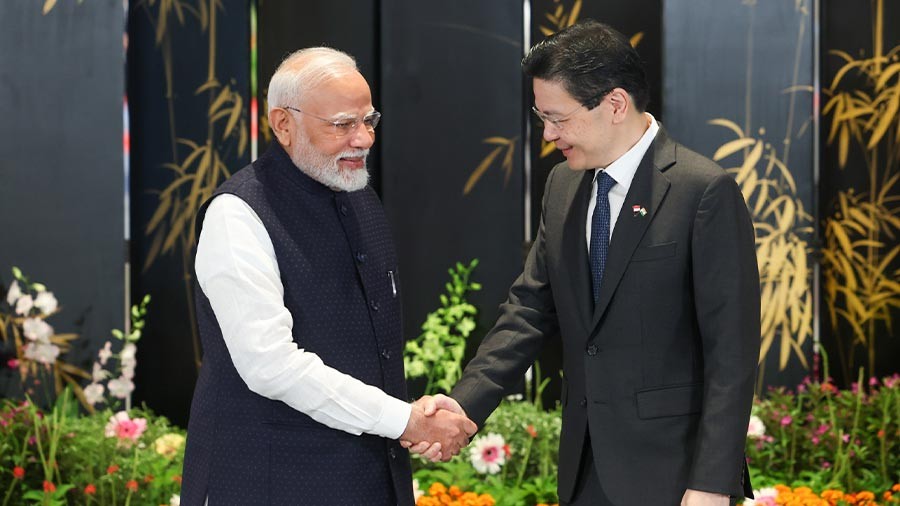
UPSC CURRENT AFFAIRS – 26th March 2025 Home / India–Singapore Sign MoUs in Digital Tech, Semiconductors, Health & Skill Development Why in News? India and Singapore have further deepened their Strategic Partnership by signing multiple MoUs in key sectors. This cooperation comes amid growing technological nationalism, shifting global value chains, and an increasing need for trusted bilateral partnerships in the Indo-Pacific. Key Highlights of the MoUs: Digital Technologies: The collaboration focuses on Digital Public Infrastructure (DPI) such as UPI, DigiLocker, and CoWIN, which India is globally promoting. Singapore sees value in India’s scalable and inclusive DPI models, aligning with its Smart Nation strategy. This MoU paves the way for cross-border fintech interoperability, data governance, cybersecurity, and digital identity systems. Semiconductor Cooperation: India seeks to emerge as a reliable semiconductor manufacturing destination, aiming to reduce global dependence on East Asian hubs like Taiwan and China. Singapore, a critical node in the global electronics supply chain, is keen to partner in India’s chip fabrication, packaging, and design ecosystem. The collaboration supports India’s Semicon India Programme, which offers incentives to attract chipmakers. Health Cooperation: Building on the trust developed during COVID-19 (e.g., India’s vaccine diplomacy), both countries aim to enhance cooperation in pharmaceuticals, telemedicine, and med-tech innovation. Singapore recognizes India’s robust pharma manufacturing capacity and seeks joint R&D, regulatory harmonization, and digital health solutions. Skill Development: The MoU focuses on future-ready vocational training, aligned with global demands in AI, robotics, logistics, and healthcare. It addresses India’s demographic advantage by equipping youth with internationally benchmarked skills, enhancing their mobility and employability in ASEAN and beyond. Singapore’s Strategic Interests Positioning as ASEAN’s Digital & Semiconductor Hub: Singapore wants to be the gateway for digital and chip supply chains in Southeast Asia. Access to India’s Market & Talent: With over a billion consumers and a digitally savvy population, India offers both scale and skills. Diversification from China: The MoUs reflect Singapore’s intent to reduce strategic overdependence on China in technology and trade. Geopolitical Implications Impact of U.S. Isolationism: Post-Trump, the U.S. retreat from global trade deals like TPP left a void in regional economic leadership. Countries like Singapore are reorienting towards India, viewing it as a stable, democratic, and non-coercive partner. China’s Technological Assertiveness: China’s dominance in rare earths, semiconductors, and 5G has raised concerns over strategic autonomy. Singapore, along with ASEAN partners, is hedging risks by cultivating tech partnerships with India, Japan, and the EU. ASEAN’s Strategic Balancing: ASEAN supports digital neutrality, multilateralism, and open innovation ecosystems. India’s Act East Policy and infrastructure investments in the region align with ASEAN’s long-term goals. Singapore acts as a facilitator for India’s Indo-Pacific vision, enhancing regional connectivity and maritime security. Conclusion These MoUs symbolize a convergence of economic, technological, and strategic interests. As global dynamics shift towards trusted, resilient, and inclusive partnerships, India–Singapore cooperation stands as a model for digital diplomacy, strategic autonomy, and people-centric development in the Indo-Pacific.
SEBI to constitute committee to decide on conflict of interest of board members
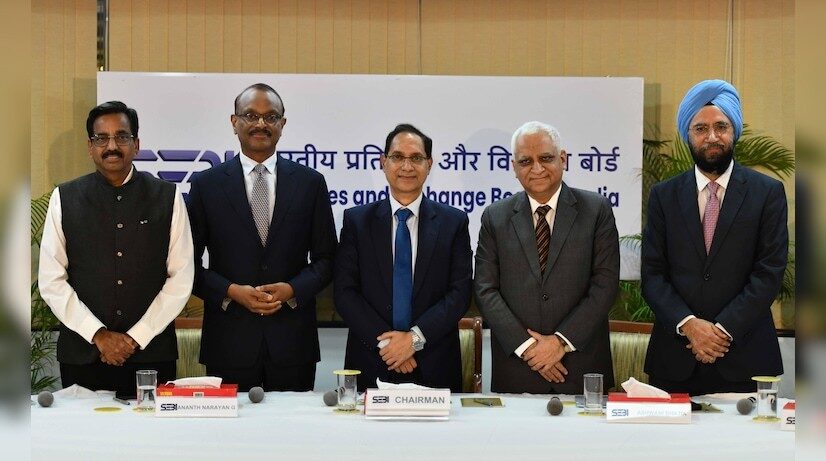
UPSC CURRENT AFFAIRS – 25th March 2025 Home / SEBI to constitute committee to decide on conflict of interest of board members Why in News? In response to conflict-of-interest allegations, the Securities and Exchange Board of India (SEBI), in its March 24, 2025 meeting, decided to constitute a High-Level Committee (HLC). The committee will undertake a comprehensive review of conflict-of-interest provisions, disclosure norms, and governance mechanisms for SEBI members and officials. Securities and Exchange Board of India (SEBI) The Securities and Exchange Board of India (SEBI) is the regulatory authority for the securities market in India, responsible for ensuring investor protection, market transparency, and the orderly functioning of stock exchanges. Establishment and Legal Framework Established: April 12, 1988, as a non-statutory body. Given statutory status: SEBI Act, 1992, granting it autonomy and regulatory powers. Headquarters: Mumbai, Maharashtra. Objectives of SEBI Protecting investors’ interests from fraud and malpractices. Regulating the securities market to ensure transparency and efficiency. Developing the securities market by introducing modern technology and reforms. Preventing insider trading and unfair trade practices. Functions of SEBI SEBI performs three main functions: Regulatory Functions Regulates stock exchanges, brokers, and intermediaries. Monitors Foreign Portfolio Investors (FPIs) and Mutual Funds. Imposes disclosure requirements for companies raising capital. Developmental Functions Promotes investor awareness through education and grievance redressal. Encourages the adoption of electronic trading and digital payment systems. Protective Functions Prohibits insider trading and fraudulent activities. Introduces strict norms for corporate governance. Implements measures to curb price manipulation in the stock market. Structure of SEBI Chairman – Appointed by the Government of India. Board Members – Includes representatives from the Finance Ministry, RBI, and corporate sector. Major SEBI Reforms SEBI (Prohibition of Insider Trading) Regulations, 2015 – Stricter insider trading rules. SEBI (Listing Obligations and Disclosure Requirements) Regulations, 2015 – Enhanced corporate transparency. SEBI’s role in IPO regulations – Ensures fair pricing and investor protection in Initial Public Offerings (IPOs). Key Decisions of SEBI Board Formation of a High-Level Committee (HLC) The HLC will consist of eminent experts from constitutional, statutory, and regulatory bodies, as well as professionals from government, public sector, private sector, and academia. The committee’s recommendations will be submitted within three months and placed before the SEBI board for consideration. Objective: Enhance transparency, accountability, and ethical standards among SEBI officials. SEBI Chairman Tuhin Kanta Pandey emphasized the need for a structured framework to ensure disclosures and prevent ethical violations. Revision in Foreign Portfolio Investor (FPI) Threshold SEBI has raised the disclosure threshold for FPIs from ₹25,000 crore to ₹50,000 crore in equity Assets Under Management (AUM). FPIs exceeding ₹50,000 crore in AUM must provide additional disclosures, per SEBI’s August 24, 2023 circular. Rationale: The cash equity market trading volume has more than doubled, from ₹58,000 crore in FY23 to ₹1,18,000 crore in FY25. No changes were made to the existing rule that FPIs holding over 50% of their AUM in a single corporate group must disclose under the additional disclosure framework. Strengthening Governance of Market Infrastructure Institutions (MIIs) SEBI approved changes in governance norms for MIIs, particularly: Appointment of Public Interest Directors (PIDs) – who act as SEBI’s representatives in MIIs. Cooling-off period for Key Management Personnel (KMPs) and Directors to prevent conflicts of interest. SEBI’s Stance on Market Volatility SEBI denied increased market volatility, stating that fluctuations were higher last year. The regulator continues to monitor operators involved in market manipulation, including pump-and-dump schemes. Conclusion SEBI’s latest reforms reflect a proactive approach to governance, transparency, and market stability. The formation of HLC, revision of FPI norms, and strengthening of MII governance aim to bolster investor confidence and reinforce SEBI’s credibility as India’s capital market regulator.