Why is the euro rising against the US dollar?
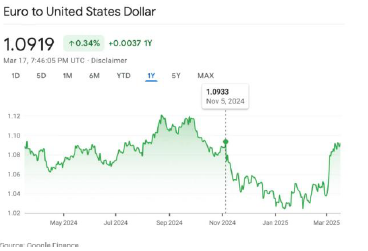
UPSC CURRENT AFFAIRS – 19 March 2025 Home / Why is the euro rising against the US dollar? Why in News: The euro-dollar exchange rate fluctuations after Donald Trump’s election in 2024 highlight the impact of economic policies, investor sentiment, and global financial trends on currency valuation. Introduction Recently, the day of the U.S. Presidential election, the euro-dollar exchange rate stood at 1.0933. Following Donald Trump’s victory, the euro weakened, and by January 20, 2025 (his inauguration day), the exchange rate had fallen to 1.0277. However, by March 17, 2025, the euro had rebounded to 1.0919, nearly its pre-election level. This currency fluctuation highlights the impact of economic policies, investor sentiment, and global financial trends on exchange rates. Understanding Currency Exchange Rates Exchange rates reflect the relative demand for two currencies. Demand arises from: Investments in stocks or bonds. Tourism and spending in foreign economies. Trade in goods and services. If demand for euros exceeds demand for dollars, the euro appreciates (gains value), making it stronger against the dollar. Conversely, if the demand for dollars rises, the euro depreciates (loses value). Why Did the Euro Depreciate After Trump’s Election? Following Trump’s victory, markets anticipated that his policies would boost U.S. economic growth, making the U.S. dollar more attractive to investors. Key expectations included: Tax Cuts & Deregulation – Increased corporate profits and economic productivity. Business-Friendly Policies – Strengthened investor confidence in the U.S. economy. Weak EU Economic Outlook – The Eurozone struggled with slow growth, political instability, and uncertain fiscal policies in key economies like Germany and France. As a result, investors moved capital into the U.S., increasing demand for dollars, leading to the euro’s depreciation against the dollar. What Led to the Euro’s Recovery? By March 2025, two major factors contributed to the euro regaining strength: Worsening U.S. Economic Outlook Instead of pro-growth policies, Trump focused on tariffs and federal budget cuts, which negatively impacted the economy. Trade tensions created uncertainty, discouraging investment. The OECD projected U.S. GDP growth to slow from 2.8% in 2024 to 2.2% in 2025 and 1.6% in 2026. Weaker economic prospects led investors to withdraw funds from the U.S., reducing dollar demand. Improving Eurozone Growth Prospects European governments, led by Germany and France, shifted away from fiscal austerity to stimulus-driven policies. The OECD projected EU GDP growth to rise from 0.7% in 2024 to 1.2% by 2026. Investor confidence in Europe’s recovery led to increased capital inflows, strengthening the euro. Future Outlook and Uncertainties Despite the euro’s rebound, its future trajectory remains uncertain: Will Europe sustain its economic momentum? Will Trump’s trade policies stabilize or further weaken the U.S. economy? Upcoming policy decisions, including: March 19: U.S. Federal Reserve’s monetary policy announcement. April 2: Trump’s expected announcement on reciprocal tariffs. Impact on India The euro-dollar fluctuations also influence the Indian rupee (INR): Rupee vs. Dollar: As the dollar weakened, the rupee appreciated from ₹87.5/USD on February 6 to ₹86.5/USD on March 18. A stronger rupee lowers import costs, especially for crude oil, helping reduce inflation. Rupee vs. Euro: As the euro strengthened, the rupee depreciated from ₹87.4/EUR on January 5 to ₹94.5/EUR on March 18. A weaker rupee benefits Indian exports to Europe, making them more competitive. Conclusion The euro’s recent fluctuations highlight the interplay of economic policies, investor sentiment, and global market trends in determining exchange rates. While a stronger dollar initially weakened the euro, the reversal in economic outlooks shifted investor preferences, leading to a euro recovery. The U.S. Federal Reserve’s monetary policy and Trump’s trade strategies will be crucial in shaping future trends, with global implications, including for India’s exchange rates, inflation, and trade balance.
Necessity of electoral reforms
UPSC CURRENT AFFAIRS – 19 March 2025 Home / Necessity of electoral reforms Why in News: The Election Commission of India’s (ECI) recent invitation to political parties for discussions on strengthening the electoral process underscores the critical need for continuous refinement of India’s democracy. Introduction The Election Commission of India (ECI) is actively engaged in discussions regarding reforms to enhance the integrity and transparency of the electoral process. This initiative comes amidst rising concerns regarding electoral roll manipulation, duplicate Electoral Photo Identity Card (EPIC) numbers, and broader issues affecting the integrity of elections. The imperative to address these challenges stems from the fundamental principle that free and fair elections are the bedrock of a robust democracy, a principle enshrined in the basic structure of the Indian Constitution. Legal Framework and Evolution of the Electoral Process Article 324 of the Constitution vests the ECI with the superintendence, direction, and control of elections to Parliament and State legislatures, including the preparation of electoral rolls. The Representation of the People Act, 1950, and the Registration of Electors Rules, 1960, provide the legal framework for electoral roll management. Since the first general election in 1952, India’s electoral process has undergone significant transformations, moving from ballot boxes to ballot papers, and ultimately to Electronic Voting Machines (EVMs) with 100% Voter Verifiable Paper Audit Trail (VVPAT) verification since 2019. This evolution reflects the nation’s commitment to modernizing and enhancing the efficiency and transparency of its electoral system. Contemporary Challenges to Electoral Integrity Despite these advancements, several issues persist, threatening the integrity of the electoral process. These include: EVM and VVPAT Concerns: Demands for a return to paper ballots and 100% VVPAT matching have been raised, though dismissed by the Supreme Court. The current system of verifying five VVPATs per assembly segment has been questioned for its statistical significance. The current system of 5% EVM micro controller verification is only accessible by the second or third place candidate, and after a written request. Electoral Roll Manipulation: Allegations of bogus voter inclusion and duplicate EPIC numbers across states, raising concerns about electoral roll integrity. The ECI’s explanation regarding the transition to a centralized database on ERONET, while valid, highlights the need for robust mechanisms to prevent such discrepancies. Campaign Process Deficiencies: Instances of “Star Campaigners” using abusive language and engaging in divisive rhetoric. Breaches of election expenditure limits by candidates and unregulated spending by political parties. The increasing criminalization of politics, with a significant proportion of elected representatives facing criminal charges. Necessary Reforms for a More Robust Electoral System To address these challenges and strengthen the electoral process, the following reforms are crucial: Enhancing EVM and VVPAT Verification: Implement a scientifically determined sample size for VVPAT matching, considering regional variations. Introduce “totaliser” machines to aggregate votes, enhancing voter anonymity at the booth level. Ensure that the 5% EVM verification process is more accessible, and that clear procedures are in place to address any discovered issues. Strengthening Electoral Roll Integrity: Consider linking Aadhaar numbers with EPIC cards after addressing privacy concerns and engaging in thorough stakeholder consultations. Implement robust mechanisms to eliminate duplicate voter IDs and ensure unique EPIC numbers across states. Reforming the Campaign Process: Empower the ECI to revoke “Star Campaigner” status for serious violations of the Model Code of Conduct (MCC). Amend election expenditure laws to include financial assistance provided by political parties to candidates. Establish a ceiling on political party spending during elections. Strictly enforce the Supreme Court’s directives regarding the disclosure of criminal antecedents by candidates and political parties. Increased Transparency and Accountability: Increase the public access to electoral role data, while protecting privacy. Increase the speed and transparency of the handling of electoral complaints. The Way Forward The ECI’s initiative to engage political parties in discussions on electoral reforms is a welcome step. A collaborative approach, involving all stakeholders, is essential to address the challenges facing India’s electoral system. By implementing the necessary reforms, India can further strengthen its democratic foundations and ensure that elections remain free, fair, and credible, reflecting the true will of the people.
Concept of audible enclaves in news

UPSC CURRENT AFFAIRS – 19 March 2025 Home / Concept of audible enclaves in news Why in News: Researchers at Pennsylvania State University have developed a method using ultrasonic transducers and acoustic metasurfaces to create localized sound zones, or “audible enclaves,” where only the intended listener can hear the audio, while it remains inaudible to others nearby. Introduction Audible enclaves are localized pockets of sound that remain unaffected by external noise. These technological innovations enable sound delivery to a specific individual even in a crowded environment. Researchers have developed these enclaves using parametric array loudspeakers and high-frequency sound waves, creating a new frontier in personalized auditory experiences. Understanding Sound Propagation Sound travels in waves through a medium, causing particles to vibrate back and forth. The frequency of these waves—how fast particles move—determines the pitch of the sound. Lower frequencies travel farther and are less directional. Higher frequencies spread out more due to diffraction but can be manipulated to form focused sound beams. How Audible Enclaves Work Traditional parametric array loudspeakers focus sound by emitting high-frequency waves modulated with an audio signal. As they travel, they self-demodulate, producing a narrow, directional sound beam that only people in its path can hear. A recent study, published on March 17 in the Proceedings of the National Academy of Sciences, introduces an advanced approach to creating audible enclaves. This method uses two high-frequency waves of different frequencies. These waves are inaudible individually, but where they intersect, non-linear interactions generate a sound wave, making it audible only at that specific point. This enables sound to be localized to a precise location without disturbing the surrounding area. Potential Applications The ability to target sound precisely has various applications: Personalized communication in crowded spaces like airports or train stations. Augmented reality (AR) and virtual reality (VR) experiences with immersive audio. Medical applications, such as assisting the hearing-impaired with directional sound cues. Advertising and entertainment, where specific individuals can receive customized audio messages. Conclusion Audible enclaves represent a significant advancement in sound technology, allowing for personalized, non-intrusive audio experiences. As research progresses, this innovation has the potential to revolutionize communication, entertainment, and assistive technologies, offering greater control over sound environments in various domains.
First Sighting of Endangered Caracal in Mukundra Hills Tiger Reserve

UPSC CURRENT AFFAIRS – 18 March 2025 Home / First Sighting of Endangered Caracal in Mukundra Hills Tiger Reserve Why in News: Recent sighting of a caracal in Mukundra Hills Tiger Reserve underscores the importance of strong conservation measures About Caracal The caracal (Caracal caracal) is a medium-sized, primarily nocturnal wild cat known for its distinctive black-tipped, pointy ears. The name ‘caracal’ originates from the Turkish word karakulak, meaning ‘black ears’. Caracals are small wild cats characterized by their long, tufted ears and reddish-tan or sandy-brown fur. Known as Siya Gosh in India, these nocturnal predators primarily hunt small mammals, birds, and rodents. They are naturally found in northwestern India, as well as in regions across Africa, the Middle East, and Central Asia. Their preferred habitats include the Aravalli hill range, semi-deserts, savannahs, scrublands, and dry forests. Although caracals once thrived across Central India and the Indo-Gangetic plains, they have not been sighted in these regions for the past four decades. Distribution and Population Decline in India Historically, caracals inhabited 13 Indian states across nine of the 26 biotic provinces. However, their population has suffered a sharp decline, with the current estimate being fewer than 50 individuals. Native to Africa, the Middle East, Central Asia, and South Asia, these agile hunters were historically valued in medieval India for their ability to catch birds mid-flight. Descriptions of caracals appear in historical texts such as Khamsa-e-Nizami, Shahnameh, and Tutinama. Their presence is now restricted mainly to Rajasthan and Gujarat, with their known habitat covering only 16,709 sq km—less than 5% of the area they occupied between 1948 and 2000. Pre-1947 to 2000: Population declined by 50%. 2001 to 2020: Over 95% decline observed. 2021: Declared ‘Critically Endangered’ by the National Board for Wildlife and the Union Ministry of Environment, Forest and Climate Change. Conservation Status Globally, caracals are classified as ‘Least Concern’ on the IUCN Red List due to their widespread presence in Africa and parts of Asia. In India, they are categorized as ‘Near Threatened’, reflecting their declining population and restricted habitat. Under Indian law, caracals are protected under Schedule-I of the Wildlife (Protection) Act, 1972, granting them the highest level of legal protection. Protection Efforts In 2021, the National Board for Wildlife (NBWL) and the Ministry of Environment, Forest and Climate Change (MoEFCC) initiated a species recovery program targeting 22 endangered species, including the caracal. Potential habitats for conservation have been identified in Kutch, the Aravalli mountain range, the Malwa plateau, and the Bundelkhand region. The Ranthambore-Kuno Landscape has been recognized as a critical conservation site to support caracal population recovery. Threats to Caracal Population Several factors have contributed to the dramatic decline of caracals in India: Habitat Loss: Rapid urbanization and land-use changes have severely impacted the caracal’s ability to find prey, such as small ungulates and rodents. Wasteland Classification: The Chambal ravines, a key natural habitat, have been designated as wastelands, leading to ecological neglect and degradation. Illegal Trade: Increasing cases of caracals being captured for sale as exotic pets further threaten their survival. Conservation Efforts and the Role of Mukundra Hills Tiger Reserve The recent sighting of a caracal in Mukundra Hills Tiger Reserve underscores the importance of strong conservation measures. The reserve’s protection regime serves as an umbrella to safeguard not only tigers but also lesser-known species like the caracal. Continued monitoring, habitat restoration, and anti-poaching efforts are critical to preventing further decline.
Study of CAR T-Cell therapy trial in India, in Leukaemia Patients

UPSC CURRENT AFFAIRS – 18 March 2025 Home / Study of CAR T-Cell therapy trial in India, in Leukaemia Patients Why in News: A recent study on India’s CAR T-cell therapy, developed by IIT Bombay and Tata Memorial Hospital, reported a 73% response rate for B-cell blood cancers, offering a cost-effective alternative to global treatments. Introduction Chimeric Antigen Receptor (CAR) T-cell therapy has emerged as a transformative approach in cancer treatment, particularly for blood cancers such as B-cell leukaemia and lymphoma. A recent study published in The Lancet Haematology has reported a remarkable 73% response rate among patients undergoing this therapy. The clinical trials, conducted by researchers from the Indian Institute of Technology (IIT) Bombay and Tata Memorial Hospital, Mumbai, mark a significant milestone in India’s cancer treatment landscape. CAR-T Cell Therapy CAR-T cell therapy (Chimeric Antigen Receptor T-cell therapy) is an advanced immunotherapy that harnesses a patient’s own immune cells to fight cancer. CAR T-cell therapy involves genetically modifying a patient’s T-cells, a type of immune cell, to target and destroy cancer cells. CAR T-cell therapy offers a targeted approach, minimizing damage to healthy cells while enhancing the immune system’s response against malignancies. It is approved for treating leukemias and lymphomas and is often called a “living drug.” Procedure: T-Cell Collection – T cells (a type of white blood cell) are extracted from the patient’s blood via apheresis. Genetic Modification – These cells are engineered in a lab to express CAR proteins, enabling them to recognize and bind to cancer-specific antigens. Expansion & Infusion – The modified T cells are multiplied and infused back into the patient, where they target and destroy cancer cells. Addressing Treatment Gaps For patients with relapsed or refractory B-cell malignancies—where standard treatments fail—options have been limited. B-cells play a crucial role in the immune system, and their uncontrolled proliferation can lead to severe complications. The clinical trials of CAR T-cell therapy in India provide an additional treatment avenue, offering hope to patients who previously had limited alternatives. Clinical Trials and Observations The study involved two phases: Phase-1: Included 14 patients with relapsed or refractory B-cell lymphoma. Phase-2: Expanded to 50 patients aged 15 and above, diagnosed with B-cell leukaemia or lymphoma. Among the 51 patients analyzed, 73% responded positively to the therapy. However, some side effects were noted, including neutropenia (low neutrophil count) in 55 out of 57 patients, thrombocytopenia (low platelet count) in 37 patients, and anaemia in 35 patients. Despite two treatment-related fatalities, the overall safety profile was deemed manageable. About T Cells T cells, or T lymphocytes, are a type of white blood cell essential for the immune system. They are responsible for cell-mediated immunity, enabling the body to detect and combat pathogens like viruses, bacteria, and cancer cells. There are two main types: Helper T cells – Support and activate other immune cells. Cytotoxic T cells – Directly destroy infected or cancerous cells. Benefits of CAR-T Cell Therapy High Effectiveness – CAR-T therapy has shown remarkable success in treating blood cancers like leukemias and lymphomas, leading to long-term remission in some patients. Personalized Treatment – Since CAR-T cells are derived from the patient’s own immune system, there is a lower risk of rejection compared to traditional therapies. Long-Lasting Immunity – The modified T cells can persist in the body, offering continued surveillance against cancer recurrence. Reduced Need for Chemotherapy – CAR-T therapy directly targets cancer cells, potentially eliminating the need for extensive chemotherapy and radiation. Challenges of CAR-T Cell Therapy Limited Success in Solid Tumors – Unlike blood cancers, CAR-T therapy faces challenges in treating solid tumors due to the tumor’s protective environment. Severe Side Effects – Patients may develop Cytokine Release Syndrome (CRS) and Neurotoxicity, which can cause life-threatening immune reactions. High Cost & Limited Accessibility – The therapy is extremely expensive, costing hundreds of thousands of dollars, making it inaccessible to many patients. Time-Consuming Process – The treatment involves extracting, modifying, and multiplying T cells, which can take several weeks, delaying treatment for critically ill patients. Potential for Relapse – If cancer cells mutate or stop expressing the targeted antigen, CAR-T cells may become ineffective. Future Prospects and Research The researchers at Tata Memorial Centre and IIT Bombay are now exploring the possibility of testing CAR T-cell therapy in earlier stages of treatment and in combination with other immunotherapies. Ongoing trials aim to refine the therapy and expand its applicability to a broader patient population. Indian Government’s Initiatives for Cancer Control Initiative Key Features Objective National Programme for Prevention and Control of Cancer, Diabetes, Cardiovascular Diseases, and Stroke (NPCDCS) Focuses on cancer prevention, screening, early detection, and treatment; strengthens healthcare infrastructure Reduce cancer burden through early diagnosis and improved healthcare access National Cancer Grid (NCG) A network of 270+ cancer centers ensuring standardized and affordable treatment; promotes research and training Improve quality and uniformity in cancer care across India Cervical Cancer Vaccination Initiative (Interim Budget 2024-25) Encourages vaccination for girls (9–14 years) to prevent HPV-related cervical cancer Reduce cervical cancer incidence through early immunization Conclusion The development of CAR T-cell therapy in India is a groundbreaking achievement in the field of oncology. With its high efficacy, manageable safety profile, and significantly reduced cost compared to global counterparts, this innovation addresses a crucial unmet need for cancer patients in India. Continued research and trials will further determine its long-term impact, paving the way for more accessible and effective cancer treatments in the country.
Kra Canal: The Impossible Dream of Southeast Asia Shipping
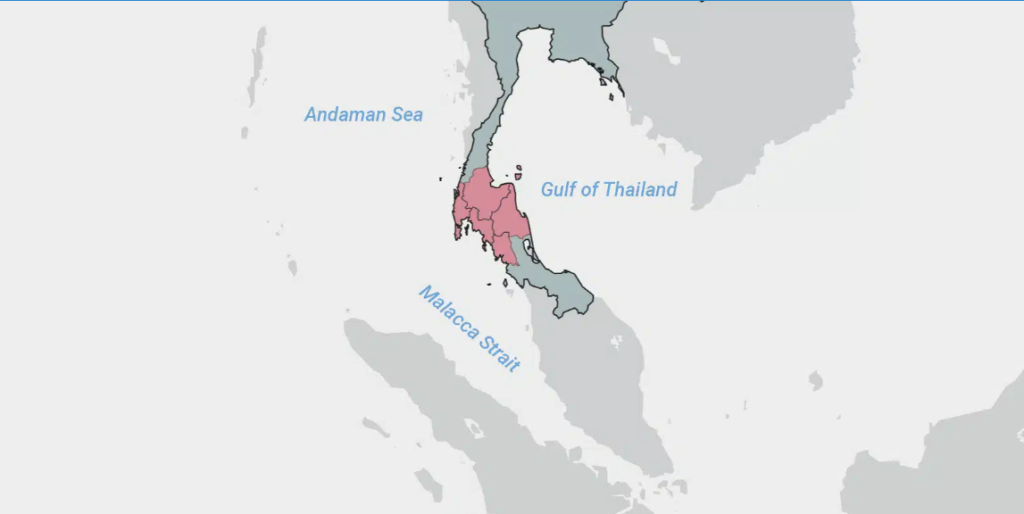
UPSC CURRENT AFFAIRS – 18 March 2025 Home / Kra Canal: The Impossible Dream of Southeast Asia Shipping Introduction The Kra Canal, a proposed waterway through Thailand’s Kra Isthmus, has long been debated for its potential to revolutionize global shipping by providing an alternative route to the Strait of Malacca. While the project has never materialized, its strategic significance remains a subject of international discourse, particularly in the context of China’s Belt and Road Initiative (BRI) and growing U.S.-China competition. Despite renewed interest, Thailand has opted for a land bridge project instead, highlighting concerns over financial feasibility, environmental impact, and geopolitical ramifications. Historical Background The idea dates back to 1677, when King Narai of Siam commissioned a survey of the Kra Isthmus. In the 19th century, British and French colonial interests shaped discussions around the canal, with Britain opposing it to maintain Singapore’s dominance in trade. The modern proposal resurfaced in 1972, when an American firm suggested a 102-km-long canal to ease congestion in the Malacca Strait. However, concerns over cost and regional security led to its rejection. China’s interest grew in 2015 as part of its Maritime Silk Road initiative, but opposition from regional players and political sensitivities stalled progress. Geopolitical Significance Strategic Importance The canal would reduce shipping distances by 1,200 nautical miles, cutting fuel costs and transit times. With nearly 80% of China’s oil imports passing through the Malacca Strait, an alternative route would reduce its dependence on a chokepoint vulnerable to naval blockades. The canal could transform Thailand into a major logistics hub, generating transit revenue and enhancing regional trade. China-U.S. Competition The Kra Canal aligns with China’s strategy to secure trade routes and expand its influence in the Indian Ocean. The U.S. and allies, including India and Singapore, oppose the project, fearing increased Chinese naval presence in the region. As a countermeasure, the U.S. supports Thailand’s land bridge project, which offers trade benefits without altering the regional power balance. Impact on ASEAN and Regional Powers Singapore opposes the canal, as it could divert shipping traffic and reduce its economic significance as a transshipment hub. India views the project as a threat to maritime security and has strengthened naval cooperation with ASEAN nations. Thailand faces internal challenges, as the canal could fuel separatist movements in its southern provinces. Economic and Environmental Challenges Financial and Logistical Barriers The estimated cost has risen to $30 billion, making large-scale financing a challenge. Maintenance costs, including dredging and security, add to the long-term financial burden. Environmental Concerns Large-scale excavation could lead to habitat destruction, marine ecosystem disruption, and increased risk of oil spills. Altering water flow between the Andaman Sea and Gulf of Thailand may impact regional weather patterns and coastal economies. Thailand’s Alternative Approach Recognizing the geopolitical and environmental risks, Thailand has prioritized a $28 billion land bridge project, which: Connects the Gulf of Thailand and Andaman Sea via rail and road networks. Avoids political opposition from Singapore, India, and the U.S.. Provides similar economic benefits while maintaining national unity. Conclusion The Kra Canal remains a high-stakes geopolitical issue, with China advocating for its construction and regional powers opposing it. Thailand’s decision to pursue a land bridge project reflects a strategic compromise, balancing economic interests with geopolitical stability. Given the economic, environmental, and security concerns, the canal’s feasibility remains uncertain, reinforcing the importance of alternative trade routes in the evolving Indo-Pacific landscape.
South vs North: The battle over redrawing India’s electoral map
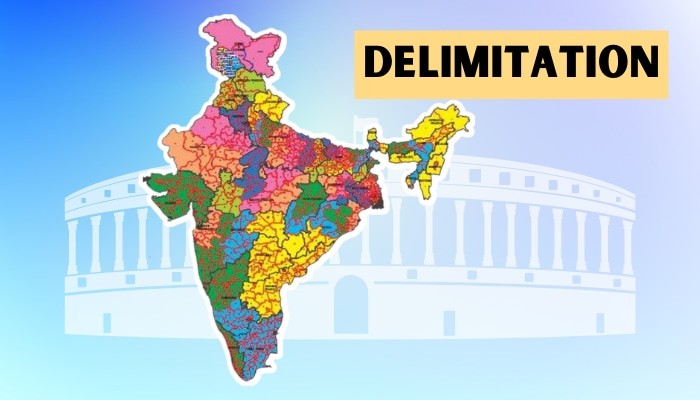
UPSC CURRENT AFFAIRS – 18 March 2025 Home / South vs North: The battle over redrawing India’s electoral map Why in News: The 2026 delimitation debate in India raises concerns over political representation, regional disparities, and federal balance, with southern states fearing seat loss due to lower population growth while northern states push for proportional reallocation. Introduction The upcoming delimitation exercise in 2026 has sparked a political debate in India, particularly in southern states, over concerns about a shift in political representation. Leaders in Tamil Nadu and other states argue that redrawing parliamentary seats based on updated population data may reduce their influence despite their contributions to national development. This issue underscores broader challenges in India’s federal structure, representation principles, and fiscal distribution. Understanding Delimitation in India Delimitation is the process of redrawing parliamentary and assembly constituencies to reflect demographic changes. The Indian Constitution mandates seat allocation based on population to ensure equitable representation. Delimitation occurred in 1951, 1961, and 1971, but was frozen thereafter due to disparities in fertility rates across states. The next delimitation is scheduled for 2026, but the absence of a recent census (last conducted in 2011) adds uncertainty. Concerns of Southern States Potential Loss of Parliamentary Seats: Southern states (Tamil Nadu, Kerala, Karnataka, Andhra Pradesh, and Telangana) have lower fertility rates and population growth than northern states like Uttar Pradesh and Bihar. If seats are redistributed, southern states could lose representation despite economic contributions. Fiscal Imbalance & Equity Concerns: Southern states generate higher tax revenue but receive less federal allocation compared to populous northern states. Redistribution based on population may further reduce their influence over financial decisions. Representation Disparity: An MP from Uttar Pradesh represents ~3 million people, while an MP from Kerala represents ~1.75 million. This creates unequal political influence, violating the principle of “one person, one vote.” Challenges with Delimitation Severe Malapportionment: Tamil Nadu and Kerala currently have more seats than their population proportion, while UP and Bihar have fewer seats than their share. By 2031, the imbalance could worsen, intensifying the north-south political divide. Constitutional & Political Deadlock: Any change in seat allocation would require a constitutional amendment and broad political consensus. Southern leaders seek to freeze electoral boundaries for another 30 years, while northern states push for a reallocation based on population growth. Federal Tensions & Regionalism: The debate has triggered north vs. south polarization, threatening India’s federal unity. Tamil Nadu’s leadership has framed delimitation as a punishment for economic success and population control. Possible Solutions Increasing Lok Sabha Seats: Expanding the number of MPs to 1,872 (from 543) would maintain proportionality without reducing any state’s representation. A more feasible increase to 848 seats could prevent loss of existing seats while balancing population representation. Reforming the Rajya Sabha: Fixing equal representation for states in the upper house (similar to the US Senate) could counterbalance population-based reallocation in the Lok Sabha. Decentralized Fiscal Model: Empowering states to retain a larger share of their revenue would reduce dependence on central allocations. Splitting Large States: Dividing states like Uttar Pradesh into smaller units may help balance representation and governance efficiency. Conclusion The 2026 delimitation debate highlights the complexities of balancing democratic representation, economic contributions, and federal unity. While increasing the number of Lok Sabha seats appears to be the most politically viable option, deeper fiscal and governance reforms are needed to address regional disparities. Any resolution will require strong bipartisan consensus to preserve India’s democratic and federal structure.
India and New Zealand sign defence cooperation pact, to up maritime safety

UPSC CURRENT AFFAIRS – 18 March 2025 Home / India and New Zealand sign defence cooperation pact, to up maritime safety Why in News: India and New Zealand signed a Defence Cooperation Pact, initiated FTA negotiations, and strengthened counterterrorism and maritime security cooperation, reinforcing their strategic ties in the Indo-Pacific region. Introduction India and New Zealand have taken significant steps to enhance their bilateral cooperation in defence, trade, and security. During the visit of New Zealand Prime Minister Christopher Luxon to India, both nations signed a Defence Cooperation Pact, initiated discussions on a Free Trade Agreement (FTA), and reaffirmed their commitment to combating terrorism and ensuring regional stability. The visit underscores India’s growing strategic engagement in the Indo-Pacific and the expanding role of economic partnerships in shaping bilateral ties. Defence and Maritime Security Cooperation India and New Zealand signed a Memorandum of Understanding (MoU) on Defence Cooperation, aimed at institutionalizing regular defence engagements. Both nations agreed on the importance of a free, open, and secure Indo-Pacific, reinforcing maritime security and the safety of sea lanes. New Zealand welcomed India’s participation in the Combined Maritime Forces (CMF) and its engagement in Command Task Force 150, which works on maritime security. Military cooperation includes: Participation in military exercises Exchange programs for defence staff colleges Regular port visits by naval ships The Indian naval vessel Tarini visited Lyttelton, Christchurch (New Zealand) in December 2024, and the Royal New Zealand Navy’s HMNZS Te Kaha is set to make a port call in Mumbai. Strategic Significance: New Zealand is part of the Five Eyes intelligence alliance, a key player in global security networks. The agreement strengthens India’s security engagement in the Indo-Pacific, countering expansionist policies in the region. Counterterrorism and Security Cooperation Both leaders reiterated their commitment to fighting terrorism, condemning the Christchurch attack (2019) and Mumbai attacks (2008). India and New Zealand agreed to: Disrupt terrorist financing networks. Dismantle terror infrastructure and online radicalization platforms. Bring perpetrators of terrorism to justice swiftly. Modi raised concerns about anti-India activities in New Zealand, urging stronger action against separatist and radical elements operating in the country. New Zealand assured continued cooperation in tackling security threats. Strategic Significance: Strengthening bilateral and multilateral cooperation in security enhances regional and global counterterrorism efforts. Helps address India’s concerns regarding terrorist financing and separatist movements abroad. Negotiations for a Free Trade Agreement (FTA) India and New Zealand agreed to launch FTA negotiations to enhance bilateral trade and investment. The trade agreement aims to: Expand mutual trade potential. Encourage investment in dairy, food processing, and pharmaceuticals. Facilitate greater market access for businesses in both countries. Bilateral Trade Snapshot (2023-24): Total trade: $1.75 billion New Zealand exports to India: $0.84 billion (wool, iron & steel, fruits, nuts, aluminium). India exports to New Zealand: $0.91 billion (pharmaceuticals, textiles, machinery, pearls, precious stones). Strategic Significance: Enhancing trade relations reduces reliance on other markets and strengthens economic ties in the Indo-Pacific region. Addresses concerns over India’s dairy sector, a key negotiation point in previous trade discussions. Migration and Skilled Workforce Mobility Agreement Recognizing the positive contributions of the Indian diaspora, both countries agreed to: Address illegal migration issues. Ease mobility for skilled Indian workers. Encourage Indian students and professionals in New Zealand. Indian Diaspora in New Zealand: Third-largest ethnic group in the country. Largest source of skilled migrants. Second-largest contributor to international student enrolments. Strategic Significance: Strengthening migration frameworks enhances people-to-people ties, boosting education and professional exchanges. Supports India’s workforce mobility and employment prospects abroad. Conclusion The visit of New Zealand Prime Minister Christopher Luxon marked a new phase in India-New Zealand relations, with agreements on defence cooperation, counterterrorism, free trade, and workforce mobility. Strengthening maritime security and economic partnerships aligns with India’s Indo-Pacific strategy, ensuring a rules-based international order. Going forward, deeper collaboration in trade, security, and migration frameworks will enhance bilateral ties, benefiting both nations.
Centre’s allocations for justice-related schemes fluctuate

UPSC CURRENT AFFAIRS – 18 March 2025 Home / Centre’s allocations for justice-related schemes fluctuate Why in News: The India Justice Report 2025-26 highlights declining budget allocations and underutilization of funds for police modernization, forensic capacities, and prison reforms, while judiciary-related schemes show optimal fund utilization. Introduction The recently released India Justice Report 2025-26 highlights a decline in budgetary allocations and underutilization of funds in various justice-related schemes. This trend has been particularly evident in the modernization of police forces, forensic capacities, and prison reforms. At the same time, judicial infrastructure and legal aid schemes have shown consistent fund utilization, reflecting a mixed approach toward justice sector funding. Modernisation Fund for State Police Forces The Modernisation Fund for State Police Forces was established to upgrade police infrastructure and enhance the Crime and Criminal Tracking Network and Systems (CCTNS). Key Budgetary Trends: Budget Estimates (BE) vs. Revised Estimates (RE) The BE for FY19 was ₹900 crore, which declined to ₹780 crore in FY21 and further to ₹587.97 crore in FY26. However, the actual spending has been significantly lower than the RE. In FY21, ₹780 crore was allocated but later revised to ₹106 crore. Similarly, in FY23, only ₹34.7 crore was spent despite an allocation of over ₹600 crore (only 6% utilization). Implications: Overestimation in Budget Estimates followed by drastic downward revisions in RE indicates poor financial planning. Low actual expenditure suggests administrative inefficiencies in fund disbursement and implementation. Modernisation of Forensic Capacities The Modernisation of Forensic Capacities Scheme aims to strengthen forensic infrastructure and address the shortage of forensic scientists. Key Budgetary Trends: The scheme witnessed an initial increase in allocations but later faced fluctuations in funding. No consistent pattern in allocations suggests a lack of long-term strategic planning in forensic modernization. Implications: The inconsistent funding may hinder the upgradation of forensic labs and investigative efficiency. A weak forensic system impacts crime investigations and judicial proceedings, leading to delays in justice delivery. Modernisation of Prisons Fund Established over two decades ago, the Modernisation of Prisons Fund focuses on renovating prisons, constructing new cells, and improving living conditions for prisoners. Key Budgetary Trends: Budget allocations peaked at ₹400 crore in FY23 but later declined to ₹300 crore in FY25 and FY26. Full utilization of funds was observed until FY23, but post-FY23, only 44% of allocated funds were utilized. Implications: A reduction in funds could stall prison reforms, affecting overcrowding, hygiene, and security measures in jails. Underutilization post-FY23 indicates administrative bottlenecks in fund disbursement. National Legal Services Authority (NALSA) The NALSA fund is allocated to enhance free legal aid services across India. Key Budgetary Trends: Allocations increased gradually since FY19, remaining in the range of ₹150-200 crore. FY24 (RE) saw a significant jump to ₹400 crore. 100% fund utilization reported consistently from FY19 to FY24. Implications: Efficient utilization of funds indicates the growing need and effectiveness of legal aid services. Increased allocations in FY24 suggest an expansion of legal aid initiatives. Development of Infrastructure Facilities for the Judiciary This centrally sponsored scheme assists State governments in strengthening judicial infrastructure. Key Budgetary Trends: Consistent utilization of funds over the past five years. Reduction in allocation from ₹1,123.40 crore (FY25) to ₹998 crore (FY26). Implications: Stable funding and full utilization indicate the importance of judiciary development in government priorities. Slight decline in FY26 allocation suggests budgetary constraints but not a lack of commitment to judicial infrastructure.
Will the new Income Tax bill reduce disputes and litigation?

UPSC CURRENT AFFAIRS – 18 March 2025 Home / Will the new Income Tax bill reduce disputes and litigation? Why in News: The Income Tax Bill, 2025 aims to simplify India’s tax law, enhance clarity, reduce litigation, and modernize tax administration. Introduction The Income Tax Bill, 2025, introduced by Finance Minister Nirmala Sitharaman in Lok Sabha on February 13, 2025, marks a significant effort to simplify and modernize India’s direct tax framework. The bill aims to replace the Income Tax Act of 1961, which has undergone numerous amendments over the decades, making its provisions complex and difficult to interpret. The bill has been referred to a 31-member Select Committee chaired by BJP MP Baijayant Panda, and its report is expected in the next Parliament session. Need for Overhauling the Income Tax Act The existing Income Tax Act of 1961 has been amended multiple times, leading to: Complex language and structure, making interpretation difficult. Increased compliance costs for taxpayers. Higher litigation rates due to ambiguity in provisions. The Income Tax Bill, 2025, therefore, seeks to: Simplify the language for easier comprehension. Consolidate redundant provisions and reorganize sections logically. Use tables and formulae to enhance clarity, particularly for TDS provisions. Notably, the bill does not introduce any policy changes in direct taxes. Key Features of the Income Tax Bill, 2025 Simplification of Provisions Consolidates 43 different sections on TDS into a single provision. Introduces clear tables categorizing residents, non-residents, and others for tax deduction. Removes repetitive and outdated clauses to make the law more concise. Introduction of the ‘Tax Year’ Concept Replaces “financial year” and “assessment year” with a uniform “tax year”. Aims to eliminate taxpayer confusion regarding the tax liability period. Aligns India’s system with global tax practices (e.g., UK, Australia). Enhanced Role of the CBDT The Central Board of Direct Taxes (CBDT) retains its authority under Sections 119 & 295 for issuing guidelines. Empowers CBDT to issue clarifications for tax regimes, addressing previous gaps in the law. Strengthening Digital and Virtual Taxation Expands the definition of “virtual digital space” to include: Cloud servers Social media accounts Online financial assets Search and seizure powers extended to digital assets. Increased Scrutiny on Cryptocurrency & Digital Assets Cryptocurrency is classified as a Virtual Digital Asset (VDA). Strengthens tax evasion checks by allowing authorities to block transactions suspected of avoiding taxation. Reinforces the government’s commitment to regulating digital assets. Expected Benefits of the Income Tax Bill, 2025 Improved Tax Compliance Easier interpretation reduces taxpayer errors and unintentional non-compliance. Streamlined provisions reduce administrative burden on tax authorities. Reduction in Litigation Clearer provisions minimize interpretation-based disputes. Faster resolution of cases leads to lower backlog in tax courts. Support for Non-Profit Organizations (NPOs) Consolidation of NPO tax exemption rules makes compliance easier. Smaller NPOs benefit from reduced dependency on tax advisors. Smoother Transition & Implementation Tax authorities to undergo training on new provisions. Government expected to introduce corresponding rules and IT system upgrades. A buffer period recommended for businesses and taxpayers to adapt. Challenges and Concerns Implementation Readiness Tax officers must be trained to ensure smooth enforcement. Upgradation of IT infrastructure is necessary to align with the new system. Concerns Over Digital Taxation and Privacy Expanded search and seizure powers raise privacy concerns. Mandatory compliance for taxpayers to provide access codes to digital assets may be seen as government overreach. Cryptocurrency Regulations and Investor Sentiment Increased scrutiny on crypto holdings may deter investors. The power to block transactions raises concerns over arbitrary actions by tax authorities. Previous Attempts to Revise the Income Tax Act 2009: Finance Minister Pranab Mukherjee proposed the Direct Tax Code (DTC) to modernize taxation but could not pass it before the 2014 elections. 2017: PM Narendra Modi called for redrafting the Income Tax Act, leading to a six-member task force that submitted a report in 2019. 2025 Bill represents the first major overhaul of the tax system since 1961. Conclusion The Income Tax Bill, 2025, is a crucial step toward simplifying India’s direct tax regime, improving clarity, and reducing disputes. While digital taxation and privacy concerns remain, the bill is expected to enhance compliance, reduce litigation, and improve tax administration. The success of this initiative will depend on efficient implementation, ensuring a smooth transition for taxpayers and authorities alike.