Thailand-Cambodia cross-border fighting
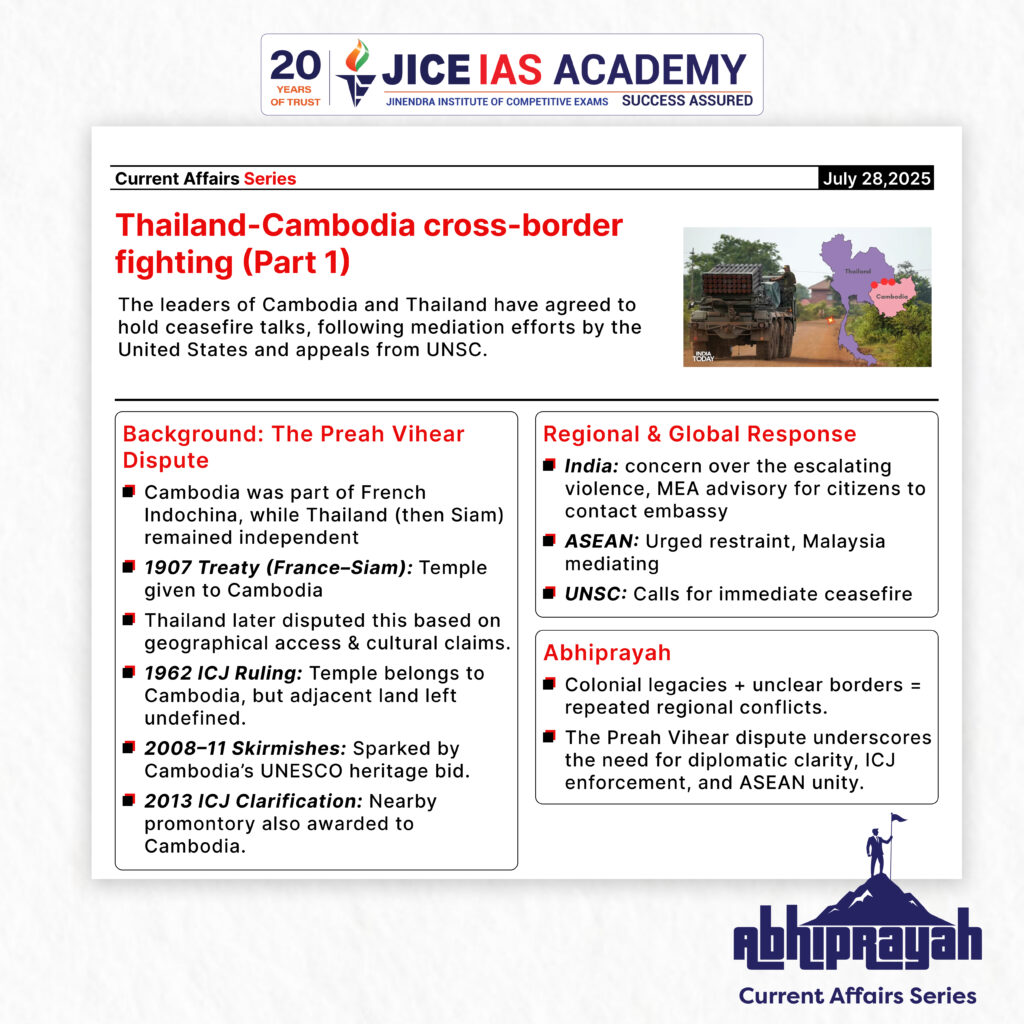
UPSC CURRENT AFFAIRS – 28th July 2025 Home / Thailand-Cambodia cross-border fighting Why in News? Amid deadly border clashes, Cambodia and Thailand have agreed to ceasefire talks, with international calls for de-escalation and mediation by the US and UNSC. Introduction Amid rising border tensions and deadly violence, the leaders of Cambodia and Thailand have agreed to hold ceasefire talks, following mediation efforts by the United States and appeals from the United Nations Security Council (UNSC). The conflict, now in its third day, has already claimed 32 lives and displaced thousands of civilians, raising concerns of a regional humanitarian crisis. Background of the Thai–Cambodian Conflict 1. Colonial Legacy and Early Tensions French Colonialism (19th–20th century): Cambodia was part of French Indochina, while Thailand (then Siam) remained independent. The colonial demarcation of borders created ambiguities. In 1907, France and Siam signed a treaty that placed the Preah Vihear Temple, located atop a cliff in the Dângrêk Mountains, under French Cambodia’s jurisdiction. Thailand later disputed this, arguing that the temple was geographically more accessible from its side and culturally Thai. 2. International Court of Justice (ICJ) Ruling, 1962 In 1962, Cambodia took the dispute to the International Court of Justice (ICJ). The ICJ ruled that the Preah Vihear Temple belonged to Cambodia, but did not clearly define the surrounding territory. Thailand complied reluctantly, withdrawing troops but maintaining that the adjacent land was still under dispute. 3. Escalation of Conflict (2008–2011) 2008: Tensions reignited when Cambodia applied for UNESCO World Heritage status for Preah Vihear Temple. Thailand opposed it, arguing it implied sovereignty over disputed land. Military skirmishes occurred intermittently between 2008 and 2011, resulting in: Casualties on both sides Damage to the temple Civilian displacement 4. Renewed ICJ Intervention (2011–2013) Cambodia again approached the ICJ to clarify the 1962 judgment. In 2013, the ICJ unanimously ruled that the area around the temple (the promontory) also belongs to Cambodia, urging both sides to withdraw troops and cooperate peacefully. Recent Developments The current flare-up began earlier this week with mutual accusations of border incursions and artillery shelling. Cambodia’s Appeal Cambodia has officially requested an “immediate ceasefire”, conveyed via its envoy to the United Nations. Thailand’s Response The Thai government has shown openness to dialogue, though it maintains that its actions were defensive in nature. Responses India India’s Ministry of External Affairs (MEA) expressed concern over the escalating violence. MEA spokesperson Randhir Jaiswal said India is monitoring the situation closely and advised Indian citizens in the region to contact embassies. Regional Dimensions ASEAN’s Role The conflict threatens regional peace in Southeast Asia, challenging the non-aggression principle enshrined in the ASEAN Charter. Malaysia, in its leadership role, is taking proactive steps to prevent further violence. Humanitarian Concerns Refugee flows into rural provinces have created logistical challenges. Aid agencies fear the onset of food insecurity, health emergencies, and civilian trauma if hostilities continue. Way Forward Stakeholder Action Required Cambodia & Thailand Immediate ceasefire and return to dialogue under ASEAN/UN mediation. United Nations Deploy peace observers if situation worsens; support humanitarian aid. ASEAN Activate crisis response and conflict resolution frameworks. India and Others Monitor safety of citizens, provide diplomatic support for peace. Conclusion The Thai–Cambodian conflict over Preah Vihear is emblematic of how colonial legacies, nationalism, and undefined borders can escalate into military confrontation. While the ICJ rulings have helped reduce tensions, the dispute underscores the importance of diplomatic clarity and regional cooperation in Southeast Asia. Introduction Economic Implications For Indian Exporters These reforms reduce transaction costs and compliance hurdles Encourage a more competitive and efficient export environment Promote value addition in key sectors like leather For Tamil Nadu The reforms particularly benefit the state’s leather industry, a major contributor to employment and exports Boost the marketability of GI-tagged E.I. leather, enhancing rural and traditional industries For Trade Policy These decisions indicate a shift from regulatory controls to policy facilitation Reinforce the goals of Make in India, Atmanirbhar Bharat, and India’s ambition to become a leading export power Recently, BVR Subrahmanyam, CEO of NITI Aayog, claimed that India has overtaken Japan to become the fourth-largest economy in the world, citing data from the International Monetary Fund (IMF). India’s rank as the world’s largest economy varies by measure—nominal GDP or purchasing power parity (PPP)—each with key implications for economic analysis. Significance and Applications
Landmark Partnership: NASA–ISRO NISAR Satellite to Revolutionize Earth Observation

UPSC CURRENT AFFAIRS – 27th July 2025 Home / Landmark Partnership: NASA–ISRO NISAR Satellite to Revolutionize Earth Observation Why in News? The NASA–ISRO Synthetic Aperture Radar (NISAR) mission is set to launch on July 30, 2025, from India using the GSLV-F16 rocket. This is a historic Earth observation mission jointly developed by India and the U.S., combining advanced radar imaging technology to monitor environmental and geological changes globally. About ISRO and NASA ISRO (Indian Space Research Organisation) is India’s national space agency, established in 1969, known for its cost-effective and innovative missions like Chandrayaan, Mangalyaan, and Cartosat series. It is headquartered in Bengaluru and operates under the Department of Space. NASA (National Aeronautics and Space Administration) is the United States’ premier space agency, established in 1958, and based in Washington, D.C. It leads global efforts in space exploration, Earth sciences, and advanced aerospace technologies. Key Features & Highlights NISAR is the world’s first dual-frequency radar satellite, using both L-band and S-band Synthetic Aperture Radar (SAR) to capture precise Earth imagery. The satellite weighs approximately 2,392 kg and features a 12-meter-wide deployable radar reflector. It will revisit and scan almost all land and ice surfaces every 12 days, ensuring near real-time monitoring. The mission is among the most expensive Earth-observation satellite projects, estimated at around $1.5 billion. Core Concepts Synthetic Aperture Radar (SAR) is a radar system that creates high-resolution images of the Earth by simulating a large antenna using satellite motion. The dual-frequency advantage allows: L-band to penetrate vegetation and forest canopies—useful for biomass and geological surveys. S-band to detect surface-level changes like soil moisture, crop conditions, and landslides. Scientific & Practical Importance Tracks natural hazards such as earthquakes, landslides, volcanic activity, and tsunamis with sub-centimeter accuracy. Enables climate monitoring, including glacial retreat, wetland shifts, and coastal erosion. Assists in agriculture and water management, observing soil moisture, crop growth, and groundwater fluctuations. Mission Architecture & Roles NASA is providing the L-band SAR, deployable reflector antenna, high-speed data systems, and onboard data storage. ISRO is contributing the S-band radar, satellite bus (I-3K platform), GSLV launch vehicle, and mission operations from India. The satellite will be placed in a sun-synchronous polar orbit at approximately 747 km altitude, with a minimum operational life of 3–5 years. Relevance NISAR will enhance the world’s capability to monitor Earth with weather-independent, day–night imaging. Supports early disaster detection, climate adaptation, and biodiversity protection. Represents a milestone in India–U.S. space cooperation, showcasing scientific diplomacy and shared environmental goals. Introduction Economic Implications For Indian Exporters These reforms reduce transaction costs and compliance hurdles Encourage a more competitive and efficient export environment Promote value addition in key sectors like leather For Tamil Nadu The reforms particularly benefit the state’s leather industry, a major contributor to employment and exports Boost the marketability of GI-tagged E.I. leather, enhancing rural and traditional industries For Trade Policy These decisions indicate a shift from regulatory controls to policy facilitation Reinforce the goals of Make in India, Atmanirbhar Bharat, and India’s ambition to become a leading export power Recently, BVR Subrahmanyam, CEO of NITI Aayog, claimed that India has overtaken Japan to become the fourth-largest economy in the world, citing data from the International Monetary Fund (IMF). India’s rank as the world’s largest economy varies by measure—nominal GDP or purchasing power parity (PPP)—each with key implications for economic analysis. Significance and Applications
Seventeen MPs Honoured with Sansad Ratna Awards for Outstanding Parliamentary Performance
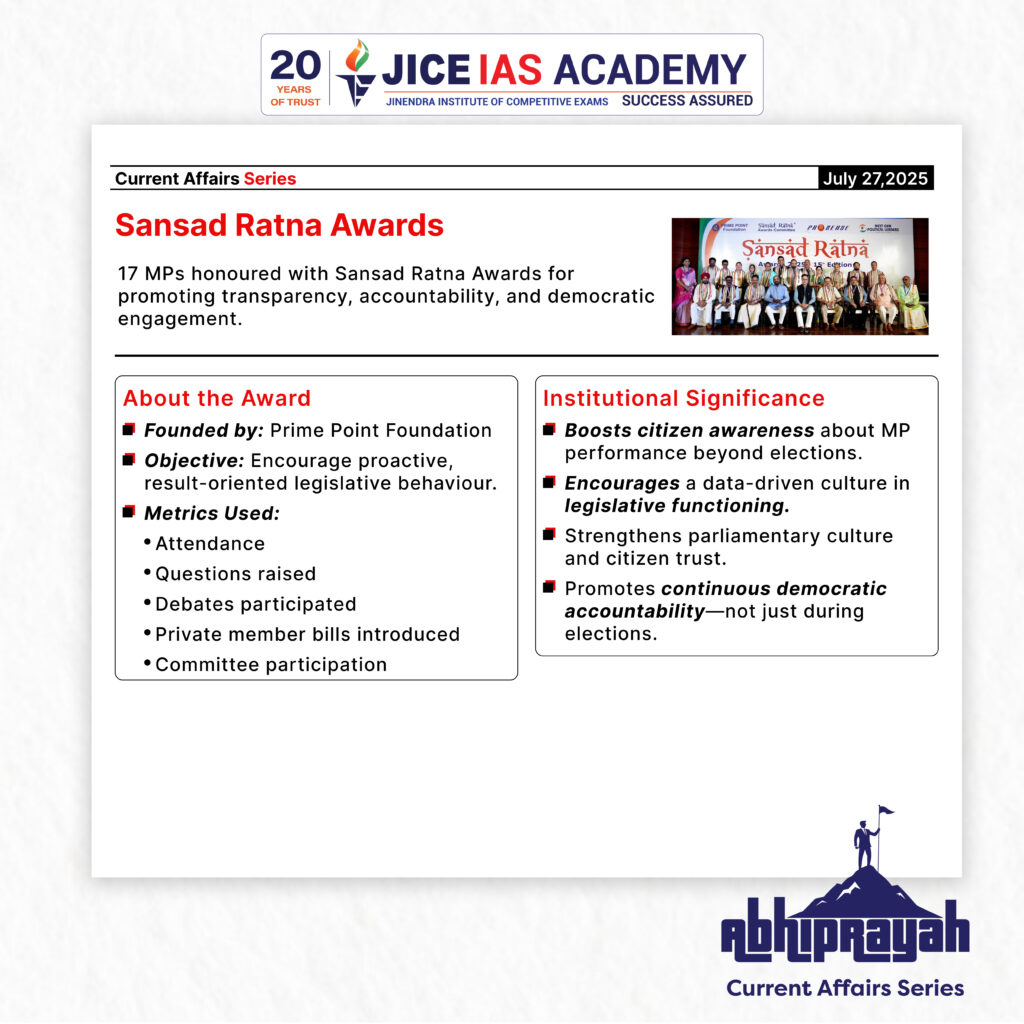
UPSC CURRENT AFFAIRS – 27th July 2025 Home / Seventeen MPs Honoured with Sansad Ratna Awards for Outstanding Parliamentary Performance Why in News? Seventeen Members of Parliament have been recognized with the Sansad Ratna Awards, which highlight excellence in legislative performance during India’s recent parliamentary sessions. The awards evaluate MPs based on metrics like attendance, questions raised, debates contributed, and private member bills introduced. About the Sansad Ratna Awards The awards are designed to encourage proactive and responsible parliamentary behavior and are based on transparent and objective metrics. They aim to reinforce democratic values and inspire more MPs to engage meaningfully in legislative processes. Award Recipients & Performance Highlights A diverse group of 17 MPs from both Lok Sabha and Rajya Sabha were recognized. The Special Awards have been conferred on Bhartruhari Mahtab (BJP, Odisha), N K Premachandran (Revolutionary Socialist Party, Kerala), Supriya Sule (NCP-SP, Maharashtra), and Shrirang Appa Barne (Shiv Sena, Maharashtra) — all of whom have maintained top performance since the 16th Lok Sabha. Other award-winning MPs include Smita Uday Wagh (BJP), Naresh Mhaske (Shiv Sena), Varsha Gaikwad (Congress), Medha Kulkarni (BJP), Praveen Patel (BJP), Bidyut Baran Mahato (BJP), and Dilip Saikia (BJP), among others. In the committee category, the Standing Committee on Finance, chaired by Bhartruhari Mahtab, and the Standing Committee on Agriculture, chaired by Dr Charanjit Singh Channi (Congress), were recognised for the quality of their reports and contributions to legislative oversight. Parliamentary Significance & Public Accountability The award signals a shift toward making MP performance transparent and results-driven. It reinforces citizen awareness of their elected representatives’ performance beyond election time. The initiative supports institutional reform by highlighting good legislative behavior and accountability. Relevance to Indian Democracy The recognitions underscore the importance of robust legislative participation in shaping policy, oversight, and governance. By tracking tangible indicators like attendance and bills raised, the awards incentivize greater MP accountability and transparency. Such initiatives can strengthen democratic practice and encourage active citizen scrutiny beyond election cycles. Introduction Economic Implications For Indian Exporters These reforms reduce transaction costs and compliance hurdles Encourage a more competitive and efficient export environment Promote value addition in key sectors like leather For Tamil Nadu The reforms particularly benefit the state’s leather industry, a major contributor to employment and exports Boost the marketability of GI-tagged E.I. leather, enhancing rural and traditional industries For Trade Policy These decisions indicate a shift from regulatory controls to policy facilitation Reinforce the goals of Make in India, Atmanirbhar Bharat, and India’s ambition to become a leading export power Recently, BVR Subrahmanyam, CEO of NITI Aayog, claimed that India has overtaken Japan to become the fourth-largest economy in the world, citing data from the International Monetary Fund (IMF). India’s rank as the world’s largest economy varies by measure—nominal GDP or purchasing power parity (PPP)—each with key implications for economic analysis. Significance and Applications
Sudan’s RSF Forms Parallel Government, Deepening Civil Conflict

UPSC CURRENT AFFAIRS – 27th July 2025 Home / Sudan’s RSF Forms Parallel Government, Deepening Civil Conflict Why in News? The Rapid Support Forces (RSF), a dominant paramilitary group in Sudan, has announced the formation of a parallel government based in Nyala, Darfur. This move comes nearly two years into Sudan’s civil war and directly challenges the authority of the military-led government in Khartoum, raising fears of the country’s formal political split. Sudan’s Conflict Background The civil war erupted in April 2023 after a power-sharing deal between Hemedti and General Abdel Fattah al-Burhan collapsed. The conflict has resulted in: Tens of thousands of deaths. Over 10 million displaced people. Widespread famine and destruction of basic services. The RSF’s declaration marks a shift from informal control to institutionalized division, potentially leading to a long-term political split. India–Sudan Relations India and Sudan share historic diplomatic and economic ties, particularly in energy, education, and health sectors. India has been seen as a neutral and trusted partner, maintaining goodwill with all sides. During the 2023 conflict escalation, India launched Operation Kaveri, successfully evacuating around 3,800 Indian nationals. Indian investments in oil, infrastructure, and healthcare remain vulnerable due to the prolonged instability. Regional and Global Impact The RSF-led government’s announcement increases the likelihood of state fragmentation, akin to Libya’s dual governments. The humanitarian crisis is worsening, with half of Sudan’s population facing acute food insecurity. There is growing concern over foreign arms and proxy involvement, especially from regional actors. The move has been widely rejected by international organizations and neighboring states fearing regional spillover. Geopolitical Relevance Sudan is a strategic location near the Red Sea and Horn of Africa—critical for trade routes, migration corridors, and regional stability. The conflict complicates peace efforts, aid access, and international engagement in Africa. For India, ensuring maritime security, protecting diaspora interests, and promoting humanitarian stability in the region remains vital. Introduction Economic Implications For Indian Exporters These reforms reduce transaction costs and compliance hurdles Encourage a more competitive and efficient export environment Promote value addition in key sectors like leather For Tamil Nadu The reforms particularly benefit the state’s leather industry, a major contributor to employment and exports Boost the marketability of GI-tagged E.I. leather, enhancing rural and traditional industries For Trade Policy These decisions indicate a shift from regulatory controls to policy facilitation Reinforce the goals of Make in India, Atmanirbhar Bharat, and India’s ambition to become a leading export power Recently, BVR Subrahmanyam, CEO of NITI Aayog, claimed that India has overtaken Japan to become the fourth-largest economy in the world, citing data from the International Monetary Fund (IMF). India’s rank as the world’s largest economy varies by measure—nominal GDP or purchasing power parity (PPP)—each with key implications for economic analysis. Significance and Applications
Kargil to Pahalgam: India’s Security Doctrine Gets a Strategic Overhaul
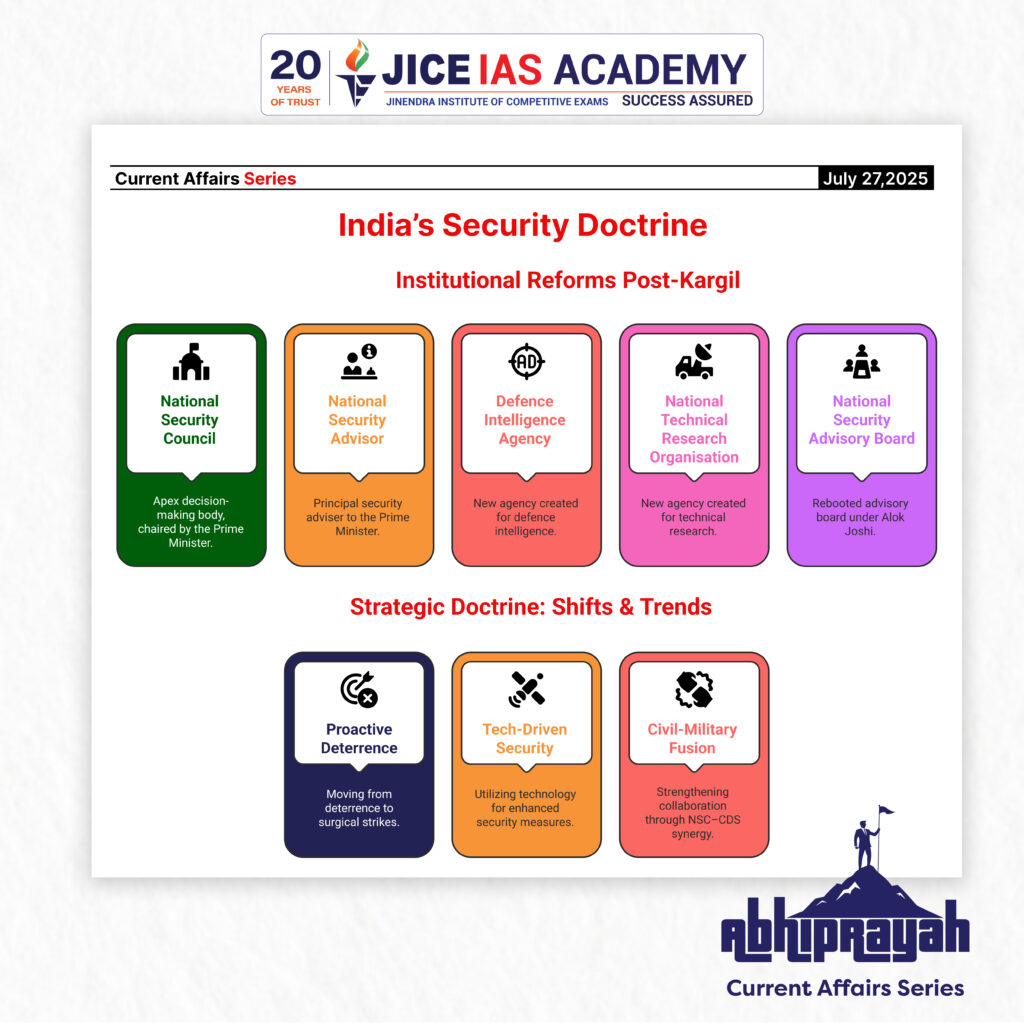
UPSC CURRENT AFFAIRS – 27th July 2025 Home / Kargil to Pahalgam: India’s Security Doctrine Gets a Strategic Overhaul Why in News? Following the April 2025 Pahalgam terror attack and the launch of Operation Sindoor, India is witnessing a strategic revamp in its national security thinking. Drawing lessons from the 1999 Kargil conflict, recent developments underscore the integration of institutional reforms with operational preparedness. Kargil Legacy & Strategic Reforms The Kargil Review Committee (KRC) led to significant overhauls in India’s defence and intelligence structure. Key outcomes: Creation of the National Security Council (NSC) to act as the apex body for political, strategic, and intelligence coordination. Appointment of the National Security Advisor (NSA) as principal adviser to the Prime Minister on internal and external security matters. Establishment of specialized bodies like: Defence Intelligence Agency (DIA) for tri-service intelligence. National Technical Research Organisation (NTRO) for technical and cyber intelligence. National Security Advisory Board (NSAB) to bring in independent strategic expertise. Pahalgam Attack & Operation Sindoor On April 22, 2025, a terrorist ambush in Pahalgam, Kashmir claimed 26 civilian lives, sparking nationwide outrage. India responded with Operation Sindoor (May 7–10), targeting terror launchpads across the LoC through precision strikes. The incident triggered: Enhanced border surveillance and rapid troop deployment. Activation of civil defence protocols and media misinformation counters. Revamp of strategic advisory and intelligence review mechanisms. Role of NSAB and NSC in Strategy Formulation The National Security Council (NSC), chaired by the Prime Minister, is responsible for coordinating national security policy and decision-making across ministries. The NSAB, a part of the NSC structure, was reconstituted after Pahalgam under former RAW chief Alok Joshi. It advises the NSA and NSC on strategic planning, long-term threat assessments, and doctrinal development. It has been tasked with helping draft a formal National Security Strategy (NSS). Chief of Defence Staff (CDS) and Military Coordination The CDS, created in 2019, acts as: The principal military adviser to the government. Head of the Department of Military Affairs (DMA) under the Ministry of Defence. Coordinator for joint theatre commands, tri-service synergy, and resource optimization. Post-Pahalgam, the CDS plays a crucial role in ensuring joint readiness, cross-border response, and defensive posturing across both land and maritime borders. Strategic Doctrine: Shifts & Evolution The current doctrine combines Kargil-era reform with modern counter-terror capabilities, focusing on: Proactive deterrence, including surgical strikes and cross-border precision responses. Real-time intelligence integration, UAV surveillance, and satellite-based monitoring. Strengthening civil-military coordination through institutional mechanisms like NSC and CDS. Challenges Ahead The absence of a published National Security Strategy (NSS) results in ambiguity across agencies and services. Rising challenges from Pakistan’s proxy networks and China’s assertiveness along the northern borders require sustained dual-front preparedness. Ensuring civilian oversight, data privacy, and transparency in a heightened security environment remains critical. Broader Implications From Kargil to Pahalgam, India’s shift reflects a transition from reactive crisis handling to institutionalized strategic foresight. Bodies like the NSC, NSAB, and CDS are central to building a long-term, technology-enabled, and globally aligned security posture. The push for an NSS would help anchor India’s security vision in the face of evolving regional and global threats. Introduction Economic Implications For Indian Exporters These reforms reduce transaction costs and compliance hurdles Encourage a more competitive and efficient export environment Promote value addition in key sectors like leather For Tamil Nadu The reforms particularly benefit the state’s leather industry, a major contributor to employment and exports Boost the marketability of GI-tagged E.I. leather, enhancing rural and traditional industries For Trade Policy These decisions indicate a shift from regulatory controls to policy facilitation Reinforce the goals of Make in India, Atmanirbhar Bharat, and India’s ambition to become a leading export power Recently, BVR Subrahmanyam, CEO of NITI Aayog, claimed that India has overtaken Japan to become the fourth-largest economy in the world, citing data from the International Monetary Fund (IMF). India’s rank as the world’s largest economy varies by measure—nominal GDP or purchasing power parity (PPP)—each with key implications for economic analysis. Significance and Applications
M.S. Swaminathan: The Scientist Who Made “Mangroves” a Buzzword
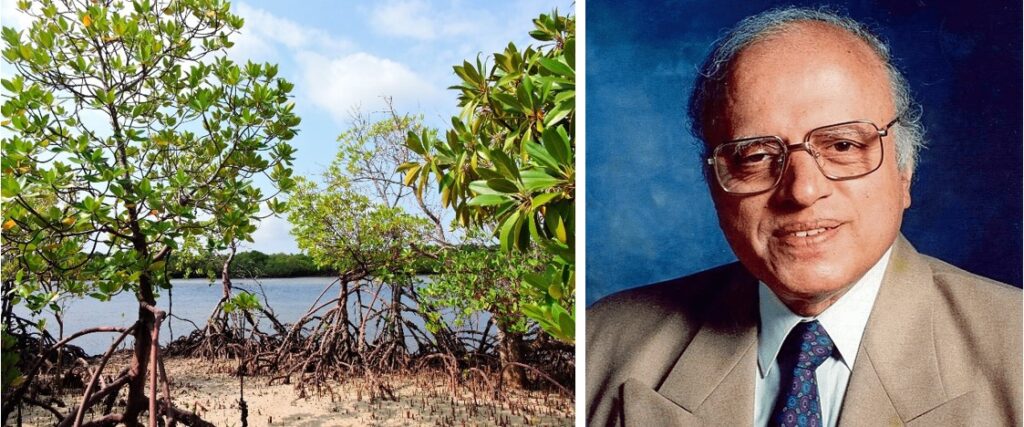
UPSC CURRENT AFFAIRS – 27th July 2025 Home / M.S. Swaminathan: The Scientist Who Made “Mangroves” a Buzzword Why in News? On the occasion of World Mangrove Day (July 26), tributes poured in for M.S. Swaminathan, who played a pioneering role in turning mangroves into a central theme in climate adaptation, conservation, and ecological governance. M.S. Swaminathan’s Vision and Early Advocacy In 1989, at a global conference in Tokyo, he warned of sea-level rise, coastal salinisation, and cyclone impacts, and positioned mangroves as a frontline defense. His triple-bottom-line approach—Ecology, Economics, and Equity—guided both genetic and ecological solutions. He also encouraged genetic research to develop salt-tolerant crop varieties using mangrove genes. Global Institutions and Frameworks Promoted by Swaminathan International Society for Mangrove Ecosystems (ISME) Established in 1990; headquartered in Okinawa, Japan. Promotes global cooperation in mangrove conservation and education. Charter for Mangroves Co-authored by Swaminathan, laying down ethical, scientific, and conservation principles for sustainable mangrove use. World Charter for Nature (UN, 1982) The Charter for Mangroves was integrated into this document, giving mangroves formal recognition as a part of global natural heritage. Global Mangrove Database and Information System (GLOMIS) A digital platform collecting global data on mangrove biodiversity, genetics, restoration methods, and policy case studies. Mangrove Conservation in India India is home to the largest mangrove cover in South Asia, with 4,992 sq km of mangroves (ISFR 2023). Key regions: Sundarbans (West Bengal) – largest contiguous mangrove forest. Bhitarkanika (Odisha), Pichavaram (Tamil Nadu), Godavari-Krishna delta (Andhra Pradesh), Maharashtra, and Andaman & Nicobar Islands. Mangrove management in India evolved from: Colonial era forest clearances. To community-based restoration, especially post-2004 tsunami. Swaminathan’s team introduced the “fishbone canal method” for tidal water reflow and ecosystem restoration. Promoted Joint Mangrove Management—a participatory conservation model involving local communities. Constitutional and Legal Protection for Mangroves in India Article 48A: Directive Principle – “State shall endeavor to protect and improve the environment and safeguard forests and wildlife.” Article 51A(g): Fundamental Duty of citizens to protect the environment. Environment (Protection) Act, 1986: Mangrove areas are classified as ecologically sensitive zones under CRZ (Coastal Regulation Zone) Notification. Managed by: Ministry of Environment, Forest and Climate Change (MoEFCC) State Forest Departments Coastal Zone Management Authorities Mangroves and International Conventions Ramsar Convention (1971): Many Indian mangrove wetlands are designated as Ramsar Sites (e.g. Sundarbans, Bhitarkanika). Convention on Biological Diversity (CBD, 1992): India is a party; mangroves are included as priority ecosystems. UN Framework Convention on Climate Change (UNFCCC): Mangroves recognized as part of “Blue Carbon” ecosystems for carbon storage. Featured in India’s Nationally Determined Contributions (NDCs). SDG 13 (Climate Action) & SDG 15 (Life on Land): Mangroves contribute to targets on ecosystem resilience and biodiversity. Growing Mangroves: Nature’s Coastal Shield Mangrove coverage in India has increased over the last decade, largely due to community participation and policy incentives. Serve as: Natural barriers against coastal disasters. Nurseries for fisheries and livelihoods. Carbon sinks, mitigating climate change. Introduction Economic Implications For Indian Exporters These reforms reduce transaction costs and compliance hurdles Encourage a more competitive and efficient export environment Promote value addition in key sectors like leather For Tamil Nadu The reforms particularly benefit the state’s leather industry, a major contributor to employment and exports Boost the marketability of GI-tagged E.I. leather, enhancing rural and traditional industries For Trade Policy These decisions indicate a shift from regulatory controls to policy facilitation Reinforce the goals of Make in India, Atmanirbhar Bharat, and India’s ambition to become a leading export power Recently, BVR Subrahmanyam, CEO of NITI Aayog, claimed that India has overtaken Japan to become the fourth-largest economy in the world, citing data from the International Monetary Fund (IMF). India’s rank as the world’s largest economy varies by measure—nominal GDP or purchasing power parity (PPP)—each with key implications for economic analysis. Significance and Applications
Two New Bush Frog Species Jakoid and Jadoh from Meghalaya Named After Khasi Language & Cuisine
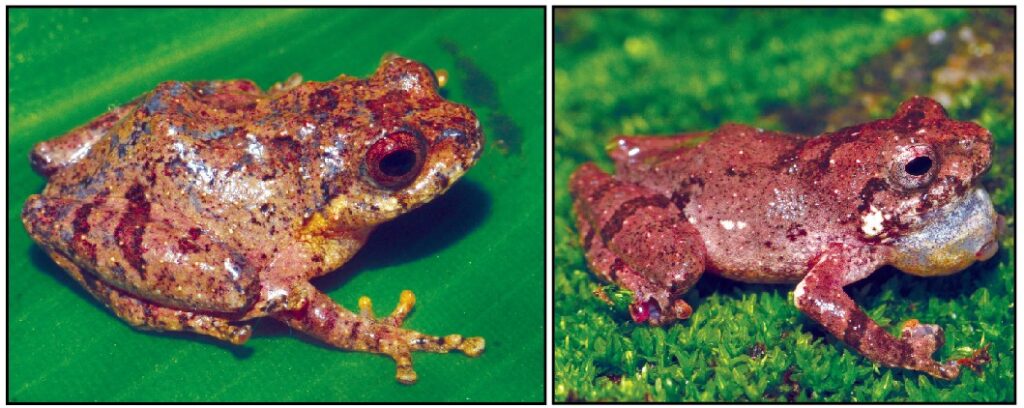
UPSC CURRENT AFFAIRS – 27th July 2025 Home / Two New Bush Frog Species Jakoid and Jadoh from Meghalaya Named After Khasi Language & Cuisine Why in News? Scientists have discovered two new species of bush frogs in the Khasi Hills of Meghalaya, emphasizing the region’s rich biodiversity. The frogs have been named using Khasi words and local cuisine, blending biological discovery with cultural recognition. Key Highlights Raorchestes jakoid is derived from the Khasi word “jakoid” meaning frog. Raorchestes jadoh is named after “Jadoh”, a traditional Khasi rice and meat dish. R. jakoid was found at an elevation of 815 m in Lawbah (East Khasi Hills), while R. jadoh was found at 1,655 m in Langtor (Eastern West Khasi Hills). Both species belong to the Raorchestes parvulus complex, known for direct development (no tadpole stage). Conservation Context The frogs were found in shrubs and low vegetation near human habitations, showing some ecological tolerance. However, this proximity also suggests a threat from habitat fragmentation, land-use changes, and human encroachment. Meghalaya lies in the Indo-Burma biodiversity hotspot, with numerous endemic and recently discovered amphibian species. Relevance The discovery highlights the ecological and cultural richness of Meghalaya, calling for increased scientific exploration and community-based conservation. It exemplifies a model where taxonomy supports both biodiversity research and local cultural appreciation. Introduction Economic Implications For Indian Exporters These reforms reduce transaction costs and compliance hurdles Encourage a more competitive and efficient export environment Promote value addition in key sectors like leather For Tamil Nadu The reforms particularly benefit the state’s leather industry, a major contributor to employment and exports Boost the marketability of GI-tagged E.I. leather, enhancing rural and traditional industries For Trade Policy These decisions indicate a shift from regulatory controls to policy facilitation Reinforce the goals of Make in India, Atmanirbhar Bharat, and India’s ambition to become a leading export power Recently, BVR Subrahmanyam, CEO of NITI Aayog, claimed that India has overtaken Japan to become the fourth-largest economy in the world, citing data from the International Monetary Fund (IMF). India’s rank as the world’s largest economy varies by measure—nominal GDP or purchasing power parity (PPP)—each with key implications for economic analysis. Significance and Applications
15th Conference of the Contracting Parties to the Ramsar Convention on Wetlands (COP15)

UPSC CURRENT AFFAIRS – 26th July 2025 Home / 15th Conference of the Contracting Parties to the Ramsar Convention on Wetlands (COP15) Why in News? Ramsar COP15, held in Victoria Falls, Zimbabwe (July 2025), aims to address the accelerating global loss of wetlands through the Victoria Falls Declaration, new funding mechanisms, and integration into climate policy. Introduction The 15th Conference of the Contracting Parties to the Ramsar Convention on Wetlands (COP15) is being held from July 23 to 31, 2025, in Victoria Falls, Zimbabwe. The summit brings together over 3,000 delegates from 172 countries to address the urgent need for wetland conservation amid accelerating global loss and degradation. About the Ramsar Convention The Ramsar Convention on Wetlands, adopted in 1971 in Ramsar, Iran, is the only global treaty focused specifically on the conservation and wise use of wetlands. It promotes the “wise use” of wetlands and encourages international cooperation for sustainable management of wetland ecosystems. As of 2025, it includes 172 contracting parties and covers over 2,400 Ramsar Sites globally. COP15 Highlights and Significance 2021 (Italy): First G20 Start-up competition – G20 Innovation League. 2022 (Indonesia): G20 Digital Innovation Network established. 2023 (India): Formal institutionalisation of Startup20 as a G20 Engagement Group. This journey reflected a growing consensus: start-ups and SMEs are critical engines of inclusive, sustainable, and innovation-driven global growth. India’s Vision and Contributions India, with its rapidly expanding start-up ecosystem, spearheaded the creation of Startup20 with two primary objectives: Policy harmonisation of global start-up ecosystems. Preservation of national ecosystem diversity and autonomy. India’s inaugural policy communiqué under Startup20 proposed: A collective investment goal of $1 trillion by 2030 into global start-up ecosystems. Development of a global start-up definition and governance framework. Enabling cross-border access to capital, talent, and markets. Promoting inclusion (gender, geography, sectors). Scaling start-ups aligned with Sustainable Development Goals (SDGs). Key Issues and Agenda at COP15 Launched on July 21, 2025, in Johannesburg, South Africa’s Startup20 focuses on: Five Key Task Forces Foundation and Alliances Finance and Investment Inclusion and Sustainability Trade and Market Access Township and Rural Entrepreneurship Notable Firsts under South Africa First-time focus on rural and township entrepreneurship. Private-sector leaders representing national start-up interests. A deliberate push to develop an implementation mechanism for policy recommendations. Key Issues and Agenda at COP15 Wetlands in Crisis Since 1970, 35% of wetlands have disappeared, three times faster than forests. GWO 2025 Report (Global Wetland Outlook 2025) warns: 20% more wetlands may vanish by 2050. Potential loss of $39 trillion in ecosystem services. Wetlands cover 6% of Earth’s surface, yet provide 7.5% of global GDP in ecosystem benefits. Victoria Falls Declaration A landmark framework for global wetland conservation. Aims to: Galvanise policy action Mainstream wetlands into national climate policies Enhance financing and innovation Will guide wetland strategy for the 2025–2034 period. Strategic Plan 2025–2034 Sets the long-term vision and policy direction for wetland conservation. Emphasis on: Restoring degraded wetlands Enhancing community engagement Integrating wetland protection into climate resilience, water security, and biodiversity goals Global Wetland Restoration Fund Proposed to finance large-scale restoration projects. Focus on innovation, climate mitigation, and inclusion. Integration into Climate and SDG Frameworks Delegates are considering how to better link wetland conservation with: Nationally Determined Contributions (NDCs) under the Paris Agreement Sustainable Development Goals (SDGs) Why Wetlands Matter Called the “kidneys of the Earth”, wetlands: Filter pollutants and purify water Mitigate floods and store carbon Provide livelihoods through agriculture, aquaculture, and tourism Support 40% of global biodiversity Economic Value Wetlands offer ecosystem services worth trillions of dollars, yet are undervalued and underprotected. Loss of 0.52% annually is eroding climate resilience and biodiversity. Zimbabwe’s Leadership Role Zimbabwe assumes Ramsar Presidency (2025–2028). Hosts 7 Ramsar Sites, including Victoria Falls. President Emmerson Mnangagwa emphasised the urgent need for: Collaborative restoration efforts Policy innovation Community-based conservation Outcomes Expected from COP15 Adoption of Victoria Falls Declaration Launch of the Strategic Plan 2025–2034 Approval of the Global Wetland Fund Commitment to integrate wetlands into climate strategies Emphasis on rural, coastal, and urban wetland restoration Challenges in Wetland Conservation Urbanisation, agriculture, pollution, and climate change continue to threaten wetland ecosystems. Gaps in financing, governance, and data limit conservation efforts. Local communities often lack awareness or support to protect wetlands sustainably. Way Forward Urbanisation, agriculture, pollution, and climate change continue to threaten wetland ecosystems. Gaps in financing, governance, and data limit conservation efforts. Local communities often lack awareness or support to protect wetlands sustainably. Introduction Economic Implications For Indian Exporters These reforms reduce transaction costs and compliance hurdles Encourage a more competitive and efficient export environment Promote value addition in key sectors like leather For Tamil Nadu The reforms particularly benefit the state’s leather industry, a major contributor to employment and exports Boost the marketability of GI-tagged E.I. leather, enhancing rural and traditional industries For Trade Policy These decisions indicate a shift from regulatory controls to policy facilitation Reinforce the goals of Make in India, Atmanirbhar Bharat, and India’s ambition to become a leading export power Recently, BVR Subrahmanyam, CEO of NITI Aayog, claimed that India has overtaken Japan to become the fourth-largest economy in the world, citing data from the International Monetary Fund (IMF). India’s rank as the world’s largest economy varies by measure—nominal GDP or purchasing power parity (PPP)—each with key implications for economic analysis. Significance and Applications
Startup20: Giving Startups a Seat at the G20 Policy Table

UPSC CURRENT AFFAIRS – 26th July 2025 Home / Startup20: Giving Startups a Seat at the G20 Policy Table Why in News? With South Africa’s G20 Presidency in 2025, Startup20 has entered its third year, continuing to evolve as the world’s highest policy forum for start-up and SME ecosystems. Introduction A landmark development under India’s G20 Presidency in 2023 was the formal recognition of Startup20 as an official G20 Engagement Group. For the first time, emerging start-ups and SMEs gained a dedicated platform to shape global policy — complementing the traditional Business20 (B20) platform for large enterprises. Background and Evolution of Startup20 2021 (Italy): First G20 Start-up competition – G20 Innovation League. 2022 (Indonesia): G20 Digital Innovation Network established. 2023 (India): Formal institutionalisation of Startup20 as a G20 Engagement Group. This journey reflected a growing consensus: start-ups and SMEs are critical engines of inclusive, sustainable, and innovation-driven global growth. India’s Vision and Contributions India, with its rapidly expanding start-up ecosystem, spearheaded the creation of Startup20 with two primary objectives: Policy harmonisation of global start-up ecosystems. Preservation of national ecosystem diversity and autonomy. India’s inaugural policy communiqué under Startup20 proposed: A collective investment goal of $1 trillion by 2030 into global start-up ecosystems. Development of a global start-up definition and governance framework. Enabling cross-border access to capital, talent, and markets. Promoting inclusion (gender, geography, sectors). Scaling start-ups aligned with Sustainable Development Goals (SDGs). South Africa’s Presidency and the 2025 Startup20 Agenda Launched on July 21, 2025, in Johannesburg, South Africa’s Startup20 focuses on: Five Key Task Forces Foundation and Alliances Finance and Investment Inclusion and Sustainability Trade and Market Access Township and Rural Entrepreneurship Notable Firsts under South Africa First-time focus on rural and township entrepreneurship. Private-sector leaders representing national start-up interests. A deliberate push to develop an implementation mechanism for policy recommendations. Critical Challenges Identified While Startup20 has created a structured process for policy formulation, two major gaps remain: Lack of a mechanism to translate recommendations into national policies. No continuity mechanism between presidencies. Proposed Solution Establishment of an international Startup20 Secretariat to provide long-term coordination — mirroring the entrepreneurial agility it promotes. Significance of Startup20 A Dual Business Platform B20: Represents large corporations. Startup20: Represents early-stage ventures and SMEs. Global Policy Voice for Start-ups A platform where global start-up ecosystems can collectively articulate shared needs. Elevates entrepreneurial agility to the highest level of policy dialogue. Promotes Inclusive and Sustainable Growth Supports underrepresented geographies and communities. Aligns innovation with climate goals, SDGs, and social development. A Model of Complementarity As demonstrated during the COVID-19 pandemic, collaboration between small innovators (e.g., Moderna, Bharat Biotech) and large firms (e.g., Pfizer, AstraZeneca) is crucial. Startup20 institutionalises such complementary innovation within global governance structures. Introduction Economic Implications For Indian Exporters These reforms reduce transaction costs and compliance hurdles Encourage a more competitive and efficient export environment Promote value addition in key sectors like leather For Tamil Nadu The reforms particularly benefit the state’s leather industry, a major contributor to employment and exports Boost the marketability of GI-tagged E.I. leather, enhancing rural and traditional industries For Trade Policy These decisions indicate a shift from regulatory controls to policy facilitation Reinforce the goals of Make in India, Atmanirbhar Bharat, and India’s ambition to become a leading export power Recently, BVR Subrahmanyam, CEO of NITI Aayog, claimed that India has overtaken Japan to become the fourth-largest economy in the world, citing data from the International Monetary Fund (IMF). India’s rank as the world’s largest economy varies by measure—nominal GDP or purchasing power parity (PPP)—each with key implications for economic analysis. Significance and Applications
Atal Pension Yojana Surpasses 8 Crore Enrolments

UPSC CURRENT AFFAIRS – 26th July 2025 Home / Atal Pension Yojana Surpasses 8 Crore Enrolments Why in News? The Atal Pension Yojana (APY), launched in 2015 to provide old-age income security for unorganized sector workers, has crossed 8 crore enrolments as it marks its 10th anniversary in 2025. Introduction The Atal Pension Yojana (APY), a flagship social security scheme of the Government of India, has crossed a major milestone by achieving over 8 crore gross enrolments as of the current Financial Year 2025–26, with 39 lakh new subscribers added this year alone. The announcement coincides with the scheme’s 10th anniversary, having been launched on May 9, 2015. Administered by the Pension Fund Regulatory and Development Authority (PFRDA), APY has evolved into one of the largest voluntary pension schemes in the world, aimed particularly at the unorganized sector. Background and Objectives Vision APY was launched with the objective of creating a universal social security system in India, particularly targeting the poor, underprivileged, and workers in the unorganized sector who lack access to formal retirement benefits. Launch and Institutional Support Introduced in 2015 under the aegis of the then National Democratic Alliance (NDA) Government. Operated and regulated by the PFRDA. Enrolment facilitated by a broad network of Banks, Department of Posts (DoP), and State-Level Bankers’ Committees (SLBCs)/Union Territory Level Bankers’ Committees (UTLBCs). Salient Features of the Atal Pension Yojana Voluntary and Contributory Open to all Indian citizens aged 18 to 40 years, except those who are or have been income tax payers. Contributions vary depending on entry age and desired pension amount. Guaranteed Monthly Pension Offers a guaranteed monthly pension of ₹1,000, ₹2,000, ₹3,000, ₹4,000, or ₹5,000 after the subscriber turns 60 years of age. The government guarantees the pension payout, which adds to the scheme’s credibility. Family Benefits Structure Upon the death of the subscriber: The spouse receives the same pension for life. After the death of both subscriber and spouse, the accumulated corpus is returned to the nominee. The scheme thereby ensures a “Sampurna Suraksha Kavach” (Complete Security Shield) for the family. Benefits and Significance Financial Security for the Elderly APY provides a predictable and reliable income to individuals during old age, particularly for those employed in informal sectors without access to EPF or corporate pension systems. Inclusion of the Unorganized Sector A large portion of India’s workforce (over 80 percent) is employed in the unorganized sector. APY bridges the gap by offering an accessible and affordable pension product. Long-Term National Impact Encourages a culture of savings for retirement. Strengthens India’s efforts towards financial inclusion and social justice. Complements other schemes like the Pradhan Mantri Jan Dhan Yojana and Pradhan Mantri Jeevan Jyoti Bima Yojana. Challenges and Constraints Despite massive enrolment, contribution discontinuation remains a concern. Many subscribers fail to continue regular payments. Need for further simplification of procedures, especially for rural and semi-literate populations. Limited outreach in remote regions and among migrant laborers. Exclusion of income tax payers restricts the upper-middle segment from availing the scheme despite their possible need for old-age financial planning. Reforms and Way Forward Development of a digital contribution tracking and reminder system to prevent drop-outs. Integration of APY awareness with other government welfare schemes to increase reach. Periodic review of pension amounts to match inflation and changing economic conditions. Continued collaboration between PFRDA, banks, post offices, and local governance bodies to drive enrolment, especially among women and younger citizens. Conclusion The Atal Pension Yojana has emerged as a cornerstone of India’s social security architecture, especially for the vulnerable and underserved segments of society. Surpassing 8 crore enrolments within a decade underscores its wide acceptance and critical role in enhancing retirement security. Going forward, with appropriate policy interventions and stakeholder coordination, APY has the potential to ensure universal pension coverage and play a crucial role in achieving inclusive development goals. Introduction Economic Implications For Indian Exporters These reforms reduce transaction costs and compliance hurdles Encourage a more competitive and efficient export environment Promote value addition in key sectors like leather For Tamil Nadu The reforms particularly benefit the state’s leather industry, a major contributor to employment and exports Boost the marketability of GI-tagged E.I. leather, enhancing rural and traditional industries For Trade Policy These decisions indicate a shift from regulatory controls to policy facilitation Reinforce the goals of Make in India, Atmanirbhar Bharat, and India’s ambition to become a leading export power Recently, BVR Subrahmanyam, CEO of NITI Aayog, claimed that India has overtaken Japan to become the fourth-largest economy in the world, citing data from the International Monetary Fund (IMF). India’s rank as the world’s largest economy varies by measure—nominal GDP or purchasing power parity (PPP)—each with key implications for economic analysis. Significance and Applications